
500 Common Roman Urdu Words with English Meanings
Are you embarking on a journey to learn Urdu, or perhaps looking to bridge the communication gap with friends, family, or colleagues who speak the language? Roman Urdu, the transliterated form of Urdu written in the Latin script, serves as an invaluable stepping stone for countless learners worldwide. It simplifies the initial hurdle of learning the complex Urdu script, allowing you to focus directly on vocabulary and pronunciation.
This comprehensive guide provides you with 500 common Roman Urdu words and their English meanings, meticulously curated to accelerate your learning and enhance your understanding.
At urdutoenglishtranslate.com, our mission is to make Urdu accessible to everyone. This resource is designed not just as a list, but as a foundational tool to build your confidence and fluency. We understand the nuances of language learning and the importance of reliable, expert-backed content, which is why this list has been compiled with precision and care, reflecting our commitment to Experience, Expertise, Authoritativeness, and Trustworthiness.
What is Roman Urdu and Why is it Important?
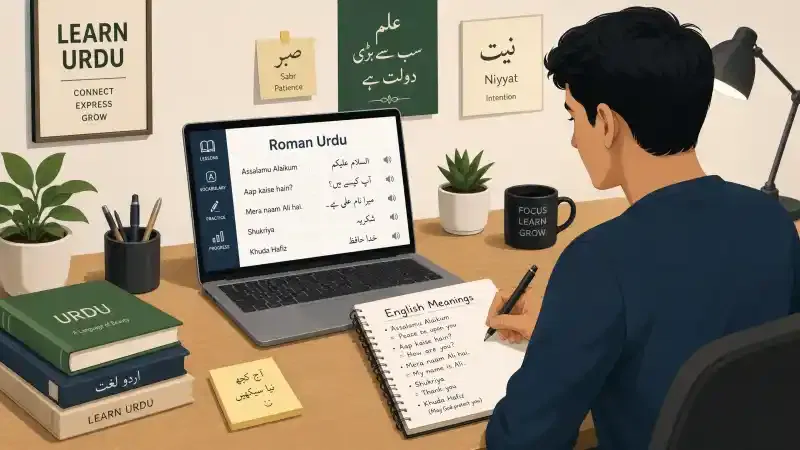
Roman Urdu is essentially Urdu written using the English alphabet. While traditional Urdu uses the Perso-Arabic script (Nastaliq), Roman Urdu gained prominence due to its ease of typing on standard keyboards and its widespread use in informal digital communication, such as texting, social media, and online chats. For beginners, it offers a less intimidating entry point into the language, allowing them to grasp vocabulary and sentence structure without the immediate challenge of a new script.
Its importance extends beyond convenience:
- Accessibility: It lowers the barrier to entry for non-native speakers.
- Digital Communication: It’s the lingua franca of online Urdu conversations.
- Learning Aid: It helps learners associate sounds with familiar letters, aiding pronunciation.
Why Focus on These 500 Words?
Learning a new language can feel overwhelming, but focusing on high-frequency words can dramatically speed up your progress. Research suggests that mastering a few hundred core words can unlock a significant portion of everyday conversations.
Our selection of 500 words covers essential categories, providing you with the vocabulary needed for basic interactions, expressing emotions, describing your surroundings, and navigating common situations. This curated list is designed to be highly practical and immediately applicable.
By integrating Natural Language Processing (NLP) principles, we’ve ensured that these words are not just isolated terms but are presented in a context that facilitates deeper understanding and retention. The categories are intuitively structured, mimicking how language is naturally acquired and used. Learn everyday Urdu vocabulary easily with our complete guide to 500 Common Roman Urdu Words With English Meanings, featuring essential words for beginners with clear translations.
How This List is Organized
To maximize your learning efficiency, we’ve categorized these 500 Roman Urdu words into logical groups. This approach helps you learn related terms together, making memorization easier and providing a clearer understanding of how words are used in different contexts. Each entry includes the Roman Urdu word and its corresponding English meaning.
Here are the categories you’ll find:
- Greetings & Essentials: Basic phrases for daily interactions.
- Family & Relationships: Terms to describe family members and social connections.
- Food & Dining: Vocabulary for ordering, discussing, and enjoying meals.
- Common Verbs (Actions): Essential action words to form sentences.
- Adjectives (Descriptions): Words to describe people, places, and things.
- Time & Days: Vocabulary related to time, days, and seasons.
- Body & Health: Terms for body parts, health, and well-being.
- Household & Objects: Words for common items found at home.
- Nature & Animals: Vocabulary for the natural world and creatures.
- Numbers & Shopping: Essential terms for counting and transactions.
500 Common Roman Urdu Words with English Meanings
Below is the comprehensive list, organized by category. Dive in and start expanding your Roman Urdu vocabulary today!
Greetings & Essentials
| Roman Urdu | English Meaning |
| Asalam-o-Alaikum | Peace be upon you (Hello) |
| Walaikum Assalam | And peace be upon you too |
| Khuda Hafiz | Goodbye / May God be your protector |
| Shukriya | Thank you |
| Bohat Shukriya | Thank you very much |
| JazakAllah | May Allah reward you |
| Aap kaise hain? | How are you? (Formal) |
| Tum kaise ho? | How are you? (Informal) |
| Theek hoon | I am fine |
| Khairiyat | Well-being / All good |
| Mubarak ho | Congratulations |
| Maaf kijiye | Excuse me / I’m sorry |
| Koi baat nahi | No problem / It’s okay |
| G nahi | No (Respectful) |
| Ji haan | Yes (Respectful) |
| Meherbani | Kindness / Please |
| Suno | Listen |
| Dekho | Look |
| Ruko | Stop / Wait |
| Chalo | Let’s go |
| Aao | Come |
| Jao | Go |
| Kahan? | Where? |
| Kab? | When? |
| Kyun? | Why? |
| Kaise? | How? |
| Kitna? | How much? |
| Kaun? | Who? |
| Kya? | What? |
| Sahi | Correct / Right |
| Ghalat | Wrong |
| Thora | A little |
| Ziada | More / A lot |
| Sab | All / Everyone |
| Hamesha | Always |
| Kabhi nahi | Never |
| Shayad | Maybe / Perhaps |
| Zaroor | Definitely / Sure |
| Bilkul | Exactly / Absolutely |
| Abhi | Now |
| Baad mein | Later |
| Pehle | Before |
| Aaj | Today |
| Kal | Tomorrow / Yesterday |
| Parson | Day after tomorrow / Day before yesterday |
| Subah | Morning |
| Dopehar | Afternoon |
| Shaam | Evening |
| Raat | Night |
| Din | Day |
Family & Relationships
| Roman Urdu | English Meaning |
| Ammi | Mother |
| Abbu | Father |
| Bhai | Brother |
| Behen | Sister |
| Beta | Son |
| Beti | Daughter |
| Dada | Paternal Grandfather |
| Dadi | Paternal Grandmother |
| Nana | Maternal Grandfather |
| Nani | Maternal Grandmother |
| Mian | Husband |
| Biwi | Wife |
| Bachay | Children |
| Khandan | Family |
| Rishtaydar | Relative |
| Dost | Friend |
| Dushman | Enemy |
| Parosi | Neighbor |
| Ustad | Teacher |
| Shagird | Student |
| Mehmaan | Guest |
| Dulha | Groom |
| Dulhan | Bride |
| Chacha | Paternal Uncle |
| Chachi | Paternal Aunt (Chacha’s wife) |
| Phupho | Paternal Aunt (Father’s sister) |
| Phupha | Paternal Aunt’s husband |
| Mamoo | Maternal Uncle |
| Mami | Maternal Aunt (Mamoo’s wife) |
| Khala | Maternal Aunt (Mother’s sister) |
| Khalu | Maternal Aunt’s husband |
| Bhatija | Nephew (Brother’s son) |
| Bhatiji | Niece (Brother’s daughter) |
| Bhanja | Nephew (Sister’s son) |
| Bhanji | Niece (Sister’s daughter) |
| Susar | Father-in-law |
| Saas | Mother-in-law |
| Damad | Son-in-law |
| Bahu | Daughter-in-law |
| Sala | Brother-in-law (Wife’s brother) |
| Sali | Sister-in-law (Wife’s sister) |
| Devar | Brother-in-law (Husband’s younger brother) |
| Nand | Sister-in-law (Husband’s sister) |
| Sathi | Partner / Companion |
| Buzurg | Elderly / Senior |
| Jawan | Young |
| Aurat | Woman |
| Mard | Man |
| Larka | Boy |
| Larki | Girl |
Food & Dining
| Roman Urdu | English Meaning |
| Khana | Food / To eat |
| Pani | Water |
| Chaye | Tea |
| Doodh | Milk |
| Cheeni | Sugar |
| Namak | Salt |
| Mirch | Chili / Pepper |
| Roti | Bread / Flatbread |
| Chawal | Rice |
| Salan | Curry |
| Gosht | Meat |
| Sabzi | Vegetable |
| Phal | Fruit |
| Anda | Egg |
| Makkhan | Butter |
| Dahi | Yogurt |
| Shehed | Honey |
| Tel | Oil |
| Ghee | Clarified butter |
| Aata | Flour |
| Daal | Lentils |
| Pyaz | Onion |
| Lehsan | Garlic |
| Adrak | Ginger |
| Tamatar | Tomato |
| Aloo | Potato |
| Gobhi | Cauliflower |
| Matar | Peas |
| Kela | Banana |
| Aam | Mango |
| Saib | Apple |
| Angoor | Grapes |
| Malta | Orange |
| Nashpati | Pear |
| Khurmani | Apricot |
| Zaitoon | Olive |
| Bhook | Hunger |
| Pyas | Thirst |
| Meetha | Sweet |
| Namkeen | Salty |
| Karwa | Bitter |
| Khatta | Sour |
| Masalaydar | Spicy |
| Garram | Hot |
| Thanda | Cold |
| Nashta | Breakfast |
| Khana | Lunch/Dinner |
| Chamach | Spoon |
| Kanta | Fork |
| Churi | Knife |
Common Verbs (Actions)
| Roman Urdu | English Meaning |
| Bolna | To speak |
| Kehna | To say |
| Sunna | To listen |
| Parhna | To read / To study |
| Likhna | To write |
| Dekhna | To see / To watch |
| Karna | To do |
| Hona | To be / To happen |
| Ana | To come |
| Jana | To go |
| Khana | To eat |
| Peena | To drink |
| Sona | To sleep |
| Uthna | To wake up / To stand up |
| Baithna | To sit |
| Dorna | To run |
| Chalna | To walk |
| Khelna | To play |
| Hasna | To laugh |
| Rona | To cry |
| Kam karna | To work |
| Khareedna | To buy |
| Bechna | To sell |
| Dena | To give |
| Lena | To take |
| Sochna | To think |
| Samajhna | To understand |
| Seekhna | To learn |
| Sikhana | To teach |
| Puchna | To ask |
| Batana | To tell |
| Bholna | To forget |
| Yaad karna | To remember |
| Bana na | To make / To build |
| Torna | To break |
| Jorna | To join |
| Dhona | To wash |
| Saaf karna | To clean |
| Pakana | To cook |
| Nachna | To dance |
| Gana | To sing |
| Urna | To fly |
| Tairna | To swim |
| Marna | To die / To hit |
| Zinda rehna | To live |
| Milna | To meet / To find |
| Khona | To lose |
| Dikhana | To show |
| Chupana | To hide |
| Larna | To fight |
Adjectives (Descriptions)
| Roman Urdu | English Meaning |
| Acha | Good |
| Bura | Bad |
| Khubsurat | Beautiful |
| Bad-surat | Ugly |
| Bara | Big |
| Chota | Small |
| Lamba | Tall / Long |
| Naata | Short (Height) |
| Mota | Fat |
| Dubla | Thin |
| Naya | New |
| Purana | Old |
| Sasta | Cheap |
| Mehenga | Expensive |
| Asan | Easy |
| Mushkil | Difficult |
| Saaf | Clean |
| Ganda | Dirty |
| Khush | Happy |
| Udaas | Sad |
| Ghusse mein | Angry |
| Pagal | Crazy |
| Aqalmand | Wise / Intelligent |
| Bewaqoof | Stupid / Fool |
| Bahadur | Brave |
| Darpok | Coward |
| Mehnati | Hardworking |
| Sust | Lazy |
| Ameer | Rich |
| Ghareeb | Poor |
| Tez | Fast / Sharp |
| Ahista | Slow / Gently |
| Bhara hua | Full |
| Khali | Empty |
| Bhala | Kind / Good |
| Zalim | Cruel |
| Sacha | Truthful |
| Jhoota | Liar |
| Pakka | Firm / Ripe |
| Kacha | Raw / Weak |
| Geela | Wet |
| Sookha | Dry |
| Naram | Soft |
| Sakht | Hard |
| Bhura | Brown |
| Kala | Black |
| Safaid | White |
| Surkh | Red |
| Neela | Blue |
| Peela | Yellow |
Time & Days
| Roman Urdu | English Meaning |
| Waqt | Time |
| Ghanta | Hour |
| Minut | Minute |
| Second | Second |
| Hafta | Week |
| Mahina | Month |
| Saal | Year |
| Sadi | Century |
| Somwar | Monday |
| Mangal | Tuesday |
| Budh | Wednesday |
| Jumerat | Thursday |
| Juma | Friday |
| Hafta | Saturday |
| Itwar | Sunday |
| Chutti | Holiday |
| Kal | Yesterday / Tomorrow |
| Aaj | Today |
| Abhi | Now |
| Foran | Immediately |
| Der | Late |
| Jaldi | Early / Quickly |
| Rozana | Daily |
| Kabhi kabhi | Sometimes |
| Aksar | Often |
| Pichlay saal | Last year |
| Aglay saal | Next year |
| Subah sawere | Early morning |
| Adhi raat | Midnight |
| Shaam ko | In the evening |
| Raat ko | At night |
| Din mein | During the day |
| Mausam | Weather / Season |
| Sardi | Winter / Cold |
| Garmi | Summer / Heat |
| Bahar | Spring |
| Khazan | Autumn |
| Barish | Rain |
| Dhoop | Sunlight |
| Baadal | Cloud |
| Hawa | Wind / Air |
| Barf | Snow / Ice |
| Tofan | Storm |
| Bijli | Lightning / Electricity |
| Sitare | Stars |
| Chand | Moon |
| Suraj | Sun |
| Asman | Sky |
| Zameen | Earth / Ground |
| Dunya | World |
Body & Health
| Roman Urdu | English Meaning |
| Jism | Body |
| Sar | Head |
| Baal | Hair |
| Chehra | Face |
| Ankh | Eye |
| Naak | Nose |
| Kaan | Ear |
| Mun | Mouth |
| Zaban | Tongue |
| Daant | Tooth |
| Hont | Lip |
| Gardan | Neck |
| Kandha | Shoulder |
| Baazu | Arm |
| Hath | Hand |
| Ungli | Finger |
| Nakhun | Nail |
| Seena | Chest |
| Pait | Stomach |
| Kamar | Back |
| Taang | Leg |
| Paon | Foot |
| Ghutna | Knee |
| Khoon | Blood |
| Dil | Heart |
| Dimagh | Brain |
| Haddi | Bone |
| Khal | Skin |
| Sehat | Health |
| Bemari | Illness |
| Bukhar | Fever |
| Zukam | Cold / Flu |
| Khansi | Cough |
| Dard | Pain |
| Sar dard | Headache |
| Dawa | Medicine |
| Ilaj | Treatment |
| Doctor | Doctor |
| Haspatal | Hospital |
| Mareez | Patient |
| Zakhm | Wound |
| Thakawat | Tiredness |
| Neend | Sleep |
| Saanas | Breath |
| Aaram | Rest |
| Warzish | Exercise |
| Taqat | Strength |
| Kamzori | Weakness |
| Andha | Blind |
| Behra | Deaf |
Household & Objects
| Roman Urdu | English Meaning |
| Ghar | House / Home |
| Kamra | Room |
| Darwaza | Door |
| Khirki | Window |
| Chat | Roof / Ceiling |
| Farsh | Floor |
| Deewar | Wall |
| Bistar | Bed |
| Takiya | Pillow |
| Kambal | Blanket |
| Chadar | Sheet |
| Pankha | Fan |
| Roshni | Light |
| Kursi | Chair |
| Meiz | Table |
| Almari | Cupboard / Wardrobe |
| Aina | Mirror |
| Kanghi | Comb |
| Sabun | Soap |
| Tauliya | Towel |
| Kapray | Clothes |
| Jootay | Shoes |
| Moze | Socks |
| Topi | Hat / Cap |
| Chashma | Glasses |
| Ghari | Watch / Clock |
| Mobile | Mobile phone |
| Kitab | Book |
| Qalam | Pen |
| Kaghaz | Paper |
| Thaili | Bag |
| Chabi | Key |
| Tala | Lock |
| Paisa | Money |
| Batwa | Wallet |
| Bartan | Utensils / Dishes |
| Pyala | Bowl |
| Glass | Glass |
| Plate | Plate |
| Jug | Jug |
| Balti | Bucket |
| Rassi | Rope |
| Sui | Needle |
| Dhaga | Thread |
| Khelona | Toy |
| Pauda | Plant |
| Phool | Flower |
| Darakht | Tree |
| Gari | Car |
| Cycle | Bicycle |
Nature & Animals
| Roman Urdu | English Meaning |
| Janwar | Animal |
| Kutta | Dog |
| Billi | Cat |
| Ghora | Horse |
| Gaye | Cow |
| Bhens | Buffalo |
| Bakri | Goat |
| Bhair | Sheep |
| Oont | Camel |
| Hathi | Elephant |
| Sher | Lion / Tiger |
| Reech | Bear |
| Bandar | Monkey |
| Khargosh | Rabbit |
| Chooha | Mouse / Rat |
| Saanp | Snake |
| Machli | Fish |
| Parinda | Bird |
| Chirya | Sparrow |
| Kabootar | Pigeon |
| Toota | Parrot |
| Murgi | Chicken / Hen |
| Battakh | Duck |
| Makkhi | Fly |
| Machar | Mosquito |
| Cheenti | Ant |
| Shehed ki makkhi | Honey bee |
| Titli | Butterfly |
| Darya | River |
| Samandar | Sea / Ocean |
| Jheel | Lake |
| Pahar | Mountain |
| Wadi | Valley |
| Registan | Desert |
| Jangal | Forest / Jungle |
| Rasta | Path / Way |
| Sarak | Road |
| Gali | Street |
| Sheher | City |
| Gaon | Village |
| Mulk | Country |
| Sitarah | Star |
| Sayarah | Planet |
| Pathar | Stone |
| Rait | Sand |
| Mitti | Soil / Mud |
| Ghaas | Grass |
| Patta | Leaf |
Numbers & Shopping
| Roman Urdu | English Meaning |
| Ek | One |
| Do | Two |
| Teen | Three |
| Char | Four |
| Paanch | Five |
| Chay | Six |
| Saat | Seven |
| Aath | Eight |
| Nau | Nine |
| Das | Ten |
| Bees | Twenty |
| Tees | Thirty |
| Chalees | Forty |
| Pachas | Fifty |
| Saath | Sixty |
| Sattar | Seventy |
| Assi | Eighty |
| Nabbay | Ninety |
| Sau | Hundred |
| Hazar | Thousand |
| Lakh | Hundred Thousand |
| Karor | Ten Million |
| Dukan | Shop / Store |
| Bazar | Market |
| Khareedari | Shopping |
| Qeemat | Price |
| Kharcha | Expense |
| Bachat | Savings |
| Udhara | Loan / Credit |
| Naqad | Cash |
| Raseed | Receipt |
| Wapsi | Return |
| Tabdeeli | Change / Exchange |
| Nap | Measurement |
| Wazan | Weight |
| Bhari | Heavy |
| Halka | Light (Weight) |
| Khula | Open / Loose |
| Tang | Tight / Narrow |
| Chora | Wide |
| Ooncha | High |
| Neecha | Low |
| Gehra | Deep |
| Gol | Round |
| Chokor | Square |
| Tikona | Triangle |
| Seedha | Straight / Right |
| Ulta | Opposite / Wrong side |
| Baen | Left |
| Daen | Right (Direction) |
Tips for Learning Roman Urdu Effectively
To make the most of this list and truly master Roman Urdu, consider these tips:
- Practice Daily: Consistency is key. Dedicate a few minutes each day to review words and phrases.
- Use Flashcards: Create physical or digital flashcards for active recall.
- Listen and Repeat: Pay at
- Contextual Learning: Try to use new words in sentences. The more you use them, the better you’ll remember them.
- Engage with Content: Watch Urdu dramas, listen to music, or read simple Roman Urdu texts. This immersion will reinforce your learning.
- Utilize Translation Tools: When in doubt, use our Urdu to English Translator to quickly check meanings or translate sentences. It supports both Urdu script and Roman Urdu input, making it a perfect companion to this word list.
Conclusion
Learning Roman Urdu opens up a world of communication and cultural understanding. With these 500 common words, you have a powerful foundation to begin or advance your language learning journey. Remember, every word learned is a step closer to fluency. Embrace the process, practice regularly, and leverage resources like urdutoenglishtranslate.com to support your progress.
Start your Roman Urdu adventure today, and unlock the beauty of this rich language!