Urdu Travel Phrases in English: 80+ Essential Expressions for Pakistan
Knowing a few practical Urdu Travel Phrases in English can make travelling through Pakistan easier, safer, and far more enjoyable. You do not need to speak fluent Urdu. A small collection of respectful, situation-specific sentences can help you arrange transport, check into a hotel, order food, ask for directions, shop in local markets, and request help during an emergency.
This guide presents useful Urdu travel phrases in English, Urdu script, and simple Roman Urdu pronunciation. Instead of giving you isolated words, it focuses on complete sentences that travellers can use in real situations.
The Urdu Travel Phrases in English mainly use the respectful aap form, making them suitable for speaking with drivers, hotel staff, shopkeepers, restaurant workers, officials, and people you have just met.
What Are the Most Useful Urdu Travel Phrases?
The most useful Urdu Travel Phrases in English are:
| Urdu | Roman Urdu | English Meaning |
|---|---|---|
| مجھے مدد چاہیے | Mujhe madad chahiye | I need help |
| مجھے اس پتے پر جانا ہے | Mujhe is patay par jana hai | I need to go to this address |
| یہ کتنی دور ہے؟ | Yeh kitni door hai? | How far is it? |
| اس کی قیمت کیا ہے؟ | Is ki qeemat kya hai? | How much does this cost? |
| واش روم کہاں ہے؟ | Washroom kahan hai? | Where is the bathroom? |
| مجھے سمجھ نہیں آئی | Mujhe samajh nahin aayi | I did not understand |
| آہستہ بولیں | Aahista bolein | Please speak slowly |
| میری بکنگ ہے | Meri booking hai | I have a reservation |
| مجھے ڈاکٹر کی ضرورت ہے | Mujhe doctor ki zaroorat hai | I need a doctor |
| کیا آپ کو انگریزی آتی ہے؟ | Kya aap ko Angrezi aati hai? | Do you speak English? |
How to Read the Urdu Travel Phrase Tables
Every phrase in this guide has three versions:
- Urdu script: The standard way Urdu is written.
- Roman Urdu: Urdu written with English letters to help with pronunciation.
- English meaning: The natural meaning you would use in conversation.
Roman Urdu Travel Phrases in English spelling is not completely standardised. For example, the word بہت may be written as bohat, bohut, or bahut. These variations normally represent the same spoken Urdu word.
Urdu Travel Phrases for Arriving at the Airport
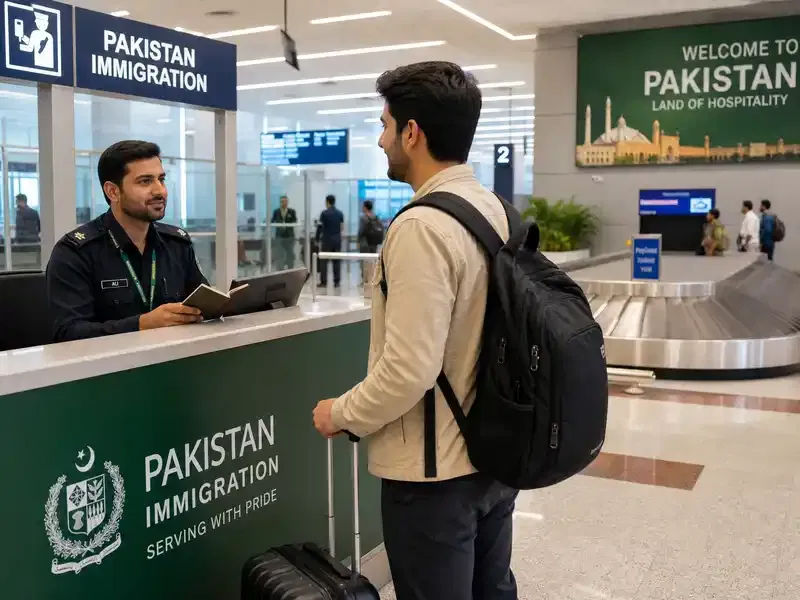
Airport conversations usually involve passports, immigration, baggage, currency, transport, and mobile connectivity. These phrases can help you communicate with airport employees and service counters.
| Urdu | Roman Urdu | English Meaning |
| میں سیاحت کے لیے آیا ہوں / آئی ہوں | Main siyahat ke liye aaya hoon / aayi hoon | I am here for tourism |
| یہ میرا پاسپورٹ ہے | Yeh mera passport hai | This is my passport |
| میری فلائٹ لیٹ ہے | Meri flight late hai | My flight is delayed |
| میرا سامان نہیں آیا | Mera samaan nahin aaya | My luggage has not arrived |
| سامان کہاں سے ملے گا؟ | Samaan kahan se milega? | Where can I collect my luggage? |
| باہر جانے کا راستہ کہاں ہے؟ | Bahar janay ka rasta kahan hai? | Where is the exit? |
| کرنسی ایکسچینج کہاں ہے؟ | Currency exchange kahan hai? | Where is the currency exchange? |
| کیا یہاں مفت وائی فائی ہے؟ | Kya yahan muft Wi-Fi hai? | Is there free Wi-Fi here? |
| مجھے ایک سم کارڈ خریدنا ہے | Mujhe aik SIM card khareedna hai | I need to buy a SIM card |
| کیا آپ میری مدد کر سکتے ہیں؟ | Kya aap meri madad kar saktay hain? | Can you help me? |
Male and Female Forms at Immigration
Some Urdu Travel Phrases in English sentences change according to the speaker’s gender.
A male traveller says:
Main siyahat ke liye aaya hoon.
I have come for tourism.
A female traveller says:
Main siyahat ke liye aayi hoon.
I have come for tourism.
Only one word changes:
- Aaya is generally used by a male speaker.
- Aayi is generally used by a female speaker.
You will see similar gender alternatives throughout this guide.
Urdu Phrases for Taxis, Rickshaws, and Ride-Hailing
Before starting a journey, confirm the destination, fare, and estimated Urdu Travel Phrases in English time. Showing the address on your phone can also prevent misunderstandings.
| Urdu | Roman Urdu | English Meaning |
| مجھے اس پتے پر جانا ہے | Mujhe is patay par jana hai | I need to go to this address |
| مجھے یہاں لے چلیں | Mujhe yahan le chalein | Please take me here |
| کرایہ کتنا ہوگا؟ | Kiraya kitna hoga? | How much will the fare be? |
| میٹر چلا دیں | Meter chala dein | Please use the meter |
| کتنا وقت لگے گا؟ | Kitna waqt lagega? | How long will it take? |
| مجھے جلدی ہے | Mujhe jaldi hai | I am in a hurry |
| یہاں روک دیں | Yahan rok dein | Please stop here |
| مجھے ہوٹل واپس جانا ہے | Mujhe hotel wapas jana hai | I need to return to my hotel |
| باقی پیسے دے دیں | Baqi paisay de dein | Please give me the remaining change |
| کیا آپ کے پاس کھلے پیسے ہیں؟ | Kya aap ke paas khulay paisay hain? | Do you have change? |
| نقشے پر یہ جگہ دیکھیں | Naqshay par yeh jagah dekhein | Please look at this place on the map |
| کیا یہ راستہ محفوظ ہے؟ | Kya yeh rasta mehfooz hai? | Is this route safe? |
A Natural Taxi Conversation in Urdu
Traveller: Mujhe is patay par jana hai.
I need to go to this address.
Driver: Theek hai.
Okay.
Traveller: Kiraya kitna hoga?
How much will the fare be?
Driver: Paanch sau rupay.
Five hundred rupees.
Traveller: Theek hai. Yahan pohanch kar bata dein.
Okay. Please tell me when we arrive.
This kind of short exchange is more useful than trying to construct a long or grammatically perfect sentence.
Urdu Travel Phrases for Buses and Trains
Public transport questions should be specific. Mention the destination, departure time, platform, stop, or ticket type whenever possible.
| Urdu | Roman Urdu | English Meaning |
| یہ بس کہاں جاتی ہے؟ | Yeh bus kahan jati hai? | Where does this bus go? |
| لاہور جانے والی بس کہاں سے ملے گی؟ | Lahore janay wali bus kahan se milegi? | Where can I find the bus to Lahore? |
| اگلی بس کتنے بجے چلے گی؟ | Agli bus kitnay bajay chalegi? | What time will the next bus leave? |
| مجھے ایک ٹکٹ چاہیے | Mujhe aik ticket chahiye | I need one ticket |
| دو ٹکٹ دے دیں | Do ticket de dein | Please give me two tickets |
| کیا یہ بس سیدھی جائے گی؟ | Kya yeh bus seedhi jayegi? | Does this bus go directly? |
| مجھے کس اسٹاپ پر اترنا ہے؟ | Mujhe kis stop par utarna hai? | At which stop should I get off? |
| مجھے یہاں اتار دیں | Mujhe yahan utaar dein | Please let me off here |
| کیا یہ سیٹ خالی ہے؟ | Kya yeh seat khali hai? | Is this seat available? |
| پلیٹ فارم نمبر کیا ہے؟ | Platform number kya hai? | What is the platform number? |
| کیا ٹرین وقت پر ہے؟ | Kya train waqt par hai? | Is the train on time? |
| ٹرین کتنی دیر سے ہے؟ | Train kitni dair se hai? | How late is the train? |
| میرا ٹکٹ کنفرم ہے؟ | Mera ticket confirm hai? | Is my ticket confirmed? |
Important Time Words for Travellers
Two common Urdu Travel Phrases in English time words can confuse visitors:
- Kal can mean either yesterday or tomorrow.
- Parson can mean either the day before yesterday or the day after tomorrow.
The intended meaning normally comes from context. However, when booking transport or accommodation, use the exact date, weekday, and time instead of relying only on kal or parson.
For example:
Mujhe Budh, pandrah July ka ticket chahiye.
I need a ticket for Wednesday, 15 July.
Urdu Phrases for Hotels and Guesthouses
Hotel staff in major cities may understand English, but these Urdu Travel Phrases in English are still useful when explaining a booking, maintenance problem, luggage request, or checkout arrangement.
| Urdu | Roman Urdu | English Meaning |
| میرے نام سے بکنگ ہے | Meray naam se booking hai | I have a reservation under my name |
| میرا نام ___ ہے | Mera naam ___ hai | My name is ___ |
| کیا کمرہ تیار ہے؟ | Kya kamra tayyar hai? | Is the room ready? |
| کیا ناشتہ شامل ہے؟ | Kya nashta shamil hai? | Is breakfast included? |
| چیک آؤٹ کتنے بجے ہے؟ | Check-out kitnay bajay hai? | What time is checkout? |
| وائی فائی کا پاس ورڈ کیا ہے؟ | Wi-Fi ka password kya hai? | What is the Wi-Fi password? |
| مجھے ایک اضافی تولیہ چاہیے | Mujhe aik izafi tauliya chahiye | I need an extra towel |
| گرم پانی نہیں آ رہا | Garam pani nahin aa raha | The hot water is not working |
| اے سی کام نہیں کر رہا | AC kaam nahin kar raha | The air conditioning is not working |
| براہ مہربانی کمرہ صاف کر دیں | Bara-e-meherbani kamra saaf kar dein | Please clean the room |
| کیا آپ ٹیکسی بلا سکتے ہیں؟ | Kya aap taxi bula saktay hain? | Can you call a taxi? |
| کیا آپ میرا سامان رکھ سکتے ہیں؟ | Kya aap mera samaan rakh saktay hain? | Can you store my luggage? |
| میں ایک رات اور رکنا چاہتا ہوں / چاہتی ہوں | Main aik raat aur rukna chahta hoon / chahti hoon | I want to stay one more night |
| کیا میں دیر سے چیک آؤٹ کر سکتا ہوں / سکتی ہوں؟ | Kya main dair se check-out kar sakta hoon / sakti hoon? | Can I check out late? |
A Simple Hotel Check-In Dialogue
Traveller: Assalamu Alaikum. Meray naam se booking hai.
Hello. I have a reservation under my name.
Receptionist: Aap ka naam kya hai?
What is your name?
Traveller: Mera naam Daniel hai.
My name is Daniel.
Traveller: Kya nashta shamil hai?
Is breakfast included?
Receptionist: Ji haan, nashta saat se das bajay tak hai.
Yes, breakfast is from seven until ten.
The word ji is frequently used to show politeness or acknowledgement. Adding it to a reply can make your Urdu sound more respectful.
Urdu Restaurant and Food Phrases
Food-related communication is especially important when you have allergies, dietary restrictions, or a low tolerance for spicy food. Do not rely only on the word “vegetarian” when explaining a serious dietary requirement. State exactly what you cannot eat.
| Urdu | Roman Urdu | English Meaning |
| کیا میں مینو دیکھ سکتا ہوں / سکتی ہوں؟ | Kya main menu dekh sakta hoon / sakti hoon? | May I see the menu? |
| مجھے یہ چاہیے | Mujhe yeh chahiye | I would like this |
| آپ کیا مشورہ دیں گے؟ | Aap kya mashwara dein ge? | What do you recommend? |
| مرچ کم رکھیں | Mirch kam rakhein | Please make it less spicy |
| بالکل مرچ نہ ڈالیں | Bilkul mirch na daalein | Please do not add chilli |
| کیا اس میں گوشت ہے؟ | Kya is mein gosht hai? | Does this contain meat? |
| میں گوشت نہیں کھاتا ہوں / کھاتی ہوں | Main gosht nahin khata hoon / khati hoon | I do not eat meat |
| مجھے ___ سے الرجی ہے | Mujhe ___ se allergy hai | I am allergic to ___ |
| مجھے مونگ پھلی سے الرجی ہے | Mujhe moong phali se allergy hai | I am allergic to peanuts |
| کیا اس میں دودھ ہے؟ | Kya is mein doodh hai? | Does this contain milk? |
| کیا اس میں انڈا ہے؟ | Kya is mein anda hai? | Does this contain egg? |
| بوتل والا پانی دیں | Bottle wala pani dein | Please give me bottled water |
| ایک چائے دے دیں | Aik chai de dein | Please give me one tea |
| کیا آپ کارڈ قبول کرتے ہیں؟ | Kya aap card qabool karte hain? | Do you accept cards? |
| بل لے آئیں، براہ مہربانی | Bill le aayein, bara-e-meherbani | Please bring the bill |
| یہ پیک کر دیں | Yeh pack kar dein | Please pack this to take away |
| کھانا بہت مزیدار تھا | Khana bohat mazedar tha | The food was delicious |
How to Explain an Allergy Clearly
Use this formula:
Mujhe + ingredient + se allergy hai.
It means:
I am allergic to + ingredient.
Examples:
- Mujhe doodh se allergy hai. — I am allergic to milk.
- Mujhe anday se allergy hai. — I am allergic to eggs.
- Mujhe moong phali se allergy hai. — I am allergic to peanuts.
For a severe allergy, show the sentence in Urdu Travel Phrases in English script on your phone as well as saying it aloud. When medical safety is involved, confirm that the person has understood your restriction rather than assuming a polite nod means complete understanding. You can get details on Roman Urdu to English Translation.
Urdu Shopping and Bargaining Phrases
Bargaining may be possible in traditional markets, small independent shops, and souvenir stalls. It is generally less appropriate in supermarkets, branded stores, pharmacies, and businesses displaying fixed prices.
| Urdu | Roman Urdu | English Meaning |
| اس کی قیمت کیا ہے؟ | Is ki qeemat kya hai? | What is its price? |
| یہ کتنے کا ہے؟ | Yeh kitnay ka hai? | How much is this? |
| یہ بہت مہنگا ہے | Yeh bohat mehnga hai | This is very expensive |
| کچھ کم کریں | Kuch kam karein | Please reduce the price |
| کیا یہ آخری قیمت ہے؟ | Kya yeh aakhri qeemat hai? | Is this the final price? |
| میں صرف دیکھ رہا ہوں / رہی ہوں | Main sirf dekh raha hoon / rahi hoon | I am only looking |
| کیا اس کا دوسرا سائز ہے؟ | Kya is ka doosra size hai? | Is there another size? |
| کوئی اور رنگ ہے؟ | Koi aur rang hai? | Is there another colour? |
| کیا میں یہ پہن کر دیکھ سکتا ہوں / سکتی ہوں؟ | Kya main yeh pehen kar dekh sakta hoon / sakti hoon? | Can I try this on? |
| یہ خراب ہے | Yeh kharab hai | This is damaged |
| رسید دے دیں | Raseed de dein | Please give me a receipt |
| میں کارڈ سے ادائیگی کروں گا / گی | Main card se adaigi karoon ga / gi | I will pay by card |
| میرے پاس نقد نہیں ہے | Meray paas naqad nahin hai | I do not have cash |
| کیا میں اسے واپس کر سکتا ہوں / سکتی ہوں؟ | Kya main isay wapas kar sakta hoon / sakti hoon? | Can I return this? |
A Polite Bargaining Example
Traveller: Is ki qeemat kya hai?
What is the price?
Shopkeeper: Do hazaar rupay.
Two thousand rupees.
Traveller: Yeh thora mehnga hai. Kuch kam karein.
This is slightly expensive. Please reduce the price.
Shopkeeper: Aakhri qeemat atharah sau rupay hai.
The final price is eighteen hundred rupees.
Bargaining works better when your tone remains friendly. Aggressive language or repeatedly criticising the product may create an unnecessarily uncomfortable interaction.
Urdu Phrases for Asking Directions
The easiest way to ask for directions is to show the destination name and use kahan hai, meaning “where is it?”
| Urdu | Roman Urdu | English Meaning |
| ___ کہاں ہے؟ | ___ kahan hai? | Where is ___? |
| یہاں سے کتنا دور ہے؟ | Yahan se kitna door hai? | How far is it from here? |
| کیا میں پیدل جا سکتا ہوں / سکتی ہوں؟ | Kya main paidal ja sakta hoon / sakti hoon? | Can I walk there? |
| مجھے راستہ بتا دیں | Mujhe rasta bata dein | Please tell me the way |
| نقشے پر دکھا دیں | Naqshay par dikha dein | Please show me on the map |
| سیدھا جائیں | Seedha jayein | Go straight |
| دائیں مڑیں | Dayein murein | Turn right |
| بائیں مڑیں | Bayein murein | Turn left |
| قریب ترین اے ٹی ایم کہاں ہے؟ | Qareeb tareen ATM kahan hai? | Where is the nearest ATM? |
| واش روم کہاں ہے؟ | Washroom kahan hai? | Where is the bathroom? |
| پولیس اسٹیشن کہاں ہے؟ | Police station kahan hai? | Where is the police station? |
| میں راستہ بھول گیا ہوں / گئی ہوں | Main rasta bhool gaya hoon / gayi hoon | I am lost |
| کیا یہ جگہ محفوظ ہے؟ | Kya yeh jagah mehfooz hai? | Is this place safe? |
| مجھے واپس ہوٹل جانا ہے | Mujhe wapas hotel jana hai | I need to return to my hotel |
Essential Direction Words
| Urdu | Roman Urdu | English |
| دائیں | Dayein | Right |
| بائیں | Bayein | Left |
| سیدھا | Seedha | Straight |
| قریب | Qareeb | Near |
| دور | Door | Far |
| سامنے | Samnay | In front |
| پیچھے | Peechay | Behind |
| اوپر | Ooper | Upstairs or above |
| نیچے | Neechay | Downstairs or below |
| یہاں | Yahan | Here |
| وہاں | Wahan | There |
These words become more useful when combined with a visible landmark, map pin, hotel card, or written destination.
Medical and Emergency Urdu Phrases
During an emergency, use short and direct sentences. Do not worry about speaking perfect Urdu. State the problem, point to the relevant object or body area, and show written information when necessary.
| Urdu | Roman Urdu | English Meaning |
| مجھے مدد چاہیے | Mujhe madad chahiye | I need help |
| پولیس کو بلائیں | Police ko bulayein | Call the police |
| ایمبولینس بلائیں | Ambulance bulayein | Call an ambulance |
| مجھے ڈاکٹر کی ضرورت ہے | Mujhe doctor ki zaroorat hai | I need a doctor |
| قریبی ہسپتال کہاں ہے؟ | Qareebi hospital kahan hai? | Where is the nearest hospital? |
| فارمیسی کہاں ہے؟ | Pharmacy kahan hai? | Where is the pharmacy? |
| میری طبیعت خراب ہے | Meri tabiyat kharab hai | I feel unwell |
| مجھے بخار ہے | Mujhe bukhar hai | I have a fever |
| مجھے چکر آ رہے ہیں | Mujhe chakkar aa rahay hain | I feel dizzy |
| مجھے یہاں درد ہو رہا ہے | Mujhe yahan dard ho raha hai | I have pain here |
| مجھے سانس لینے میں مشکل ہو رہی ہے | Mujhe saans lenay mein mushkil ho rahi hai | I am having difficulty breathing |
| میری دوا ختم ہو گئی ہے | Meri dawa khatam ho gayi hai | I have run out of my medicine |
| میرا پاسپورٹ گم ہو گیا ہے | Mera passport gum ho gaya hai | My passport is lost |
| میرا فون چوری ہو گیا ہے | Mera phone chori ho gaya hai | My phone has been stolen |
| میرا بٹوا گم ہو گیا ہے | Mera batwa gum ho gaya hai | My wallet is lost |
| مجھے اپنے سفارت خانے سے رابطہ کرنا ہے | Mujhe apne safarat khanay se rabta karna hai | I need to contact my embassy |
| میرے ہوٹل کو فون کریں | Meray hotel ko phone karein | Please call my hotel |
| میرے خاندان کو اطلاع دیں | Meray khandan ko ittila dein | Please inform my family |
Emergency contact arrangements can differ by location and service. Before visiting a remote area, save the current contact details for your accommodation, Urdu Travel Phrases in English operator, insurer, embassy or consulate, and relevant local emergency services.
Urdu Phrases for Overcoming a Language Barrier
When communication becomes difficult, ask the other person to slow down, repeat the sentence, write it down, or type it into your phone.
| Urdu | Roman Urdu | English Meaning |
| کیا آپ کو انگریزی آتی ہے؟ | Kya aap ko Angrezi aati hai? | Do you speak English? |
| میں تھوڑی سی اردو بولتا ہوں / بولتی ہوں | Main thori si Urdu bolta hoon / bolti hoon | I speak a little Urdu |
| مجھے سمجھ نہیں آئی | Mujhe samajh nahin aayi | I did not understand |
| آہستہ بولیں | Aahista bolein | Please speak slowly |
| دوبارہ کہیں | Dobara kahein | Please say it again |
| یہ لکھ دیں | Yeh likh dein | Please write this down |
| اس کا انگریزی میں کیا مطلب ہے؟ | Is ka Angrezi mein kya matlab hai? | What does this mean in English? |
| کیا آپ میرے فون میں ٹائپ کر سکتے ہیں؟ | Kya aap meray phone mein type kar saktay hain? | Can you type it into my phone? |
| ایک منٹ، میں ترجمہ کر رہا ہوں / رہی ہوں | Aik minute, main tarjuma kar raha hoon / rahi hoon | One moment, I am translating |
| مجھے یہ لفظ سمجھ نہیں آیا | Mujhe yeh lafz samajh nahin aaya | I did not understand this word |
| آسان الفاظ میں بتائیں | Aasan alfaaz mein batayein | Please explain in simple words |
When you receive an unfamiliar Urdu message, notice, menu item, or transport instruction, you can also enter it into an Urdu Travel Phrases in English to check its likely meaning.
Three Urdu Sentence Patterns Every Traveller Can Reuse
Memorising complete lists helps, but learning a few reusable sentence structures gives you far more flexibility.
1. Mujhe ___ Chahiye
Mujhe ___ chahiye means I need ___ or I would like ___.
Examples:
| Roman Urdu | English |
| Mujhe pani chahiye | I need water |
| Mujhe ticket chahiye | I need a ticket |
| Mujhe taxi chahiye | I need a taxi |
| Mujhe doctor chahiye | I need a doctor |
| Mujhe kamra chahiye | I need a room |
You can insert many nouns into the same structure without changing the rest of the sentence.
2. ___ Kahan Hai?
___ kahan hai? means Where is ___?
Examples:
| Roman Urdu | English |
| Hotel kahan hai? | Where is the hotel? |
| Station kahan hai? | Where is the station? |
| Washroom kahan hai? | Where is the bathroom? |
| ATM kahan hai? | Where is the ATM? |
| Bazaar kahan hai? | Where is the market? |
3. ___ Kar Dein
Adding kar dein turns an action into a polite request.
Examples:
| Roman Urdu | English |
| Yahan rok dein | Please stop here |
| Yeh pack kar dein | Please pack this |
| Kamra saaf kar dein | Please clean the room |
| Yeh likh dein | Please write this |
| Taxi bula dein | Please call a taxi |
This pattern often sounds more natural in spoken Urdu than repeatedly using a direct translation of the English word “please.”
How to Sound Polite Without Speaking Perfect Urdu
Politeness matters more than having a perfect accent. Use the following habits when speaking to strangers:
Use Aap Instead of Tum
Aap is the respectful word for “you.”
Tum is more informal and is normally used with friends, relatives, children, or people with whom you have an established casual relationship.
Using aap is the safer choice with:
- Hotel employees
- Drivers
- Shopkeepers
- Officials
- Older people
- Strangers
Add Ji to Short Replies
Ji can express respect, acknowledgement, or polite agreement.
Examples:
- Ji haan — Yes
- Ji nahin — No
- Ji, theek hai — Yes, that is fine
- Shukriya ji — Thank you
Use Polite Verb Endings
Commands such as do, stop, or tell me can sound abrupt when translated too literally.
More respectful forms include:
- De dein — Please give
- Rok dein — Please stop
- Bata dein — Please tell me
- Dikha dein — Please show me
- Bula dein — Please call
These endings allow you to make practical requests without sounding demanding.
Male and Female Urdu Forms Travellers Should Know
Urdu Travel Phrases in English sometimes changes a verb according to the speaker’s gender.
| English | Male Speaker | Female Speaker |
| I came | Main aaya hoon | Main aayi hoon |
| I can go | Main ja sakta hoon | Main ja sakti hoon |
| I want to stay | Main rukna chahta hoon | Main rukna chahti hoon |
| I do not eat meat | Main gosht nahin khata | Main gosht nahin khati |
| I am looking | Main dekh raha hoon | Main dekh rahi hoon |
| I am translating | Main tarjuma kar raha hoon | Main tarjuma kar rahi hoon |
| I am lost | Main rasta bhool gaya hoon | Main rasta bhool gayi hoon |
Do not allow these variations to prevent you from speaking. Even when the gender ending is imperfect, listeners can usually understand the intended message from context.
Common Mistakes Travellers Make With Urdu Phrases
Translating Every Word Literally
Natural Urdu does not always match English word order. Memorise the complete meaning rather than translating each word separately while speaking.
For example:
Mujhe pani chahiye naturally means “I need water.”
Its word order is closer to “To me, water is needed,” but that literal structure is not useful in normal English.
Using Very Formal Dictionary Urdu
Some dictionary Urdu Travel Phrases in English are grammatically correct but sound unusually literary in an everyday taxi, restaurant, or market conversation.
Modern spoken Urdu regularly uses familiar English loanwords such as:
- Hotel
- Taxi
- Booking
- Wi-Fi
- SIM card
- Platform
- Ticket
- Bill
- Menu
- Card
Using these familiar words can make communication easier and more natural.
Forgetting Gender Endings
A female traveller may accidentally use a male ending such as sakta instead of sakti. This is a common learner mistake and rarely prevents understanding.
Focus first on the key noun and action. Improve the gender ending as your confidence develops.
Speaking Too Quickly
A memorised sentence may become unclear when delivered too quickly. Pause between the important words.
Instead of rushing:
Mujheispatayparjanahai
Say:
Mujhe — is patay par — jana hai.
Assuming a Nod Always Means Full Understanding
A person may nod to remain polite even when a complicated allergy, medical condition, or destination has not been fully understood.
For safety-critical information, ask the person to repeat the key detail or show the information in writing.
Practical Pronunciation Tips for Roman Urdu
You do not need a perfect Urdu accent, but these simple pronunciation notes can make your speech clearer.
Aa Is Usually a Longer Vowel
- Aap sounds closer to “aahp” than “app.”
- Kahan means where.
- Samaan means luggage or belongings.
Kh Is Pronounced From the Throat
The kh sound appears in words such as:
- Khana — Food
- Kharab — Bad or not working
- Khali — Empty
- Khulay paisay — Change or smaller money
A simple English “k” sound may still be understood, so do not force the sound if it feels uncomfortable.
Gh Is Different From a Hard English G
Examples include:
- Ghalat — Wrong
- Ghar — Home
- Ghum or gum — Lost
Roman Urdu Travel Phrases in English spellings vary, so you may see the same word written differently online.
The Ending Ein Often Signals Politeness
Common examples include:
- Bolein — Please speak
- Batayein — Please tell
- Dikha dein — Please show
- Ruk jayein — Please stop or wait
These forms are useful because they allow you to speak respectfully without constructing a long sentence.
A One-Minute Urdu Travel Phrase Card
Save or screenshot this compact phrase card:
| Situation | Roman Urdu Travel Phrases in English | English |
| Help | Mujhe madad chahiye | I need help |
| English | Kya aap ko Angrezi aati hai? | Do you speak English? |
| Confusion | Mujhe samajh nahin aayi | I did not understand |
| Slow down | Aahista bolein | Please speak slowly |
| Directions | Yeh jagah kahan hai? | Where is this place? |
| Taxi | Mujhe is patay par jana hai | I need to go to this address |
| Fare | Kiraya kitna hoga? | How much will the fare be? |
| Hotel | Meray naam se booking hai | I have a reservation |
| Food | Mirch kam rakhein | Please make it less spicy |
| Allergy | Mujhe ___ se allergy hai | I am allergic to ___ |
| Price | Is ki qeemat kya hai? | How much is this? |
| Bathroom | Washroom kahan hai? | Where is the bathroom? |
| Doctor | Mujhe doctor ki zaroorat hai | I need a doctor |
| Lost passport | Mera passport gum ho gaya hai | My passport is lost |
| Thank you | Bohat shukriya | Thank you very much |
FAQs About Urdu Travel Phrases in English
What are the most important Urdu Travel Phrases in English for a tourist?
The most important phrases are Mujhe madad chahiye for “I need help,” Washroom kahan hai? for “Where is the bathroom?”, Mujhe is patay par jana hai for giving a taxi destination, and Mujhe samajh nahin aayi when you do not understand someone.
Travellers with allergies should also memorise Mujhe ___ se allergy hai, meaning “I am allergic to ___.”
How do I ask whether someone speaks English in Urdu?
Say:
Kya aap ko Angrezi aati hai?
It means “Do you know or speak English?” and can be used respectfully with both men and women.
You can then say:
Main thori si Urdu bolta hoon if you are male, or Main thori si Urdu bolti hoon if you are female.
Both mean “I speak a little Urdu.”
Should tourists use aap or tum?
Tourists should normally use aap. It is respectful and appropriate for strangers, employees, officials, drivers, shopkeepers, and older people.
Tum is informal and may sound overly familiar when used with someone you have just met.
Can I communicate using only Roman Urdu Travel Phrases in English?
Yes. Roman Urdu Travel Phrases in English can help you pronounce and type spoken Urdu without learning the Urdu script immediately. However, showing the Urdu-script version can be useful when pronunciation is unclear or when communicating important medical, dietary, or destination information.
How do I say “Where is the bathroom?” in Urdu?
Say:
Washroom kahan hai?
واش روم کہاں ہے؟
The English loanword “washroom” is widely understood in everyday Pakistani conversation.
A more formal expression is:
Bait-ul-khala kahan hai?
بیت الخلا کہاں ہے؟
For most travellers, washroom kahan hai? is easier and more natural.
How do I ask someone to speak slowly in Urdu?
Say:
Aahista bolein.
آہستہ بولیں۔
For an even softer request, say:
Bara-e-meherbani aahista bolein.
براہ مہربانی آہستہ بولیں۔
This means “Please speak slowly.”
What is the Urdu phrase for “I am lost”?
A male traveller says:
Main rasta bhool gaya hoon.
A female Urdu Travel Phrases in English says:
Main rasta bhool gayi hoon.
Both mean “I have lost my way” or “I am lost.”
How do I say “not spicy” in Urdu?
Say:
Bilkul mirch na daalein.
بالکل مرچ نہ ڈالیں۔
This means “Please do not add any chilli.”
For mildly spiced food, say:
Mirch kam rakhein.
مرچ کم رکھیں۔
This means “Please use less chilli.”
Final Thoughts on Urdu Travel Phrases in English
You do not need hundreds of memorised sentences to communicate successfully. Start with a few adaptable patterns:
- Mujhe ___ chahiye — I need ___
- ___ kahan hai? — Where is ___?
- ___ kar dein — Please do ___
- Kitna hoga? — How much will it be?
- Mujhe samajh nahin aayi — I did not understand
Use aap, speak slowly, keep important addresses and medical details written on your phone, and do not worry about minor pronunciation mistakes. A respectful attempt to speak Urdu Travel Phrases in English can make routine travel interactions easier and create warmer connections with the people you meet.