Common Urdu Translation Mistakes
Urdu translation mistakes happen when learners focus only on words instead of meaning. Common Urdu Translation Mistakes often appear during Urdu-to-English translation because both languages follow different rules. Urdu and English have different grammar patterns, sentence structures, and expressions.
Many beginners Common Urdu Translation Mistakes word by word. This method can change the original meaning. A correct translation needs context, cultural understanding, and natural language use.
For example, Urdu phrases often carry cultural meanings that do not match direct English words. A translator must understand the message behind the phrase, not just its vocabulary.
Urdu-to-English translation feels challenging because Urdu uses different sentence patterns, gender rules, and expressions. English also requires accurate use of articles, prepositions, and verb forms.
This guide will help you understand common translation errors and avoid them. You will learn incorrect and correct translation examples with clear explanations. You will also discover practical ways to improve translation accuracy and develop better Urdu-to-English skills.
What Are Common Urdu Translation Mistakes?
Common Urdu Translation Mistakes are errors that change the meaning, accuracy, or natural flow of a translated sentence. These mistakes happen when someone converts Urdu into English without understanding both languages deeply. Good Urdu Translation requires more than replacing words from a source language with words from a target language. It requires understanding the message behind those words.
A translation error happens when a translator chooses an incorrect word, grammar rule, or sentence structure. A mistranslation occurs when the entire meaning changes during translation. Meaning confusion happens when a word or phrase has multiple meanings, but the translator selects the wrong one.
A grammar error appears when the translation uses incorrect sentence patterns, verb forms, articles, or prepositions. These mistakes can make English sentences unclear or unnatural.
Beginners often make these mistakes because Urdu and English follow different language rules. Urdu uses different sentence structures, expressions, and cultural references. Direct translation often ignores contextual meaning, which affects translation accuracy.
For example, an Urdu phrase may have a deeper cultural meaning than its individual words. A learner who translates each word separately may lose the original message.
Why Is Urdu Translation Difficult?
Common Urdu Translation Mistakes becomes difficult because Urdu and English follow different language systems. A translator must understand grammar, sentence patterns, and cultural meanings. Simply changing Urdu words into English words often creates unclear or unnatural sentences.
Both languages have unique rules. Urdu depends heavily on context, while English follows more fixed patterns. These differences create challenges for beginners and even advanced learners.
Differences Between Urdu and English Grammar
Urdu Grammar and English Grammar work differently. Urdu usually follows a subject-object-verb structure. English usually follows a subject-verb-object structure.
For example:
Urdu:
میں کتاب پڑھتا ہوں۔
Word order:
I book read.
Natural English:
I read a book.
Urdu also uses postpositions instead of English prepositions. Urdu places these words after nouns, while English places them before nouns.
Urdu:
گھر میں
English:
In the house
Urdu also has gender-based grammar. Words and verbs can change according to gender. English does not use the same gender system for most nouns.
Urdu allows flexible word order, but English needs a clearer sentence pattern. Changing word order in English can affect meaning and accuracy.
These differences in syntax, sentence structure, and word order make translation challenging.
Cultural Meaning Changes Translation
Language carries culture. Many Urdu expressions have meanings beyond their individual words. A direct translation may sound strange because it ignores cultural context and cultural nuance.
For example:
| Urdu Expression | Literal Translation | Natural English |
| دل لگانا | Attach the heart | Become interested |
| ہاتھ بٹانا | Divide hands | Help someone |
The phrase دل لگانا does not mean attaching a heart physically. It describes developing interest or enjoying something. Similarly, ہاتھ بٹانا means helping someone, not dividing hands.
7 Common Urdu Translation Mistakes With Examples
Common Urdu Translation Mistakes requires more than knowing vocabulary. Many learners make mistakes because they translate words without understanding grammar, culture, and context. These errors can change the meaning or make English sentences sound unnatural.
Learning common mistakes helps improve translation accuracy. Let’s explore some frequent Urdu translation problems with examples.
1. Translating Urdu Idioms Literally
Many Urdu Idioms have meanings beyond their individual words. A Literal Translation often creates confusing or incorrect English. Idioms need an Idiomatic Expression approach because their meanings depend on culture and usage.
Example:
Urdu:
آنکھوں کا تارا
Wrong Translation:
Star of the eyes
Correct Translation:
Apple of my eye
The literal translation sounds strange in English. The Urdu expression describes someone who is very loved or special. A translator must understand the intended meaning instead of translating each word separately.
2. Ignoring Context While Translating Urdu Words
Many Urdu words have multiple meanings. This concept is called polysemy. The correct meaning depends on the sentence and situation.
Example:
Word:
دل
Possible meanings:
- Heart
- Feelings
- Courage
- Desire
Sentence context decides the correct meaning. For example, “دل مضبوط کرنا” means “to gain courage,” not “to make the heart strong.”
A translator needs Contextual Meaning to achieve Semantic Equivalence. Choosing the wrong meaning can create inaccurate translations.
3. Word-for-Word Translation Errors
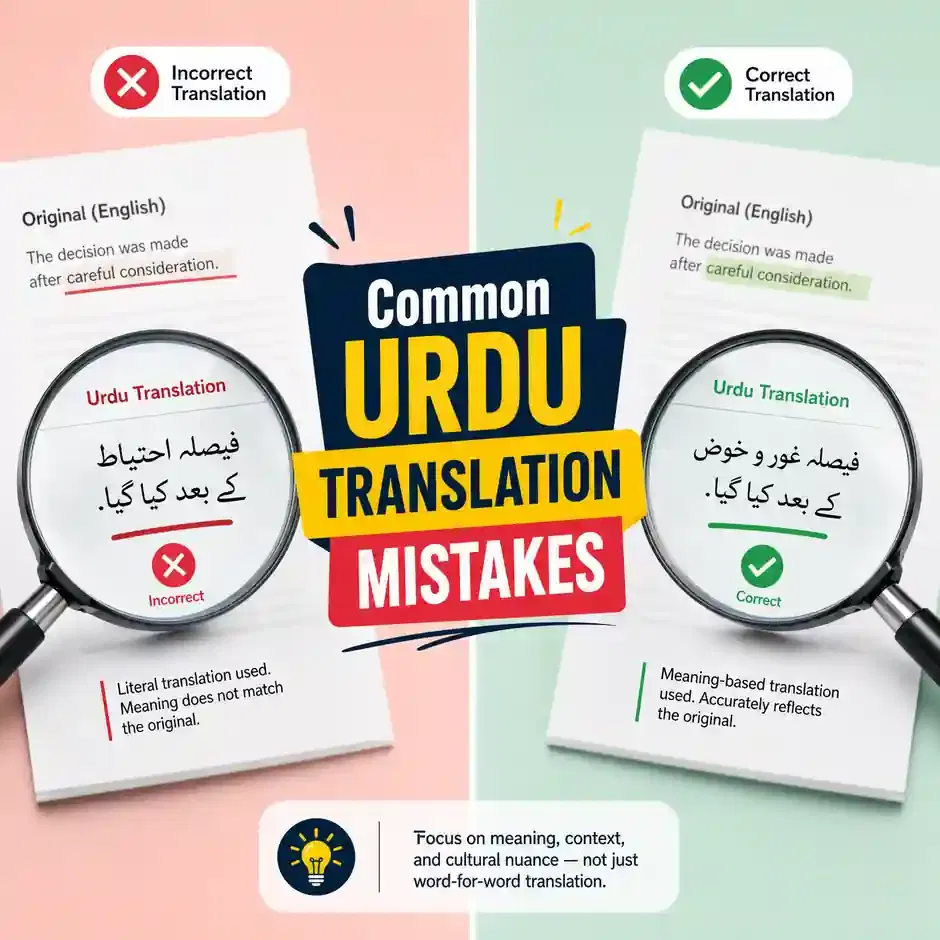
Word-for-Word Translation often produces unnatural English. Urdu and English follow different sentence structures, so direct translation may fail.
Example:
Urdu:
مجھے یاد ہے
Wrong Translation:
It is remembered to me
Correct Translation:
I remember
The correct translation focuses on meaning, not individual words. Direct Translation works only when both languages share similar structures.
4. Incorrect Urdu Verb Translation
Verb mistakes are common in Urdu-to-English translation. Learners often struggle with tense, verb forms, and helping verbs.
Example:
Wrong:
I am knowing him.
Correct:
I know him.
English does not use continuous tense with some verbs like “know.” Understanding Tense Error and Grammar Error patterns helps learners create accurate sentences.
5. Subject-Verb Agreement Mistakes
English verbs must match the subject. Many Urdu speakers make mistakes because Urdu follows different agreement rules.
Example:
Wrong:
He go to school.
Correct:
He goes to school.
The subject “he” requires “goes” in English. Learning English Grammar rules improves sentence accuracy and prevents Subject-Verb Agreement Errors.
6. Urdu Gender Translation Mistakes
Urdu uses grammatical gender. Nouns and verbs can change according to masculine and feminine forms. English usually does not follow the same system.
Examples:
وہ گئی
She went.
وہ گیا
He went.
The translator must understand the speaker, context, and sentence meaning. Differences in Morphology and Language Rules can create translation challenges.
7. Article Usage Mistakes
Urdu speakers often struggle with English articles because Urdu does not use “a,” “an,” and “the” in the same way.
Example:
Wrong:
I bought book.
Correct:
I bought a book.
English requires articles in many situations. Understanding Article Error patterns improves English Sentence Formation and makes translations sound natural.
Common English Mistakes Made by Urdu Speakers
Many Urdu speakers face common challenges when they learn English because both languages follow different rules. These differences often affect sentence formation, grammar, and communication. One frequent mistake is missing articles like “a,” “an,” and “the” because Urdu does not use them in the same way.
For example, learners may say “She is teacher” instead of “She is a teacher.” Incorrect tense usage is another common issue. Urdu speakers sometimes translate tense patterns directly, which creates unnatural sentences.
For example, “I am living here since five years” should be “I have been living here for five years.” Many learners also follow direct Urdu sentence structure while speaking English. Urdu usually uses a subject-object-verb pattern, but English uses a subject-verb-object pattern. Wrong prepositions create more confusion because English uses different rules. For example, “Discuss about the problem” should be “Discuss the problem.” Another challenge is translation thinking, where learners create an Urdu sentence first and then convert it into English.
This approach often reduces fluency and natural expression. Following effective English Learning Tips, improving English Communication Skills, and practicing English for Urdu Speakers can help learners avoid these mistakes and develop confident communication.
Literal Translation vs Contextual Translation
Translation can follow two different approaches: Literal Translation and Contextual Translation. Understanding the difference helps learners choose the right method for accurate communication. Literal translation focuses on individual words, while contextual translation focuses on the complete message and intended meaning.
Many beginners depend on Literal Meaning because it feels easier. However, translating every word directly can create confusing sentences. Languages have different grammar rules, expressions, and cultural meanings. A word that works in one language may not carry the same meaning in another language.
Contextual Meaning helps translators understand the situation, emotion, and purpose behind a sentence. This approach creates more natural and accurate translations. It follows the idea of Dynamic Equivalence, where the translation delivers the same message and effect instead of copying every word.
| Feature | Literal Translation | Contextual Translation |
| Focus | Words | Meaning |
| Accuracy | Often low | Higher |
| Use | Simple texts | Real communication |
| Approach | Direct word replacement | Meaning-based translation |
For example, translating Urdu idioms requires contextual understanding. A phrase may look incorrect when translated word by word but sound natural when translated by meaning.
How to Avoid Urdu Translation Mistakes
Avoiding Common Urdu Translation Mistakes mistakes requires regular practice and a better understanding of both Urdu and English. Translation is not only about replacing words. It requires learning the meaning, structure, and purpose behind each sentence. Effective Translation Practice helps learners identify common errors and improve their skills over time.
Start with context-based translation. Always understand the situation before translating a word or sentence. The same Urdu word can have different meanings depending on its usage. Context helps you choose the correct English equivalent.
Learning common Urdu expressions also improves accuracy. Many Urdu phrases and idioms have cultural meanings that need natural English translations. Memorizing expressions helps you avoid confusing word-for-word translations.
Improving English Grammar is another important step. Strong grammar knowledge helps learners understand sentence structure, tenses, articles, and prepositions. It creates more accurate and natural translations.
Reading native English content also improves language skills. Books, articles, and conversations expose learners to natural sentence patterns and everyday expressions.
Translation tools can support learning, but use them carefully. Machine tools may provide direct translations without understanding cultural meaning or context. Always review and improve the final translation.
Urdu Translation Practice Examples
Regular practice plays an important role in improving Urdu-to-English translation skills. Translation Exercises help learners understand the difference between incorrect and natural translations. Good translation requires attention to grammar, context, and meaning. For daily conversation, consider the Urdu sentence “مجھے بھوک لگی ہے۔” A direct translation like “Hunger has happened to me” sounds unnatural. The correct translation is “I am hungry” because English expresses this feeling differently. In workplace communication, the sentence “میں آپ کو بعد میں جواب دوں گا۔” should not become “I will give you answer later.”
A natural translation is “I will reply to you later.” This sounds more professional in English. In academic communication, “مجھے اس موضوع پر تحقیق کرنی ہے۔” is better translated as “I need to research this topic” instead of “I have to do research on this topic.” Urdu idioms also require careful translation. For example, “اونٹ کے منہ میں زیرہ” does not mean “A cumin seed in a camel’s mouth.” Its natural meaning is “Too little for a big need.” These Translation Examples show why translators need cultural understanding, grammar knowledge, and context awareness. Regular practice helps learners create clear, accurate, and natural English translations.
Best Tools to Improve Urdu Translation Accuracy
Improving Common Urdu Translation Mistakes accuracy requires the right tools and learning methods. Translation tools can support learners, but they work best when combined with language knowledge and human understanding. Good Translation Best Practices focus on meaning, grammar, and context instead of depending only on automatic results.
Urdu dictionaries are helpful for understanding word meanings, pronunciation, and usage. A reliable dictionary helps learners check different meanings of a word and choose the correct option according to context.
Translation tools can provide quick results, but users should review their suggestions carefully. Automated tools may struggle with Urdu idioms, cultural expressions, and complex sentences. Always compare the output with the original meaning.
Grammar resources help learners improve sentence structure, verb usage, articles, and prepositions. Strong grammar knowledge improves Translation Quality and reduces common errors.
Corpus examples are also valuable because they show how native speakers use words and phrases in real situations. They help learners understand natural English expressions instead of memorized translations.
Human review remains important for professional translation. A skilled translator can identify cultural issues, unclear meanings, and unnatural phrases that tools may miss.
Frequently Asked Questions
What are common Urdu translation mistakes?
Common Urdu translation mistakes include literal translation, wrong word choices, grammar errors, incorrect tense usage, and ignoring context. Many learners translate individual words instead of understanding the complete meaning. Accurate translation requires knowledge of vocabulary, grammar, and cultural expressions.
Why do Urdu speakers make English grammar mistakes?
Urdu speakers often make English grammar mistakes because Urdu and English follow different language rules. Differences in sentence structure, articles, prepositions, and verb patterns create challenges. Regular practice and understanding English Grammar can help learners improve accuracy.
Why is literal translation incorrect?
Literal translation can create incorrect or unnatural sentences because languages do not always share the same expressions and structures. Some Urdu phrases have cultural meanings that cannot translate word by word. Context-based translation provides a more natural result.
How can I improve Urdu-to-English translation skills?
You can improve Urdu-to-English translation skills through regular practice, reading native English content, learning common Urdu expressions, and improving grammar knowledge. Translation exercises and feedback also help identify mistakes and build confidence.
What is the difference between Urdu and English sentence structure?
Common Urdu Translation Mistakes usually follows a subject-object-verb structure, while English follows a subject-verb-object structure. This difference affects sentence formation and word order. Understanding these patterns helps create clearer translations.
Are AI translation tools accurate for Urdu?
AI translation tools can help with basic Urdu translation, but they may struggle with idioms, cultural meanings, and complex sentences. Human review remains important for improving accuracy and ensuring natural communication. AI tools work best when combined with grammar knowledge and context understanding.
Conclusion
Accurate Common Urdu Translation Mistakes understanding meaning, not just replacing words. A good translator focuses on the message behind a sentence. Words alone cannot always express the complete idea, especially when dealing with Urdu expressions and cultural phrases.
Context plays an important role in translation accuracy. The same Urdu word can have different meanings depending on the situation. Understanding the context helps create natural and clear English translations.
Grammar and culture also affect translation quality. Urdu and English follow different sentence structures, grammar rules, and communication styles. Learning these differences helps avoid common translation mistakes.
Continuous practice builds confidence and improves fluency. Regular translation exercises, reading native English content, and learning common Urdu expressions help learners develop better skills.
By avoiding literal translation and focusing on meaning, learners can create more accurate and natural translations. Strong vocabulary, grammar knowledge, and cultural awareness lead to better Urdu-to-English communication. Translation becomes easier when learners practice consistently and understand both languages deeply.