English to Polish Translator
Translate English to Polish online with our English to Polish translator. Enter an English word, phrase, sentence, paragraph, or longer text. The tool provides a Polish translation in seconds.
Select English → Polish to translate English into Polish. You can also use the language selector to change the translation direction when supported.
Use the Copy button to save your translated text. Use Clear to remove the current text and start again.
This English Polish translator works for everyday translation needs. It can help with words, phrases, sentences, and longer text.
Translation quality can vary with context, grammar, idioms, and specialized terms. Review important translations before using them for legal, medical, academic, or official purposes.
Translate English to Polish Online
english to polish translator Online lets you convert English text into Polish from any device. You only need an internet connection and text to translate.
Enter your English words, phrases, sentences, paragraphs, or longer text into the translator. The tool processes your input and returns a Polish translation.
Short text often needs less context to translate correctly. Longer text gives the tool more context but may contain more complex grammar and meaning.
You can copy the translated result after reviewing it. This makes the tool useful for messages, travel, study, and everyday communication.
If the translator is offered free, you can use it without paying for each translation. Availability may depend on the tool’s current features.
Context matters in English to Polish translation. The same English word can have different Polish translations in different situations.
Online language translation can save time, but machine translation still needs human review for important or specialized text.
English to Polish Translation for Words, Phrases, Sentences, and Text
English Words to Polish
You can translate individual English words into Polish quickly. A word may have several meanings, so context can change the correct Polish equivalent.
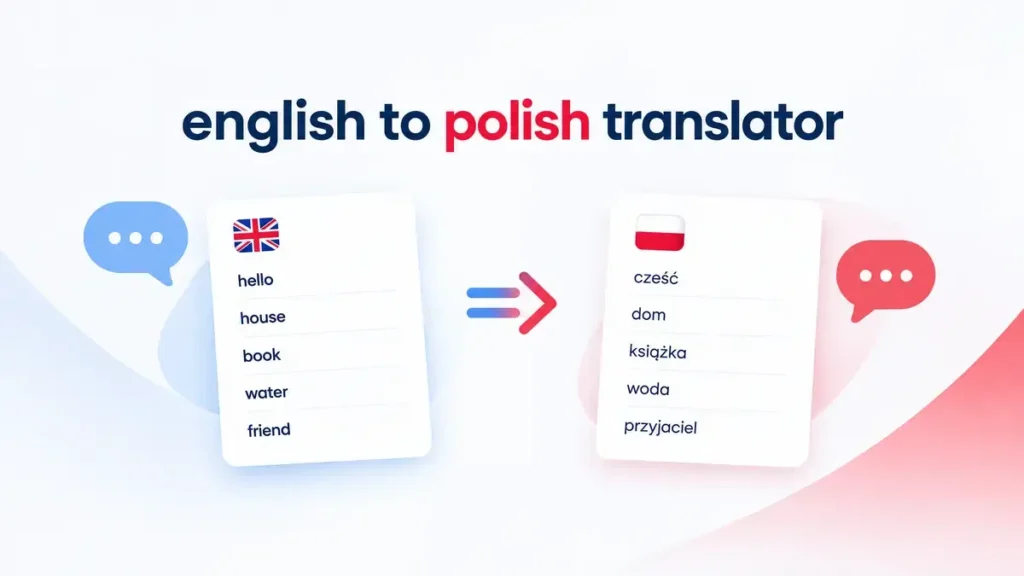
Example:
House → Dom
Book → Książka
English Phrases to Polish
An English phrase may need more than a word-for-word translation. Common expressions and idioms often need natural Polish equivalents.
Context helps preserve the intended meaning instead of producing a literal result.
English Sentences to Polish
Sentence translation considers grammar, word order, and meaning. Polish sentence structure can differ from English structure.
A complete sentence also gives more context than an isolated word. This can help produce a more suitable Polish translation.
English Paragraphs and Longer Text
Longer text requires consistency across connected sentences. Pronouns, repeated terms, and references should keep their meaning throughout the paragraph.
Context becomes especially important when translating longer text. Review the result when the text contains complex ideas or specialized language.
English to Polish Dictionary and Word Meanings
An english to polish translator dictionary can help you understand individual words and their possible Polish meanings.
One English word may have several Polish translations. The right choice depends on its meaning and context.
For example, “bank” can refer to a financial institution or the side of a river. Each meaning needs different Polish vocabulary.
Word forms also matter. A Polish word can change based on grammar, number, gender, or sentence role.
Example sentences provide useful context. They show how a word works within a complete sentence.
A dictionary and machine translation serve different purposes. A dictionary lists possible meanings and word information. A translator selects wording based on the surrounding text.
Use an English to Polish dictionary when you need to check a word’s meaning or usage. Use a translator when you need to convert connected English text into Polish.
English to Polish Grammar and Natural Translation
English and Polish use different grammar systems. These differences can affect how a translation sounds and reads.
Polish Word Order
Polish allows flexible word order because grammatical endings often show sentence roles. English usually depends more on word position.
A direct word-for-word conversion may therefore sound unnatural in Polish.
Cases and Noun Forms
Polish uses grammatical cases to show how nouns function in sentences. Noun endings can change according to their role, number, and gender.
This process is called noun declension.
Verbs, Gender, and Number
Polish verbs change for features such as person, number, tense, and aspect. Polish nouns, adjectives, and pronouns also follow grammatical patterns.
Adjectives and pronouns can agree with nouns in relevant grammatical features.
Parts of Speech
English and Polish both use nouns, verbs, adjectives, pronouns, and other parts of speech. Their forms and uses can differ between the two languages.
Why Context Matters
A literal translation does not always produce natural Polish. Idioms, specialized terms, proper names, and cultural references need careful interpretation.
Simple phrases often require less contextual analysis. Complex sentences can require more grammatical and semantic judgment.
Translation quality can therefore vary with context, vocabulary, and grammar. Review important translations before using them for official or specialized purposes.
Polish Language: Alphabet, Diacritics, Pronunciation, and Vocabulary
Polish uses the Latin alphabet with several letters and diacritical marks. The modern Polish alphabet contains 32 letters.
Polish Alphabet
Polish includes letters that English does not use. These letters help represent Polish sounds and spelling patterns.
Polish also uses several common letter combinations. These include sz, cz, rz, ch, dz, dź, and dż.
Polish Diacritics
Polish has nine letters with diacritical marks:
Ą, Ć, Ę, Ł, Ń, Ó, Ś, Ź, Ż
These marks can change pronunciation and distinguish different words. For example, ł and l represent different Polish letters.
The letters ą and ę use ogoneks. Letters such as ć, ń, ś, and ź use an acute accent. ż uses a dot, while ł uses a stroke.
Polish Pronunciation
Polish spelling can differ from English pronunciation patterns. Some letters and letter combinations represent sounds that English speakers may not expect.
Polish pronunciation also depends on spelling and word structure. Polish normally places stress on the penultimate syllable.
Polish Vocabulary
Polish vocabulary includes many words whose meaning depends on context. A single English word can therefore require different Polish equivalents.
Understanding Polish spelling, pronunciation, and vocabulary helps explain why context matters in English to Polish translation.
English to Polish Translator Accuracy and Limitations
English to Polish translation quality depends on the text, context, grammar, and terminology. Machine Translation systems can produce useful results, but no translation method handles every situation perfectly.
What Affects Translation Accuracy?
Context helps determine the correct meaning of English words and phrases. Grammar, idioms, slang, proper nouns, and cultural references can also affect the result.
Technical terms may require domain-specific knowledge. Polish grammatical forms can also change based on gender, number, case, and sentence structure.
Long documents create additional challenges. Terms, names, and meanings should remain consistent across the full text.
Easier and More Complex Translations
Common words, simple sentences, everyday phrases, and clear factual text are usually easier to translate.
More review may be needed for legal documents, medical information, contracts, academic writing, technical terminology, idioms, marketing copy, and official documents.
Machine Translation Limitations
Automatic Translation can process large amounts of text quickly. Neural Machine Translation and Artificial Intelligence can use surrounding text to generate more natural results.
However, Natural Language Processing systems can still misunderstand ambiguous wording or specialized context. Large Language Models may also generate wording that sounds natural but does not fully preserve the source meaning.
Translation evaluation itself can involve multiple valid translations for the same source text. NIST notes that human assessment remains important when evaluating translation quality.
Why Review Important Translations?
Always review important translations before using them officially. Check names, numbers, dates, technical terms, and the intended meaning.
For legal, medical, academic, contractual, or official content, consider review by a qualified human translator or subject expert.
A trustworthy English to Polish translator should make its limitations clear rather than promise perfect accuracy.
How to Use the English to Polish Translator
To translate English to Polish, enter or paste your English word, phrase, sentence, paragraph, or longer text into the English to Polish translation tool. Select English as the source language and Polish as the target language, then start the translation. The tool processes your text and provides a Polish result. You can use the Copy button to save the translated text or Clear to remove the current input and start again.
If language switching is available, you can change the translation direction when you need Polish to English translation. The English to Polish online tool can help with everyday messages, study, travel, and general text translation. After receiving the result, read it carefully and check that the meaning matches your original text. Pay special attention to names, numbers, dates, technical terms, and context. For legal, medical, academic, contractual, or official content, review the translation carefully before using it.
English to Polish Translator Examples and Practical Uses
Examples can help you understand how English words, phrases, sentences, and longer text appear in Polish.
English word → Polish
Hello → Cześć
Book → Książka
Water → Woda
English phrase → Polish
Good morning → Dzień dobry
Thank you very much → Dziękuję bardzo
See you later → Do zobaczenia później
English sentence → Polish
Where is the train station? → Gdzie jest dworzec kolejowy?
I am learning Polish. → Uczę się polskiego.
English paragraph → Polish
English: “I am visiting Poland for the first time. I want to learn about Polish culture and try local food.”
Polish: “Odwiedzam Polskę po raz pierwszy. Chcę poznać polską kulturę i spróbować lokalnego jedzenia.”
Students and Language Learning
Students can use an English to Polish translator to check vocabulary, understand reading material, and support language learning. It can also help compare English words with their Polish equivalents and understand common Polish phrases.
Travel
Travelers can translate basic communication, directions, menus, signs, and everyday phrases. This can make simple interactions easier while visiting Poland.
Business
An English to Polish translator can help with basic emails, product information, and customer communication. Important business documents should receive appropriate human review before use.
Everyday Communication
You can translate messages, short notes, social posts, and general text for everyday communication. Reviewing the Polish result helps ensure that the wording matches your intended meaning.
English to Polish Translator Technology
An English to Polish translator can use several technologies to process and convert language. Machine Translation uses software to convert text from one language into another. Neural Machine Translation (NMT) uses neural models that learn language patterns from translation data.
Natural Language Processing (NLP) helps computers process and analyze human language. It can support tasks such as language detection, text processing, and translation. Artificial Intelligence can help modern language systems use patterns and surrounding context when generating translations.
Some translation systems may also connect with Large Language Models or other language technologies. Translation Software can combine these technologies to process user input and produce translated text. A Translation API can provide similar translation functions to other websites or applications.
Other technologies can support related language tasks. Unicode provides a standard way to represent characters across digital systems, while UTF-8 is a widely used Unicode encoding. These standards help display Polish characters such as ą, ć, ę, ł, ń, ó, ś, ź, and ż correctly.
Optical Character Recognition (OCR) can extract text from images or scanned documents before translation. Speech Recognition can convert spoken language into text that a translation system can process. The exact technologies used by a particular translator depend on its implementation and available features.
FAQS
What is an English to Polish translator?
An English to Polish translator is a tool that converts English words, phrases, sentences, or longer text into Polish. It can support everyday communication, study, travel, and general translation needs.
How can I translate English to Polish online?
Enter your English text into the translator, select English as the source language and Polish as the target language, then start the translation. Review the Polish result before using it.
Can I translate English words into Polish?
Yes. You can translate individual English words into Polish. Remember that one English word can have different Polish meanings depending on context.
Can I translate English sentences into Polish?
Yes. The translator can process English sentences and provide Polish translations. Complete sentences usually provide more context than isolated words.
Can I translate English text into Polish?
Yes. You can translate paragraphs and longer English text into Polish. Longer content may contain more complex grammar, terminology, and context.
Is the English to Polish translator free?
If the translator is provided as a free online tool, you can use its available translation features without paying for individual translations. Features may vary by service.
How accurate is English to Polish translation?
Translation quality depends on context, grammar, vocabulary, idioms, and text complexity. Simple everyday text is generally easier to process than specialized or ambiguous content.
Can the translator handle Polish grammar?
A translation system can process many Polish grammatical patterns, but complex structures may require review. Polish uses cases, grammatical gender, number, and verb forms that can affect wording.
Can I use an English to Polish translator for travel?
Yes. It can help translate directions, menus, basic questions, signs, and everyday travel phrases. Review important information before relying on a translation.
Can students use an English to Polish translator?
Yes. Students can use it to check vocabulary, understand text, compare English and Polish wording, and support language learning. It should support learning rather than replace it.
Conclusion
An English to Polish translator provides a simple way to convert English words, phrases, sentences, paragraphs, and longer text into Polish. It can support everyday communication without requiring users to understand Polish grammar or vocabulary first. Students can use it to check words and support language learning. Travelers can translate useful phrases, directions, menus, and basic questions. Businesses can use it for general messages, product information, and customer communication.
The translator can also help users understand how English meaning changes when expressed in Polish. Context remains important because English words may have several Polish equivalents. Grammar, idioms, slang, cultural references, proper names, and technical terms can also affect the final translation.
Machine translation and AI-based systems can process text quickly, but they can still produce wording that needs review. This matters most for legal, medical, academic, contractual, and official content.
For everyday translation, the tool offers a convenient starting point. Enter your English text, select Polish, generate the translation, and review the result carefully. For important content, consider additional review from a qualified translator or subject expert. This approach helps you use English to Polish translation efficiently while keeping meaning and context in focus.