Hieroglyphics Translator
Use our hieroglyphics translator to explore Egyptian hieroglyphs in a simple and practical way. Enter a word, name, or short phrase to generate a hieroglyphic representation.
You can type your text, view the result, and copy the generated symbols. The tool can help students, history enthusiasts, writers, and curious learners explore Ancient Egyptian writing.
However, hieroglyphics work differently from the modern English alphabet. Ancient Egyptian scribes used signs to represent sounds, words, and ideas. Some signs also helped clarify a word’s meaning.
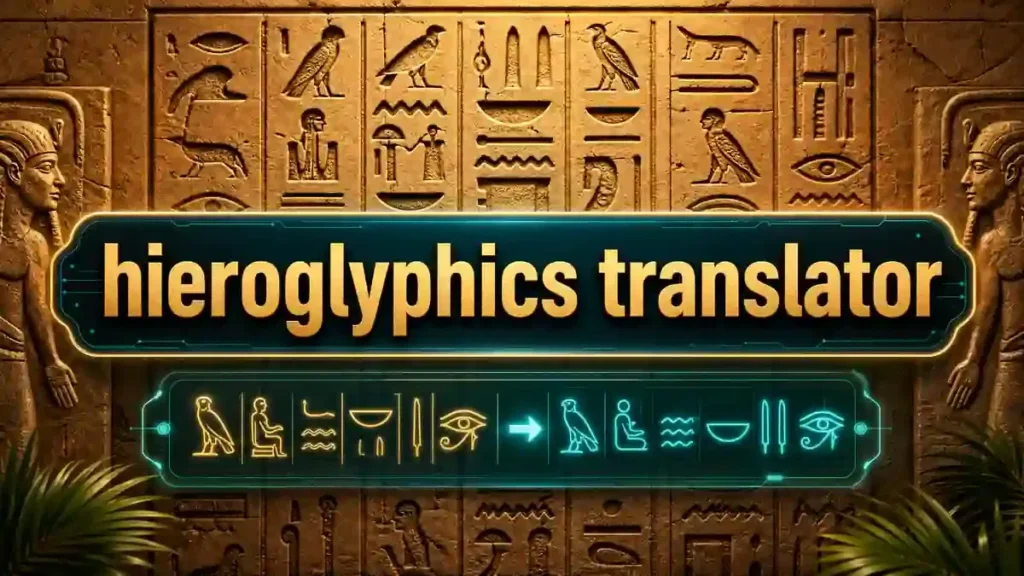
For this reason, converting English letters into symbols does not always create a true Ancient Egyptian translation. A name usually needs transliteration because names represent sounds. A complete sentence may require grammar, vocabulary, and historical context.
Our tool aims to make hieroglyphic writing easier to explore. It also explains what each result represents whenever possible. This approach helps you distinguish simple symbol conversion from phonetic transliteration and genuine translation.
Translate Text With Our Hieroglyphics Translator
Our hieroglyphics translator helps you explore Egyptian writing with simple text input. Enter a word, name, short phrase, or longer text.
You can also use the tool as a hieroglyphic translator or Egyptian hieroglyphics translator. The exact result depends on the translation method.
For example, you can convert English text into hieroglyphic signs. You can also explore phonetic representations for names and selected words.
An Ancient Egyptian translator works differently from a basic symbol converter. Ancient Egyptian used a complex writing system with signs for sounds, words, and meaning.
You can enter common words, personal names, short messages, or other text. If the tool supports reverse lookup, you can also enter hieroglyphic characters for identification.
English to Hieroglyphics
The tool can represent English words with suitable hieroglyphic signs. For names, it usually focuses on matching sounds instead of translating meanings.
This process is called transliteration. It helps represent a modern name using symbols with similar phonetic values.
However, English and Ancient Egyptian follow different grammar systems. Therefore, longer sentences may need more than direct symbol conversion.
Hieroglyphics to English
Translating hieroglyphics to English can require more context. A single sign may represent a sound, word, or idea.
The meaning can also depend on nearby signs and the historical context. Complete inscriptions may require linguistic knowledge for accurate interpretation.
Egyptian Symbols Translator
An Egyptian symbols translator can help identify individual hieroglyphic characters. Identifying one symbol differs from translating an entire inscription.
A single symbol may have several functions. The surrounding text often determines its intended meaning.
Our tool helps you explore both possibilities clearly. It separates simple symbol identification from deeper hieroglyphic interpretation.
How to Use the Hieroglyphics Translator
Our hieroglyphics translator makes it easy to explore Egyptian hieroglyphic writing. You can convert words, names, phrases, and short messages in three simple steps.
Step 1: Enter Your Text
Start by entering the text you want to convert. You can type your name, a single word, a short phrase, or a message.
For example, you may enter:
- Your name
- A common word
- A short phrase
- A personal message
Keep your text clear and simple for the best results. Names and unfamiliar words often need phonetic matching.
Step 2: Choose the Translation Method
Select the method that matches your goal. Symbol conversion replaces text with matching hieroglyphic symbols. Phonetic transliteration focuses on how a word sounds.
Ancient Egyptian translation focuses on meaning. This option requires more linguistic context and may not suit every modern phrase.
Step 3: Get and Copy Your Result
The tool then displays your hieroglyphic output. Depending on the selected mode, you may also see transliteration or symbol details.
Review the result before using it. You can then copy the Unicode hieroglyphs and paste them into supported documents, messages, or creative projects.
This simple process helps you explore hieroglyphic writing while understanding how the final result was created.
What Does This Hieroglyphics Translator Actually Do?
A hieroglyphics translator can produce different types of results. Understanding the method helps you use the tool correctly.
Ancient Egyptian hieroglyphs did not work like a simple English alphabet. A sign could represent a sound, a word, or help explain meaning.
For this reason, our tool separates translation, transliteration, and symbol conversion. Each method serves a different purpose.
Translation
Translation focuses on meaning. It converts the meaning of an English word or sentence into an Ancient Egyptian equivalent.
This process can require knowledge of Egyptian vocabulary, grammar, and historical context. Modern words may also lack a direct Ancient Egyptian equivalent.
A true translation therefore requires more than replacing English letters with symbols.
Transliteration
Transliteration focuses on sound. It represents the sounds of a modern word using hieroglyphic signs with similar phonetic values.
This method works well for personal names and foreign words. Your name does not usually need translation. It needs a representation based on its pronunciation.
Different spellings or pronunciations can produce different results.
Symbol Conversion
Symbol conversion replaces modern letters with selected hieroglyphic symbols. It creates a visual representation but may not create a historically accurate Ancient Egyptian word.
This method works best for creative or decorative purposes.
Why This Matters
Our tool clearly identifies the method behind each result. We do not claim that every output provides a perfect Ancient Egyptian translation.
Egyptian hieroglyphic writing used phonograms, logograms, and determinatives. Context often changed how readers understood a sign.
Understanding the method helps you interpret the result correctly and use it with greater confidence.
English to Hieroglyphics Translator
Our English to hieroglyphics translator helps you represent modern text with Egyptian hieroglyphic signs. You can enter a word, name, or short phrase.
Modern English and Ancient Egyptian belong to very different language systems. They use different grammar, vocabulary, sounds, and writing conventions.
Because of this difference, English words do not always have direct Ancient Egyptian equivalents. Names create another challenge because they usually represent sounds, not meanings.
For names and unfamiliar words, the tool can use phonetic transliteration. It selects hieroglyphic signs that represent similar sounds.
For example, the owl sign has the phonetic value m in Egyptian writing. Egyptologists commonly identify this sign as Gardiner G17.
| English | Transliteration | Hieroglyphic Output |
| M | m | 𓅓 |
This example shows a phonetic value, not a complete word translation.
Our Egyptian writing translator can also provide symbol-based representations for simple text. This approach works well for creative projects and educational exploration.
A complete Ancient Egyptian translation requires more than matching letters. Egyptian hieroglyphs could represent sounds, words, or semantic categories. The surrounding context often influenced how readers understood them.
For this reason, our tool identifies its method clearly. It helps you understand whether the result represents a sound, a symbol conversion, or a genuine translation. This creates a more useful and trustworthy hieroglyph translator experience.
Hieroglyphics to English Translator
A hieroglyphics to English translator works differently from a simple text converter. Egyptian hieroglyphs can represent sounds, words, pictures, and semantic categories.
This makes reverse translation more difficult than English-to-hieroglyph conversion. The reader must examine each sign within its surrounding text.
How to Translate Hieroglyphics to English
Start by identifying the individual signs. Then determine their possible phonetic or semantic functions.
Next, check the direction of the inscription. Egyptian texts could run horizontally or vertically. They could also read from either direction.
After that, identify words and grammatical patterns. Compare the signs with established Egyptological references.
Finally, consider the historical context. The same sign can perform different functions in different contexts.
How to Decode Hieroglyphic Symbols
A single symbol does not always provide a complete meaning. Unicode’s Egyptian Hieroglyph Database classifies signs as pictograms, logograms, phonograms, and classifiers. Classifiers are traditionally called determinatives.
For example, a phonogram can represent a sound. A logogram can represent an Egyptian word. A classifier can indicate a word’s semantic category.
Therefore, context matters when you decode hieroglyphic symbols. You should examine nearby signs, word structure, and the inscription’s subject.
When a Hieroglyphics Decoder May Not Be Enough
Online tools work well for basic exploration and individual symbols. They have important limits with historical inscriptions.
Consider expert analysis for temple inscriptions, tomb inscriptions, damaged texts, and archaeological material. Complex texts may also require specialist knowledge.
An expert can examine grammar, spelling, historical forms, damaged signs, and unusual writing conventions.
Our hieroglyphics decoder should help you explore the writing system. It should not claim certainty when the evidence does not support it.
That transparent approach gives users a clearer and more trustworthy understanding of Egyptian hieroglyphic text.
Write Your Name in Hieroglyphics
Writing your name in hieroglyphics is one of the most popular ways to explore Ancient Egyptian writing. However, names need careful handling.
How Names Are Written in Hieroglyphics
Egyptologists usually represent foreign names through transliteration. They focus on the sounds rather than translating the name’s meaning.
For example, the name Mark can be represented through signs that approximate its sounds. The result represents the name phonetically, rather than translating its modern meaning into Egyptian.
Ancient Egyptian writing used signs with different phonetic values. Some signs represented one consonant, while others represented two or three consonants. Determinatives could also clarify meaning without adding pronunciation.
Can Any Modern Name Be Translated?
Not every modern name has a direct Ancient Egyptian translation. Many names originated in languages and cultures that developed much later.
You can approach a modern name in three ways:
- Translate its meaning: Find an Ancient Egyptian word with a similar meaning.
- Represent its sound: Choose signs that approximate the name’s pronunciation.
- Create a decorative representation: Use hieroglyphic symbols for visual effect.
These approaches produce different results. A phonetic representation does not claim that Ancient Egyptians used the same name.
Generate Your Name in Hieroglyphics
Enter your name into our hieroglyphics translator to create a phonetic representation. Check the output before using it for a tattoo, artwork, jewelry, or publication.
Our tool can help you explore what your name may look like in hieroglyphics. It also helps you understand the difference between a historical translation and a modern symbolic representation.
Egyptian Hieroglyphic Alphabet
The term hieroglyphic alphabet can be useful, but it needs some clarification. Egyptian hieroglyphs do not form an alphabet like modern English.
Ancient Egyptian scribes used signs for different purposes. Some signs represented single consonants. Others represented two or three consonants. Some signs represented complete words or helped clarify meaning.
This means you cannot match every English letter with one universal hieroglyph. Instead, Egyptologists use phonetic values and established sign classifications.
The table below shows a few well-known examples:
| Sound / Transliteration | Hieroglyph | Gardiner Reference | Function |
| ʿ / ꜥ | 𓂝 | D36 | Uniliteral sign |
| y / i | 𓇋 | M17 | Uniliteral sign |
| m | 𓅓 | G17 | Uniliteral sign |
| n | 𓈖 | N35 | Uniliteral sign |
| r | 𓂋 | D21 | Uniliteral sign |
| w | 𓅱 | G43 | Uniliteral sign |
How Do Egyptian Hieroglyphics Work?
Egyptian hieroglyphics form a complex writing system. They combine signs that represent sounds, words, and meaning.
This system differs from modern alphabetic writing. Ancient Egyptian scribes used several types of signs together. Context helped readers understand how each sign worked.
Phonograms
Phonograms represent sounds rather than the objects they depict. A picture could represent a sound linked to its Egyptian word.
Some phonograms represented one consonant. Others represented two or three consonants. Ancient Egyptian writing generally did not record vowels.
Logograms
Logograms represent complete words or concepts. A sign could therefore communicate a word without spelling every sound separately.
This feature makes hieroglyphic writing different from a simple alphabet.
Ideograms
Ideograms use visual signs to express an object or concept. For example, a picture could represent the thing it depicts.
The Metropolitan Museum of Art describes such signs as sense signs. These signs could represent objects such as land, offerings, or a scepter.
Determinatives
Determinatives help clarify a word’s meaning. They usually appear after the signs that spell a word.
Determinatives do not normally add pronunciation. Instead, they help distinguish words with similar consonants.
Phonetic Values
A hieroglyph does not always have one fixed role. Its function depends on the surrounding signs and context.
One sign can represent a sound in one word and contribute to a different function elsewhere. This mixed system helped Egyptian scribes express both sound and meaning.
Understanding these functions explains why accurate hieroglyphic translation requires more than matching pictures with English words.
How to Read Egyptian Hieroglyphics
Learning how to read Egyptian hieroglyphics starts with understanding their direction and layout. The script does not always follow modern reading habits.
Reading Direction
Hieroglyphic texts can run from left to right or right to left. They can also appear in vertical columns that run from top to bottom.
The direction often depends on the arrangement of the signs. Readers should check the figures before deciding where the text begins.
How Symbol Orientation Helps
Human and animal figures provide an important reading clue. Their faces usually point toward the beginning of the text.
For example, figures facing right generally indicate a reading direction toward the right side. Figures facing left generally indicate the opposite direction.
This rule helps readers identify the starting point without relying on modern punctuation or spaces.
Why Hieroglyphs Do Not Always Look Like a Straight Sentence
Hieroglyphic writing often uses carefully arranged groups of signs. Scribes placed signs together to create balanced visual units.
Egyptologists call these units quadrats. A quadrat can contain several signs arranged horizontally or vertically within one visual space.
This arrangement affects how readers understand the inscription’s structure. You should not always read every sign as a separate character in one straight line.
Unicode supports special formatting controls for Egyptian hieroglyphs. These controls help represent the traditional arrangement of signs into quadrats and other visual structures.
Understanding reading direction and sign placement makes hieroglyphic text easier to analyze. It also explains why a reliable hieroglyphics translator needs more than simple symbol matching.
Hieroglyphic Symbols and Their Meanings
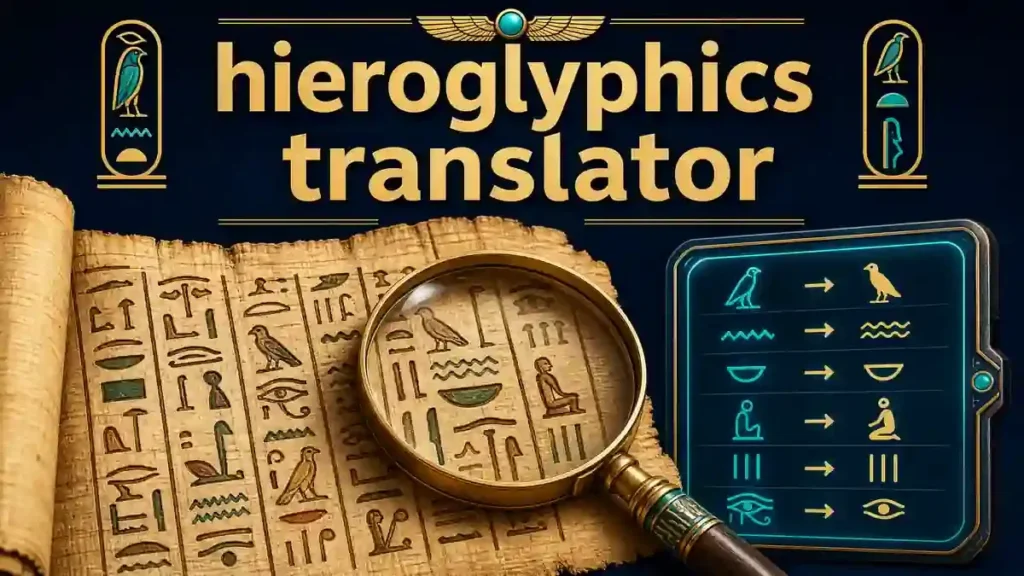
Egyptian hieroglyphs combine pictures, sounds, words, and meaning. A symbol’s appearance can suggest its origin, but its function depends on context.
Animal Symbols
Animals appear often in Egyptian hieroglyphic writing. Their signs could represent sounds, words, or concepts.
For example, the owl sign 𓅓 has the Gardiner reference G17. It represents the sound m.
| Symbol | Name | Meaning | Sound | Gardiner | Function |
| 𓅓 | Owl | Owl image | m | G17 | Phonogram |
| 𓅱 | Quail chick | Bird | w | G43 | Phonogram |
Human Symbols
Human figures could represent actions, roles, or sounds. Their meaning depends on their position and surrounding signs.
A seated person, for example, can serve as a determinative. It can help identify a word connected with a person.
Egyptian Gods and Religious Symbols
Religious imagery played an important role in Egyptian writing and art. Gods could appear as humans, animals, or combinations of both.
For example, falcon imagery connects strongly with Horus. The Metropolitan Museum explains how Egyptian deities used distinctive animal and human forms.
Nature and Object Symbols
Plants, tools, body parts, and everyday objects also appear as hieroglyphic signs. Their images could carry phonetic or semantic functions.
Common Hieroglyphic Characters
The Gardiner system organizes many commonly used signs into recognizable categories. Modern Egyptology still uses this system as an important reference.
Do not assume that an object’s picture always equals its English meaning. A hieroglyph may represent a sound instead.
That distinction helps explain why reliable hieroglyphic translation requires both sign identification and context.
Unicode Egyptian Hieroglyphs
Egyptian hieroglyphs can appear as digital characters through Unicode. This makes it possible to copy, store, search, and display hieroglyphic text on supported systems.
The main Egyptian Hieroglyphs Unicode block covers U+13000–U+1342F. Unicode also includes Egyptian Hieroglyphs Extended-A, which adds more encoded signs.
Unicode also maintains Unikemet, its Egyptian Hieroglyph Database. It provides descriptions, sources, catalog references, functions, and other sign properties. The database supports technical work with digital hieroglyphic text.
Copy and Paste Hieroglyphic Text
You can copy Unicode hieroglyphs from a supported translator or character lookup tool. You can then paste them into compatible websites, documents, and messages.
For example:
𓅓 𓇋 𓂋
However, copying a symbol does not automatically provide its historical meaning. The character only represents the encoded sign. Its interpretation still depends on its function and context.
Why Some Devices May Display Symbols Differently
Hieroglyphic characters need suitable font support. A device may display a symbol correctly on one platform but show a missing-character box elsewhere.
Different fonts can also produce different visual designs. The underlying Unicode character remains the same.
Hieroglyphic Character Lookup
A hieroglyphic character lookup tool can make research easier. Enter or select a Unicode sign to find its character information.
Useful details can include:
- Unicode code point
- Character name
- Gardiner reference
- Description
- Phonetic value
- Function
- Source references
This feature can turn a basic hieroglyphic text converter into a more useful learning and research tool. Unicode’s Unikemet database provides an authoritative foundation for this type of character information.
Rosetta Stone and the Decoding of Hieroglyphics
The Rosetta Stone played a major role in unlocking the ancient Egyptian writing system. It contains the same decree in three scripts: hieroglyphs, Demotic, and Ancient Greek. Scholars could already read Greek, so they could compare the known text with the Egyptian scripts.
The stone dates to 196 BC. Its decree honored the young ruler Ptolemy V. The three versions gave scholars a crucial way to compare words and names.
Thomas Young
English scholar Thomas Young made an important breakthrough. He showed that some hieroglyphs represented the sounds of royal names.
His work included identifying phonetic elements in the name Ptolemy. This helped challenge the idea that hieroglyphs only represented pictures or ideas.
Jean-François Champollion
French scholar Jean-François Champollion built on earlier discoveries. In 1822, he showed that hieroglyphs could record the sounds of the Egyptian language.
He studied royal names, the Rosetta Stone, Demotic writing, and Coptic. His work revealed that Egyptian writing combined phonetic and non-phonetic signs.
This discovery changed how scholars understood Egyptian inscriptions. It also created the foundation for modern Egyptology.
The Rosetta Stone therefore matters to modern hieroglyphics translators. It shows why researchers must examine sounds, words, signs, and context together.
Cartouches and Ancient Egyptian Names
Cartouches are one of the most recognizable features of Egyptian hieroglyphic writing. They connect hieroglyphs with royal names and Egyptian rulers.
What Is a Cartouche?
A cartouche is an oval enclosure that surrounds a royal name. A horizontal line usually appears at one end of the enclosure.
The shape resembles a loop of rope. Ancient Egyptian scribes used it to distinguish important royal names from surrounding text. Unicode also represents cartouche boundaries with paired characters for digital hieroglyphic text.
Why Royal Names Were Written Inside Cartouches
Egyptian kings used several names during their reigns. Two important royal names were the nomen and prenomen.
These names normally appeared inside cartouches. The Unicode Standard specifically identifies these two names as the principal royal names enclosed by cartouches.
Cartouches therefore served more than a decorative purpose. They helped readers recognize royal names within inscriptions.
You can find cartouches in monuments, temples, tombs, and other Egyptian inscriptions. They often appear alongside titles and religious texts.
Can I Put My Name Inside a Cartouche?
Yes, you can create a modern name representation inside a cartouche. Our name generator can help you explore this style.
However, a modern name inside a cartouche does not make it an ancient Egyptian royal name. The result represents your name using an Egyptian-inspired format.
For personal projects, you can use the generated cartouche for artwork, learning, or creative designs. For historical work, always distinguish modern name representations from authentic ancient inscriptions.
Use our name in hieroglyphics tool to generate your name, then place the result inside a cartouche-style design.
Can Hieroglyphics Be Translated Accurately?
Hieroglyphics can be translated accurately when readers have enough evidence and context. However, online tools cannot guarantee perfect results for every inscription.
Accuracy depends on several factors. These include the historical period, language stage, grammar, vocabulary, sign arrangement, and surrounding context. Damaged inscriptions create additional challenges. Different readings can also remain possible.
Egyptian writing changed across long periods of history. Scholars study changes in sign forms and usage when they date inscriptions. The Metropolitan Museum of Art notes that sign forms and determinatives can vary across different periods.
Simple Words and Names
Automation can help with simple words and personal names. It can identify signs and provide common phonetic values.
Names often need transliteration rather than direct translation. The result should represent the name’s sounds clearly.
Still, users should check important names before using them permanently. This matters for tattoos, jewelry, artwork, and published material.
Complete Historical Inscriptions
Long inscriptions require much more analysis. A translator must consider grammar, sign order, context, and historical usage.
Experts may also examine unusual spellings, damaged signs, and changes in writing style. The Metropolitan Museum documents how sign forms can change across periods and contexts.
A specialized Egyptologist may therefore provide a more reliable reading than an automated decoder.
Modern Words That Did Not Exist in Ancient Egypt
Modern concepts can create another problem. Ancient Egyptians did not have direct words for many modern technologies, institutions, and ideas.
A translator may need to approximate the concept instead. It may use an older word with a related meaning or explain the concept through several words.
A trustworthy hieroglyphics translator should state these limits clearly. It should never present uncertain results as proven Ancient Egyptian translations.
Accuracy begins with honesty. Clear limitations help users understand what the tool can provide and when expert analysis makes more sense.
Hieroglyphics Translator vs Hieroglyphics Decoder
A hieroglyphics translator and a hieroglyphics decoder may sound similar. However, they serve different purposes.
Understanding the difference helps you choose the right tool for your task. It also prevents confusion between translation, transliteration, and symbol identification.
| Tool | Main Purpose |
| Hieroglyphics Translator | Converts text or meaning into another language or writing form |
| Transliteration Tool | Represents sounds using another writing system |
| Symbol Converter | Creates a hieroglyphic-style representation of modern text |
| Hieroglyphics Decoder | Helps identify and interpret hieroglyphic signs |
| Character Lookup | Provides information about individual hieroglyphic characters |
A hieroglyphics translator works best when you want to explore text conversion. It may use phonetic values for names or words.
A transliteration tool focuses on pronunciation. It does not necessarily translate the meaning of a word.
A symbol converter creates a visual representation. It may not produce authentic Ancient Egyptian language.
A hieroglyphics decoder starts with existing signs. It can help identify their possible sounds, functions, or meanings.
A character lookup provides detailed information about one sign. This can include its Unicode value, Gardiner reference, description, and phonetic value.
These tools can work together. You might identify a symbol first, check its character information, and then study its role within an inscription.
The right choice depends on your goal. Use a translator for conversion, a decoder for interpretation, and a lookup tool for detailed sign research.
Common Problems When Translating Hieroglyphics
Translating Egyptian hieroglyphics requires more care than matching pictures with English words. Several common mistakes can produce misleading results.
Treating Hieroglyphics as a Simple Alphabet
Hieroglyphs do not work like the modern English alphabet. Signs can represent sounds, words, or semantic information.
A single English letter may also have several possible hieroglyphic representations. Direct A–Z substitution can therefore create inaccurate results.
Ignoring Context
Context helps determine how a sign functions. Readers must consider nearby signs, grammar, word structure, and the subject of the inscription.
A symbol’s picture alone does not always reveal its intended meaning.
Translating Names Instead of Transliteration
Modern names usually need phonetic representation rather than literal translation. Their sounds matter more than their original meanings.
A phonetic rendering can approximate a name without claiming that Ancient Egyptians used the same name.
Using Random Symbols
Choosing symbols because they look attractive can create meaningless text. Each sign should have a documented phonetic or semantic role.
Reliable references can help verify individual signs and their functions.
Assuming Every Symbol Has One Meaning
Egyptian hieroglyphs can perform different functions. Phonograms represent sounds, while logograms can represent words. Determinatives can also clarify meaning without adding pronunciation.
Trusting Every Online Hieroglyphics Translator
Not every online tool uses the same method. Some tools provide decorative symbol substitutions rather than genuine Ancient Egyptian translations.
Check how a translator generates its results before relying on them. Look for clear explanations, reliable references, and honest limitations.
A trustworthy tool should tell you what its output represents. It should never present an approximate conversion as a certain historical translation.
Who Can Use a Hieroglyphics Translator?
A hieroglyphics translator can help anyone curious about Ancient Egyptian writing. You do not need advanced Egyptology knowledge to explore basic signs and sounds.
Students
Students can use the tool to explore Egyptian history and writing. It can make lessons more interactive and easier to understand.
Teachers
Teachers can use hieroglyphic examples in classroom activities. Students can compare modern writing with an ancient writing system.
History Enthusiasts
History enthusiasts can explore names, words, symbols, and famous Egyptian inscriptions. The tool offers a simple way to start learning.
Egyptology Learners
Beginners can study phonetic values, hieroglyphic characters, and common sign functions. More advanced learners can use character references for further research.
Writers and Game Developers
Writers and game developers can explore Egyptian themes for stories, games, and fictional worlds. They should verify historical details before presenting invented text as authentic.
Designers
Designers can create educational graphics, themed artwork, and other visual projects. They should avoid treating decorative symbols as genuine translations.
Travelers and Museum Visitors
Travelers can use a translator before visiting Egyptian museums, temples, and archaeological sites. It can help them recognize common signs and names.
People Exploring Personal Names
You can explore how your name might look in Egyptian hieroglyphs. A phonetic representation can provide a useful starting point.
Creative Projects
Hieroglyphic text can add visual interest to invitations, artwork, educational projects, and themed designs.
Whatever your goal, use the translator as a learning and exploration tool. For important historical inscriptions, consult reliable Egyptological sources or qualified specialists.
Frequently Asked Questions
What is a hieroglyphics translator?
A hieroglyphics translator converts modern text into Egyptian hieroglyphic representations. Some tools also help interpret existing hieroglyphic characters.
Can hieroglyphics be translated into English?
Yes. Scholars can translate many Egyptian inscriptions into English. However, accurate translation requires context, grammar, vocabulary, and historical knowledge.
How do I translate hieroglyphics to English?
Identify the signs, determine their functions, check their reading direction, and examine their context. Complex inscriptions may require expert analysis.
How accurate is an online hieroglyphics translator?
Accuracy depends on the tool and its method. Simple converters may provide phonetic or decorative representations rather than genuine Ancient Egyptian translations.
How do I write my name in hieroglyphics?
Enter your name into a hieroglyphics translator that supports phonetic conversion. The tool can represent your name based on its sounds.
What does my name look like in hieroglyphics?
A translator can create a phonetic hieroglyphic representation of your name. The result does not necessarily translate your name’s original meaning.
Is there an Egyptian hieroglyphic alphabet?
Egyptian hieroglyphs include signs with single, double, and triple consonantal values. They also include signs that represent words and semantic information. Therefore, the system does not match the modern English alphabet.
How do hieroglyphics work?
Hieroglyphs can represent sounds, words, and semantic categories. Scribes combined different sign types to express language and meaning.
How do you read Egyptian hieroglyphics?
First, determine the reading direction and sign arrangement. Then identify the signs and examine their phonetic, lexical, and grammatical functions.
What do Egyptian hieroglyphics mean?
Individual signs can represent sounds, words, objects, or semantic categories. Their exact meaning often depends on their surrounding text.
Conclusion
A hieroglyphics translator makes Ancient Egyptian writing easier to explore. You can use it to examine names, words, symbols, and short text.
However, hieroglyphic writing involves more than replacing English letters with Egyptian symbols. Signs can represent sounds, words, and semantic information. Context can also change how readers interpret an inscription.
Our translator helps you explore these fascinating symbols in a practical way. It can support phonetic representations, symbol conversion, and basic character identification.
For historical inscriptions, accuracy requires greater care. Temple texts, tomb inscriptions, damaged writings, and complex passages may need expert Egyptological analysis.
Use the translator as a starting point for learning and exploration. Check important results against reliable Egyptological sources when accuracy matters.
Whether you want to write your name in hieroglyphics, understand a symbol, or learn how Ancient Egyptian writing worked, the right tools can make the process easier.