
Roman Urdu Sentences for Daily Conversation
Want to speak Urdu naturally in everyday life? Learning Roman Urdu Sentences for Daily Conversation is the fastest way to do it. Instead of memorizing single words, you learn complete sentences that Pakistanis actually use — at home, in the market, at the office, and on the road. Because Roman Urdu is written in familiar English letters, you can read every sentence on this page right away, even if you have never studied the Urdu script.
In this complete guide you will find 100 Roman Urdu Sentences for Daily Conversation with simple English meanings, organized into six everyday situations: greetings and meeting people, morning routine and home life, shopping and the market, office and work, travel and directions, and dining and food. Each table gives you the sentence in Roman Urdu and exactly what it means in English, so you can start speaking from today.
Why Learn Roman Urdu Sentences for Daily Conversation?
Words are building blocks, but sentences are what people really say. When you learn Roman Urdu Sentences for Daily Conversation as ready-made chunks, you can join real conversations immediately instead of translating word by word in your head. A learner who knows the sentence Mujhe bhook lagi hai will always sound more natural than one who only knows the words bhook and laga separately. Here is why learning full sentences works so well:
- They sound natural. Native speakers talk in complete sentences, so you blend in faster.
- They are easy to remember. A sentence tied to a real situation — like ordering food — sticks in memory far better than a lone vocabulary word.
- They build confidence quickly. Just twenty good sentences cover most of your daily small talk.
- They work everywhere. Home, bazaar, office, or travel — the same Roman Urdu Sentences for Daily Conversation appear again and again.
There is one more advantage. Roman Urdu is the language of everyday Pakistan — WhatsApp chats, shop signs, YouTube comments, and family conversations all run on it. Mastering Roman Urdu Sentences for Daily Conversation does not just teach you grammar; it opens the door to how millions of people actually talk every single day.
Greetings and Meeting People

Every conversation starts with a greeting, and in Pakistan the right greeting sets the whole tone. The Roman Urdu Sentences for Daily Conversation in this section cover the classic Assalam-o-Alaikum exchange, polite introductions, and warm farewells. Notice how Pakistanis often ask Sab khairiyat hai? (is everything alright?) — it is more than a question; it is a way of showing you care about the other person.
Use formal greetings like Aap kaise hain? with elders and strangers, and friendly ones like Kaise ho dost? with friends your own age. A farewell such as Phir milenge, inshaAllah leaves every meeting on a hopeful note. Practice these Roman Urdu Sentences for Daily Conversation out loud — greetings are the easiest sentences to master because you use them every day.
| Roman Urdu Sentence | English Meaning |
|---|---|
| Assalam-o-Alaikum! Aap kaise hain? | Hello! How are you? (formal) |
| Wa Alaikum Assalam! Main theek hoon, aap sunaiye. | Hello back! I am fine, tell me about yourself. |
| Aap se mil kar bohat khushi hui. | It was a great pleasure meeting you. |
| Kya haal chaal hain? | How are things going? |
| Sab khairiyat hai? | Is everything alright? |
| Aap ka naam kya hai? | What is your name? |
| Mera naam Ahmed hai. | My name is Ahmed. |
| Aap kahan se hain? | Where are you from? |
| Main Lahore se hoon. | I am from Lahore. |
| Aap kya kaam karte hain? | What do you do for work? |
| Khush Aamdeed! | Welcome! |
| Aap ko dekh kar acha laga. | It was nice to see you. |
| Kaise ho dost? Bohat dinon baad mile! | How are you, friend? We met after so many days! |
| Phir milenge, inshaAllah. | We will meet again, God willing. |
| Allah Hafiz! Apna khayal rakhiye ga. | Goodbye! Take care of yourself. |
Morning Routine and Home Life
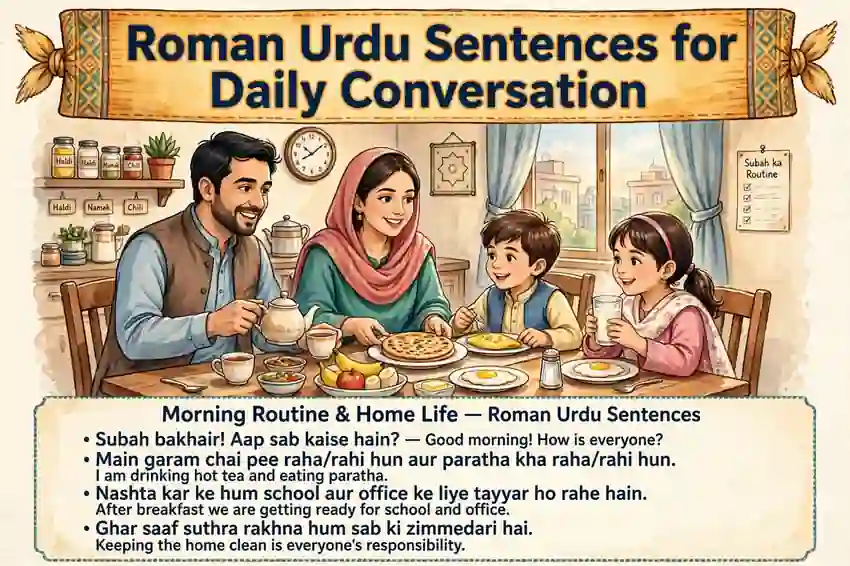
Home is where most daily Urdu is spoken, and mornings are full of small, repeated sentences. The Roman Urdu Sentences for Daily Conversation below cover waking up, breakfast, getting the kids ready, and the little household tasks that fill a Pakistani morning — from Chai thandi ho rahi hai to Mujhe office ke liye der ho rahi hai. These are the sentences mothers, fathers, and children exchange every single day.
Learning home-life sentences first is smart because the situation never changes — you hear the same lines each morning, which makes them easy to remember. Try using one new sentence at home tomorrow, for example Nashta tayyar hai, aa jaiye at breakfast time. Small daily practice with these Roman Urdu Sentences for Daily Conversation builds speaking habits that last.
| Roman Urdu Sentence | English Meaning |
|---|---|
| Subah bakhair! Aap jaldi uth gaye. | Good morning! You woke up early. |
| Nashta tayyar hai, aa jaiye. | Breakfast is ready, come along. |
| Aaj mausam kaisa hai? | How is the weather today? |
| Chai thandi ho rahi hai, jaldi piyen. | The tea is getting cold, drink it quickly. |
| Bachay school ke liye tayyar hain? | Are the kids ready for school? |
| Mera mobile kahan hai? | Where is my mobile phone? |
| Kapray press kar diye hain. | The clothes have been ironed. |
| Ghar ka kaam kab khatam hoga? | When will the housework be finished? |
| Aaj khane mein kya banega? | What will be cooked for dinner today? |
| Bijli chali gayi hai. | The power has gone out. |
| Darwaza band kar dena. | Please close the door. |
| Paani garam kar do. | Heat up the water. |
| Mujhe office ke liye der ho rahi hai. | I am getting late for the office. |
| Tiffin table par rakh diya hai. | I have placed the lunchbox on the table. |
| Sham ko sabzi le aana. | Bring vegetables in the evening. |
| Ghar saaf suthra rakho. | Keep the house clean and tidy. |
| Mehman aa rahe hain, tayyari kar lo. | Guests are coming, get ready. |
| Raat ko jaldi so jana. | Go to sleep early at night. |
Shopping and the Market
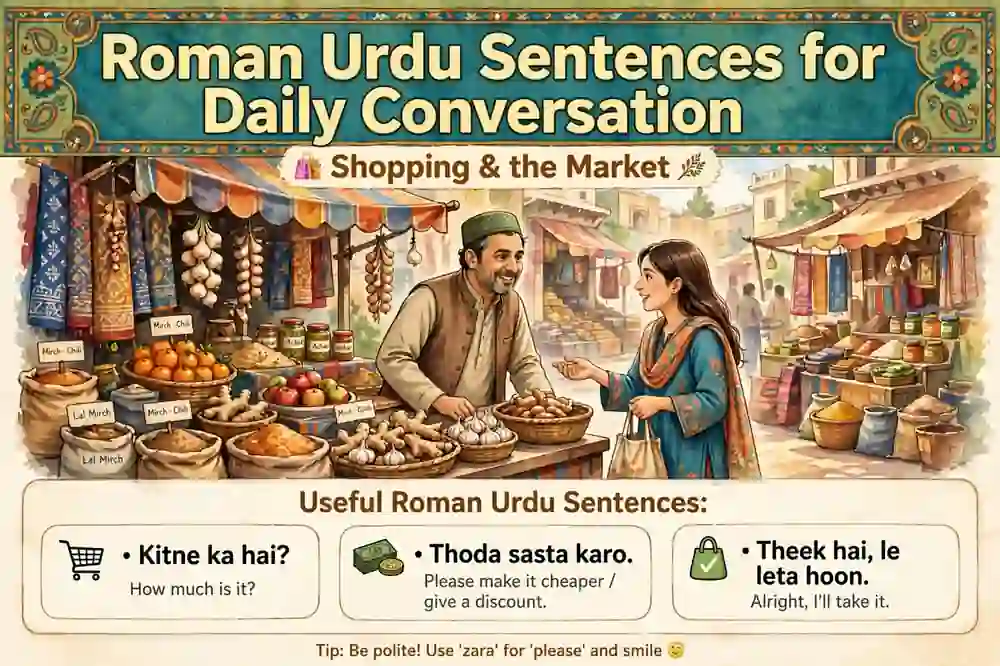
Bargaining in a Pakistani bazaar is almost a sport, and it runs entirely on a handful of repeated sentences. The Roman Urdu Sentences for Daily Conversation in this section teach you to ask prices (Yeh kitne ka hai?), bargain politely (Thora kam karen, bhai), and ask for the final price (Final price kya hogi?). Shopkeepers expect a little negotiation, so these sentences save you real money.
A polite tone matters more than perfect grammar in the market. Smiling and saying Bhai (brother) while bargaining keeps things friendly. Also learn the practical lines — Kya card se payment ho jayegi? and Khulla nahi hai mere paas — because payment talk happens at every single shop. These Roman Urdu Sentences for Daily Conversation turn a stressful market trip into a fun conversation.
| Roman Urdu Sentence | English Meaning |
|---|---|
| Yeh kitne ka hai? | How much is this? |
| Thora kam karen, bhai. | Please reduce the price a little, brother. |
| Kya is mein koi aur rang hai? | Do you have this in another colour? |
| Yeh wala dikhaiye, please. | Please show me this one. |
| Final price kya hogi? | What will be the final price? |
| Mujhe yeh pasand nahi aaya. | I did not like this one. |
| Koi sasta wala dikhao. | Show me a cheaper one. |
| Yeh kapra kharab ho jayega? | Will this fabric get spoiled? |
| Do kilo aalu de den. | Give me two kilos of potatoes. |
| Taaza sabzi hai? | Are the vegetables fresh? |
| Bill bana den. | Please make the bill. |
| Kya card se payment ho jayegi? | Can I pay by card? |
| Khulla nahi hai mere paas. | I do not have change. |
| Yeh cheez wapas ho sakti hai? | Can this item be returned? |
| Dukaan kab band hoti hai? | When does the shop close? |
| Is ka bill alag se bana den. | Make a separate bill for this. |
| Aaj koi discount chal raha hai? | Is there any discount running today? |
Office and Work

Pakistani offices mix Urdu and English freely — meetings, deadlines, and leave requests all happen in this blend. The Roman Urdu Sentences for Daily Conversation below cover the workday essentials: asking about meetings (Meeting kitne baje hai?), requesting leave (Mujhe kal ki chhutti chahiye), and confirming tasks (Yeh kaam mere zimme hai). These sentences keep you polite and professional with colleagues and bosses alike.
Notice the respectful tone used with seniors — Boss ne aap ko bulaya hai and File par sign kar den use the polite aap form. Using aap instead of tum at work is an important sign of respect in Pakistani office culture. Master these Roman Urdu Sentences for Daily Conversation and your workday communication will feel effortless.
| Roman Urdu Sentence | English Meaning |
|---|---|
| Meeting kitne baje hai? | What time is the meeting? |
| Mujhe kal ki chhutti chahiye. | I need leave for tomorrow. |
| Yeh report aaj hi complete karni hai. | This report must be completed today itself. |
| Boss ne aap ko bulaya hai. | The boss has called you. |
| Email bhej di hai, check kar len. | I have sent the email, please check it. |
| Project ki deadline kab hai? | When is the project deadline? |
| Mujhe thori madad chahiye. | I need a little help. |
| Kal se naya schedule lagega. | A new schedule will start from tomorrow. |
| Lunch break kitne baje hota hai? | What time is the lunch break? |
| Salary kab aayegi? | When will the salary come? |
| Yeh kaam mere zimme hai. | This task is my responsibility. |
| File par sign kar den. | Please sign the file. |
| Client se baat ho gayi hai. | I have talked to the client. |
| Overtime karna parega aaj. | We will have to work overtime today. |
| Kaam khatam karke ghar jao. | Finish the work and go home. |
Travel and Directions
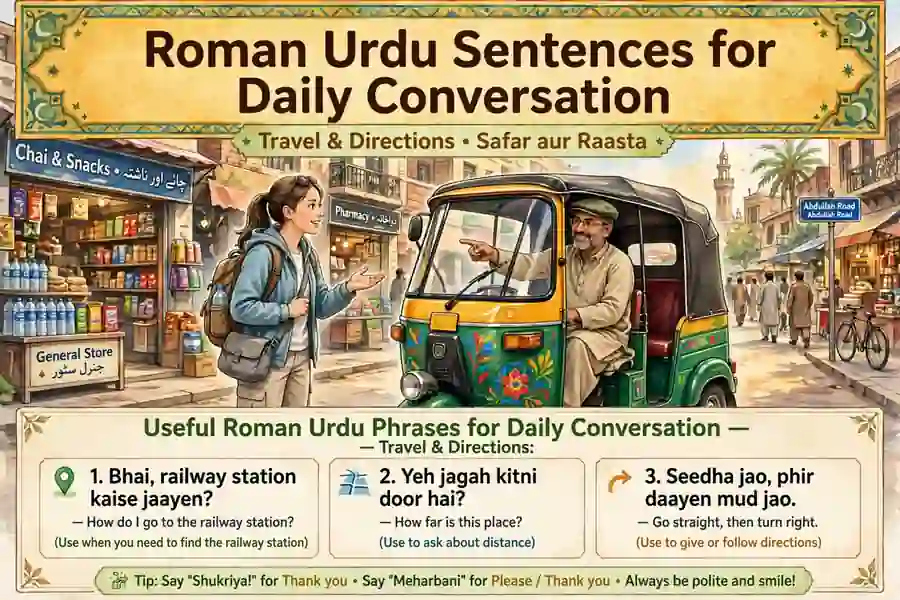
Whether you are catching a bus in Karachi or finding your way through Lahore’s old streets, travel sentences are survival tools. The Roman Urdu Sentences for Daily Conversation here teach you to ask for directions (Station kitni door hai?), negotiate with drivers (Rickshaw wala kitne paise lega?), and handle the classic Pakistani moment — Rasta bhool gaya hoon (I have lost my way). People in Pakistan love helping travellers, so do not hesitate to ask.
Two tips make travel talk easy. First, agree on the fare before sitting in the rickshaw — Kitne paise loge? asked upfront avoids arguments later. Second, keep Map mein location bhej den ready; sharing a live location solves most direction confusion instantly. With these Roman Urdu Sentences for Daily Conversation, you will never feel lost for words on the road.
| Roman Urdu Sentence | English Meaning |
|---|---|
| Station kitni door hai? | How far is the station? |
| Yeh bus kahan jayegi? | Where will this bus go? |
| Mujhe airport jana hai. | I need to go to the airport. |
| Rickshaw wala kitne paise lega? | How much will the rickshaw driver charge? |
| Seedha jaiye, phir left mur jaiye. | Go straight, then turn left. |
| Yeh rasta kahan nikalta hai? | Where does this road lead to? |
| Ticket kahan se milega? | Where can I get the ticket? |
| Train kitne baje aayegi? | What time will the train arrive? |
| Mujhe hotel tak chhor den. | Please drop me at the hotel. |
| Petrol pump nazdeek hai? | Is there a petrol pump nearby? |
| Rasta bhool gaya hoon. | I have lost my way. |
| Map mein location bhej den. | Please send the location on the map. |
| Kitna waqt lagega wahan pohanchne mein? | How long will it take to reach there? |
| Traffic bohat hai aaj. | There is a lot of traffic today. |
| Jaldi karen, flight miss ho jayegi. | Hurry up, we will miss the flight. |
| Samaan sambhal kar rakhen. | Keep the luggage safe. |
| Yeh jagah bohat khoobsurat hai. | This place is very beautiful. |
| Wapsi ka ticket bhi le len. | Take the return ticket as well. |
Dining and Food
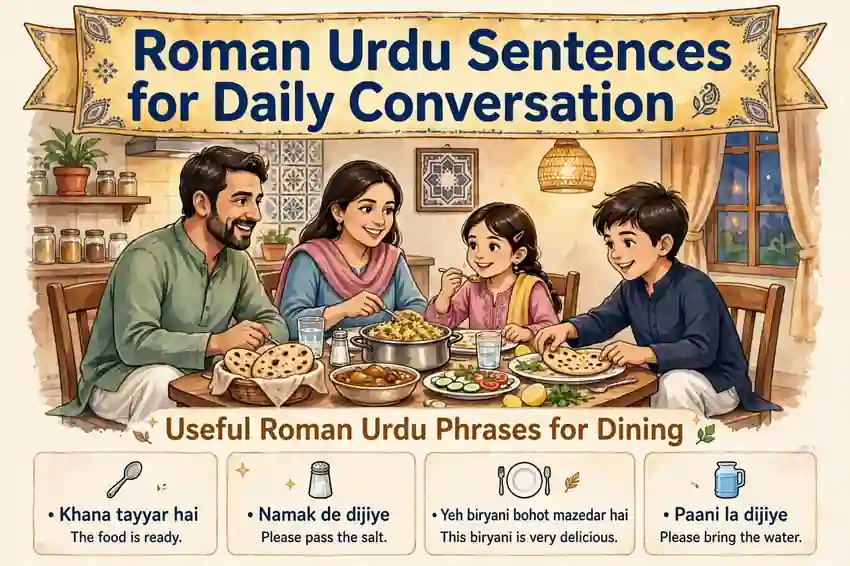
Food is at the heart of Pakistani hospitality, and mealtimes come with their own warm vocabulary. The Roman Urdu Sentences for Daily Conversation in this final section cover everything from saying you are hungry (Mujhe bohat bhook lagi hai) to complimenting the cook (Yeh khana bohat mazedaar hai). At a restaurant, Menu dikhaiye, please and Bill le aaiye, please handle the whole visit.
Pakistani food culture has one golden rule: never refuse food rudely. If you are full, a smile with Shukriya, khana bohat acha tha keeps everyone happy. And remember — Ghar ka khana sab se acha hota hai (home-cooked food is the best) is a compliment that wins every Pakistani heart. These Roman Urdu Sentences for Daily Conversation make every meal a chance to connect.
| Roman Urdu Sentence | English Meaning |
|---|---|
| Mujhe bohat bhook lagi hai. | I am very hungry. |
| Aaj khane mein kya hai? | What is for dinner today? |
| Menu dikhaiye, please. | Please show me the menu. |
| Yeh khana bohat mazedaar hai. | This food is very delicious. |
| Thora namak kam hai. | It has a little less salt. |
| Mirch zyada mat dalna. | Do not add too much chilli. |
| Ek chai aur le aaiye. | Please bring one more tea. |
| Bill le aaiye, please. | Please bring the bill. |
| Khana garam karke den. | Serve the food hot. |
| Meetha kya hai? | What dessert is there? |
| Mujhe yeh dish pasand hai. | I like this dish. |
| Paani ka glass de den. | Please give me a glass of water. |
| Table reserve karna hai. | I want to reserve a table. |
| Ghar ka khana sab se acha hota hai. | Home-cooked food is the best. |
| Dawat mein kya kya tha? | What was served at the feast? |
| Chammach aur kaanta de den. | Please give me a spoon and fork. |
| Shukriya, khana bohat acha tha. | Thank you, the food was very good. |
5 Quick Tips to Use Roman Urdu Sentences for Daily Conversation
Knowing the sentences is only half the job — using them is what builds fluency. Follow these five simple tips and the Roman Urdu Sentences for Daily Conversation above will become a natural part of your speech within weeks:
- Learn five sentences a day. Do not try to memorize all 100 Roman Urdu Sentences for Daily Conversation at once. Five a day means you finish in 20 days — and you will actually remember them.
- Say them out loud. Reading silently is not enough. Speak each of these Roman Urdu Sentences for Daily Conversation three times; your mouth needs the practice as much as your memory.
- Use one situation per week. Week one: only greetings. Week two: only market sentences. Real situations lock sentences into long-term memory.
- Mix in the polite words. Adding please, shukriya, and bhai makes even simple sentences sound warm and respectful.
- Text them to a friend. Send one new sentence daily on WhatsApp to a Pakistani friend and ask them to correct your Roman Urdu Sentences for Daily Conversation — free tutoring!
The secret is consistency, not speed. Ten minutes a day with these Roman Urdu Sentences for Daily Conversation beats a three-hour cram session every time. Pick your five sentences for today and start now.
FAQs About Roman Urdu Sentences for Daily Conversation
How many Roman Urdu sentences should I learn first?
Start with 20 to 30 Roman Urdu Sentences for Daily Conversation from the situations you face most — usually greetings, home life, and food. Once those feel natural, add the market, office, and travel sections. Quality of practice matters more than the number of sentences you collect.
Is Roman Urdu easy for English speakers?
Yes, much easier than the Urdu script. Roman Urdu uses the same alphabet you already read, so you can pronounce every sentence on this page immediately. Most learners can hold basic daily conversations within a few weeks of regular practice.
What is the difference between aap, tum, and tu?
Aap is formal and respectful — use it with elders, strangers, and at work. Tum is friendly and used with friends and people your age. Tu is very informal and can sound rude to strangers, so beginners should stick with aap and tum.
Can I use these sentences on WhatsApp and social media?
Absolutely — that is exactly where Roman Urdu lives. Pakistanis chat, comment, and post in Roman Urdu all day long. Using these sentences in your messages is one of the best ways to practice with native speakers.
How do I pronounce Roman Urdu correctly?
Read it mostly like English, with a few special sounds: kh (as in khana) comes from the throat, gh (as in ghar) is a deep gargling sound, and rh-style r is rolled lightly. Listening to Pakistani dramas or YouTube videos while reading these sentences trains your ear fast.
Where can I learn more Roman Urdu?
After mastering these sentences, explore our 100 Common Roman Urdu Phrases With English Meanings for shorter everyday expressions, and our Common Roman Urdu Words and Their English Meanings to build your vocabulary word by word.
Conclusion
You now have 100 Roman Urdu Sentences for Daily Conversation covering every part of a normal day — from the morning greeting to the dinner table. Do not try to learn them all tonight. Pick five, use them tomorrow in real situations, and add five more the next day. Within a month, you will be handling daily conversations in Roman Urdu with real confidence.
Want to go further with Roman Urdu Sentences for Daily Conversation? Read our 100 Common Roman Urdu Phrases With English Meanings for quick everyday expressions, check Common Roman Urdu Words and Their English Meanings to grow your vocabulary, or try our
Urdu to English translator whenever you need an instant translation. Keep practicing — mehnat ka phal meetha hota hai!