
Urdu Colors With English Meanings
Urdu Colors With English Meanings are part of everyday life. We use them to describe clothes, flowers, fruits, vehicles, and many other things. Learning Urdu colors with English meanings helps you build vocabulary and speak Urdu with greater confidence.
The Urdu word for color is رنگ (rang). The phrase رنگوں کے نام (rangon ke naam) means “names of colors.” These words help you describe the world around you in simple, clear language.
Some common Urdu color names include لال (laal) for red, نیلا (neela) for blue, سبز (sabz) for green, and پیلا (peela) for yellow. You may also hear alternative words in daily conversations. For example, people use سرخ (surkh) for red and ہرا (hara) for green. Usage can vary by context and region.
This guide covers common color names in Urdu with English meanings, Urdu script, and Roman Urdu spellings. You’ll also discover different shades, useful example sentences, and basic grammar rules. These examples will help you understand how Urdu speakers describe colors naturally.
Whether you’re a beginner, a student, or someone teaching children, this guide offers a practical way to learn Urdu color vocabulary. Start with the basic colors, then explore more shades and everyday expressions.
What Is Color Called in Urdu?
The Urdu word for color is رنگ (rang). It refers to the color we see on objects, clothes, flowers, and other things.
The phrase رنگوں کے نام (rangon ke naam) means “names of colors” in English. Urdu speakers use this phrase when they discuss or learn different colors.
Here are a few useful examples:
- لال (laal) — Red
- نیلا (neela) — Blue
- سبز (sabz) — Green
- پیلا (peela) — Yellow
- سفید (safed) — White
- کالا (kaala) — Black
You may notice that some Urdu color words have different forms. For example, نیلا (neela) often describes a masculine noun, while نیلی (neeli) describes a feminine noun. You’ll learn more about this grammar later in the guide.
You may also hear alternative words for certain colors. For example, Urdu speakers use لال (laal) and سرخ (surkh) for red. Both words are common, though their usage can vary by context.
Learning rang and rangon ke naam gives you a useful starting point for describing everyday objects in Urdu. Next, let’s explore common Urdu color names with their English meanings.
Basic Colors in Urdu Colors With English Meanings
Learning basic color names is a great first step for Urdu beginners. These words help you describe everyday objects, clothes, flowers, and food. The table below lists 10 common colors in Urdu, along with their English meanings and Roman Urdu spellings.
| English Color | Urdu Name | Roman Urdu |
| Red | لال | Laal |
| Blue | نیلا | Neela |
| Green | سبز | Sabz |
| Yellow | پیلا | Peela |
| Black | کالا | Kaala |
| White | سفید | Safed |
| Pink | گلابی | Gulabi |
| Purple | جامنی | Jamni |
| Orange | نارنجی | Naranji |
| Brown | بھورا | Bhoora |
How to Use These Urdu Color Names
You can use these words to describe objects around you. For example, لال پھول (laal phool) means “red flower,” and کالی بلی (kaali billi) means “black cat.”
Some Urdu color words change their endings to match the noun’s grammatical gender. For example, نیلا (neela) becomes نیلی (neeli) with many feminine nouns. Similarly, کالا (kaala) becomes کالی (kaali).
Urdu also has alternative names for certain colors. People use سرخ (surkh) for red and ہرا (hara) for green. The best choice depends on the phrase and context.
50+ Color Names in Urdu With Pictures
Colors play an important role in our daily lives. We see them in clothes, flowers, food, nature, and home decorations. Learning color names in Urdu and English helps children, students, and language learners describe the world around them. This guide covers 50+ color names in Urdu with pictures, including Urdu spellings, Roman Urdu, English meanings, and visual swatches for easy identification.
You’ll learn common color names, such as لال (Laal – Red), نیلا (Neela – Blue), سبز (Sabz – Green), پیلا (Peela – Yellow), and کالا (Kala – Black). You’ll also discover less common shades, including فیروزی (Ferozi – Turquoise), جامنی (Jamni – Purple), and گلابی (Gulabi – Pink). Each entry will help you connect the Urdu word with its English meaning and a recognizable color shade.
This collection also makes Urdu vocabulary easier to remember through visual learning. Children can use it for school assignments, while beginners can practice everyday conversations. Parents and teachers can use these color names to introduce new words through simple examples. The guide also covers light, dark, and mixed shades to expand your vocabulary beyond basic colors.
Whether you want to improve your Urdu, teach children, or learn everyday translations, this guide offers a practical starting point. Explore the list to learn color names, understand their meanings, and recognize each shade with confidence.
Light, Dark, and Different Shades in Urdu
Colors come in many shades, from soft pastels to deep, rich tones. Learning these variations helps you describe clothes, paint, flowers, and everyday objects more accurately. In Urdu, you can identify these shades by their common names and match them with familiar English terms. For example, آسمانی (Aasmani) means sky blue, while گہرا نیلا (Gehra Neela) means dark blue.
Similarly, میرون (Maroon) describes a deep reddish-brown shade, and فیروزی (Ferozi) refers to turquoise. Other popular shades include خاکی (Khaki – Beige or Khaki), لیونڈر (Lavender – Lavender), ہلکا گلابی (Halka Gulabi – Light Pink), and گہرا سبز (Gehra Sabz – Dark Green). Some Urdu color names vary by region, context, and everyday usage. This guide explores light, dark, and mixed shades with Urdu spellings, Roman Urdu, English meanings, and visual swatches.
These examples will help you recognize subtle color differences and build a stronger vocabulary. Whether you’re choosing clothing, describing a painting, or learning Urdu, understanding different shades makes color descriptions clearer and more precise.
Urdu Color Words With Different Meanings and Alternatives
Urdu uses several words for the same basic color, but their usage can differ by context, region, and speaking style. Understanding these alternatives helps you choose the right word in everyday conversations, writing, and descriptions. For example, لال (Laal) and سرخ (Surkh) both mean red. People commonly use Laal in everyday speech, while Surkh often appears in formal writing and literary descriptions. Similarly, ہرا (Hara) and سبز (Sabz) both mean green.
Hara often describes the color of leaves or plants, while Sabz frequently appears in phrases about greenery and nature. Another example is پیلا (Peela) and زرد (Zard), which both mean yellow. Peela is common in everyday conversation, while Zard often describes pale yellow tones or appears in literary language. These differences are not strict rules, and speakers may use the words interchangeably.
Learning both alternatives expands your Urdu Colors With English Meanings vocabulary and helps you understand books, conversations, and cultural expressions. It also makes color descriptions more natural and precise. When learning Urdu color names, focus on each word’s meaning, common usage, and context rather than memorizing direct translations alone.
How to Pronounce Colors in Urdu
Learning Urdu color names becomes easier when you combine Urdu script, Roman Urdu, and spoken practice. Start with common words like لال (Laal – Red), نیلا (Neela – Blue), سبز (Sabz – Green), پیلا (Peela – Yellow), and کالا (Kaala – Black). Read each word aloud and repeat it several times to build confidence. Roman Urdu helps beginners understand how each word sounds without learning the Urdu alphabet first.
Pay attention to long vowel sounds, clear consonants, and natural word stress. For example, stretch the long vowel in Neela slightly, but keep the pronunciation smooth. You can also listen to audio examples to hear each word and practice speaking at your own pace. Start with three to five color names daily, then test your memory by matching each word with its color.
For extra practice, name objects around you in Urdu, such as a red apple, a blue shirt, or green leaves. Regular listening and repetition will help you recognize color names in conversations and pronounce them more naturally. Beginners should focus on clear pronunciation rather than speaking quickly. With consistent practice, you can build your Urdu vocabulary and use color names confidently in everyday situations.
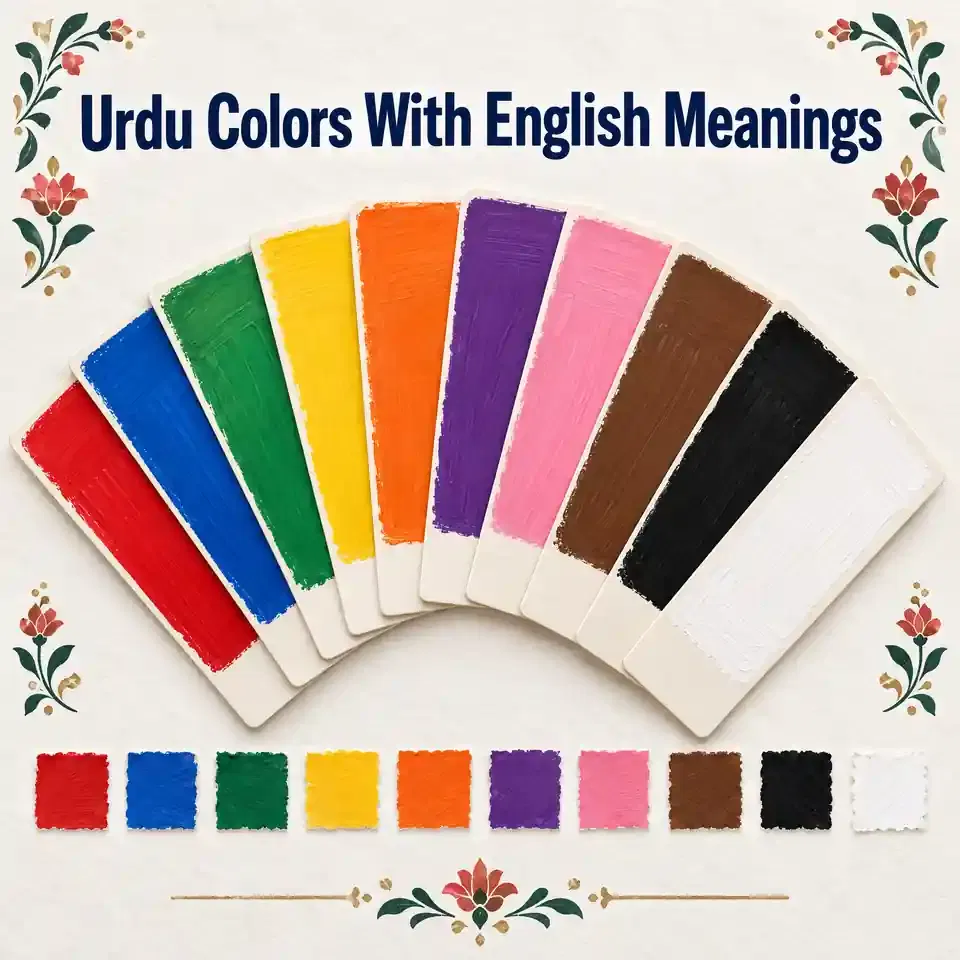
Urdu Color Names in Everyday Sentences
Using Urdu Colors With English Meanings names in everyday sentences helps you remember new Urdu words and speak with confidence. You can practice these words while describing clothes, food, flowers, and objects around you. Each example includes Urdu script, Roman Urdu, and an English translation to make learning easier. For example, یہ پھول لال ہے (Yeh phool laal hai) means “This flower is red.”
Similarly, میری قمیض نیلی ہے (Meri qameez neeli hai) means “My shirt is blue.” You can also describe nature with sentences like درخت سبز ہے (Darakht sabz hai), meaning “The tree is green.” Notice how some Urdu color words change their endings to match the noun they describe. For example, نیلا (neela) often becomes نیلی (neeli) with feminine nouns.
Practice these patterns with simple sentences about your daily life. Say each sentence aloud, then replace the color or object with another word. This method helps you build vocabulary, understand basic Urdu grammar, and form natural sentences. With regular practice, you can use Urdu Colors With English Meanings names in conversations, schoolwork, and everyday descriptions.
Urdu Color Grammar: Masculine and Feminine Forms
Urdu Colors With English Meanings names often change their endings to match the gender and number of the nouns they describe. Understanding this rule helps you form correct sentences and use color words naturally. For example, نیلا (Neela) usually describes a masculine singular noun, while نیلی (Neeli) describes a feminine singular noun.
The form نیلے (Neele) often describes masculine plural nouns or appears in certain grammatical contexts. You can see this pattern in نیلا کپڑا (Neela kapra – Blue cloth) and نیلی قمیض (Neeli qameez – Blue shirt). Similarly, کالا (Kaala) becomes کالی (Kaali) and کالے (Kaale), while پیلا (Peela) becomes پیلی (Peeli) and پیلے (Peele). However, not every color adjective follows this pattern. Words such as سرخ (Surkh), سبز (Sabz), and گلابی (Gulabi) generally keep the same form across masculine and feminine nouns.
For example, سرخ پھول (Surkh phool) means “red flower,” while سرخ قمیض (Surkh qameez) means “red shirt.” The color word remains unchanged in both examples. To learn these patterns, practice pairing color names with common Urdu Colors With English Meanings nouns. Pay attention to each noun’s grammatical gender and whether it is singular or plural. This simple approach will help you describe people, clothes, objects, and nature more accurately in Urdu.
Colors in Pakistani Culture and Everyday Life
Urdu Colors With English Meanings hold a visible place in Pakistani culture, from traditional clothing to truck art, weddings, and national celebrations. Green and white carry special significance on Pakistan’s national flag. Green represents the Muslim majority, while white represents religious minorities. The flag’s white crescent symbolizes progress, and the star represents light and knowledge.
In everyday clothing, bright shades such as لال (Laal – Red), گلابی (Gulabi – Pink), پیلا (Peela – Yellow), and فیروزی (Ferozi – Turquoise) often appear in festive outfits, including shalwar kameez, dupattas, and bridal wear. Red and other rich shades are especially common in traditional bridal clothing, although choices vary by region, family, and personal taste. Pakistani truck art also makes striking use of vivid colors, floral patterns, painted landscapes, and decorative lettering. These designs turn trucks into moving displays of local creativity and craftsmanship.
Regional embroidery, pottery, textiles, and folk art offer more examples of how color shapes Pakistan’s visual identity. However, color meanings can change with context, so no single interpretation applies to every community or occasion. Learning Urdu color names helps you describe these cultural details more clearly and understand how colors appear in daily Pakistani life.
Frequently Asked Questions
What are the most common color names in Urdu?
Common Urdu Colors With English Meanings names include لال (Laal – Red), نیلا (Neela – Blue), سبز (Sabz – Green), پیلا (Peela – Yellow), کالا (Kaala – Black), and سفید (Safed – White). These words help you describe clothing, objects, nature, and everyday surroundings.
How do you say colors in Urdu with English meanings?
You can learn Urdu colors by pairing each Urdu word with its English meaning. For example, گلابی (Gulabi) means pink, نارنجی (Naranji) means orange, and جامنی (Jamni) means purple. Learning Urdu script alongside Roman Urdu helps you recognize and remember each word.
How can I pronounce Urdu color names correctly?
Start with simple words such as Laal, Neela, Sabz, and Peela. Read each word aloud and listen to a fluent Urdu speaker when possible. Practice daily with objects around you, such as a red apple or a blue shirt. Repeated practice helps improve pronunciation and recall.
What is the difference between light and dark colors in Urdu?
Urdu speakers often add words that describe a shade’s intensity. ہلکا (Halka) means light, while گہرا (Gehra) means dark or deep. For example, ہلکا نیلا (Halka Neela) means light blue, and گہرا سبز (Gehra Sabz) means dark green.
Do Urdu color names change with masculine and feminine nouns?
Some Urdu color adjectives change according to the noun’s gender and number. For example, نیلا (Neela) describes a masculine noun, while نیلی (Neeli) describes a feminine noun. You can say نیلا کپڑا (Neela Kapra – Blue cloth) and نیلی قمیض (Neeli Qameez – Blue shirt). Other color words, such as سبز (Sabz) and سرخ (Surkh), usually keep the same form.
Are Laal and Surkh both Urdu words for red?
Yes. لال (Laal) and سرخ (Surkh) both mean red. Laal is common in everyday conversation, while Surkh often appears in formal writing and literary expressions. The best choice depends on the sentence and context.
What is the easiest way to memorize Urdu colors?
Learn five colors at a time and connect each word to a familiar object. Write the Urdu spelling, Roman Urdu pronunciation, and English meaning together. Use flashcards, label household items, and make short sentences. Review older words regularly before adding new ones.
Can I learn Urdu colors without knowing the Urdu alphabet?
Yes. Roman Urdu Colors With English Meanings lets beginners start learning color names without reading Urdu script. However, learning the Urdu alphabet helps you read signs, books, labels, and written conversations. For the best results, practice Urdu script and Roman Urdu together.
Conclusion
Learning Urdu Colors With English Meanings names in Urdu helps you build vocabulary and communicate more confidently in everyday situations. From basic colors like لال (Laal – Red), نیلا (Neela – Blue), and سبز (Sabz – Green) to shades like فیروزی (Ferozi – Turquoise), each word adds detail to your conversations. Understanding pronunciation, masculine and feminine forms, and common alternatives also helps you use color words correctly.
These words appear in clothing, art, schoolwork, and Pakistani cultural traditions. Keep practicing with everyday objects, simple Urdu sentences, and color pictures to remember each name. With regular practice, you can recognize, pronounce, and use Urdu color names with greater ease.