
Urdu Greetings With English Meanings: The Complete Guide (2026)
Urdu Greetings With English Meanings is one of the most poetic and expressive languages in the world, and the way it greets people reflects that beauty. Whether you are learning Urdu for the first time, planning a trip to Pakistan or India, reconnecting with your heritage, or simply curious about how Urdu speakers say “hello,” this guide gives you accurate, native-level Urdu Greetings With English Meanings.
Unlike generic word lists, this guide explains when to use each greeting, who to use it with, and why it matters culturally — because in Urdu Greetings With English Meanings are never just words. They carry respect, religion, warmth, and social hierarchy all at once.
Why Urdu Greetings Are More Than Just “Hello”
In English, “hello” works in almost every situation. In Urdu Greetings With English Meanings shift depending on:
- Formality — talking to an elder vs. a friend
- Religion — Islamic greetings carry spiritual meaning
- Time of day — morning, evening, and night greetings differ
- Relationship — family, strangers, colleagues, and guests are greeted differently
Common Urdu Greetings With English Meanings
Below is a complete reference table of everyday Urdu Greetings With English Meanings.
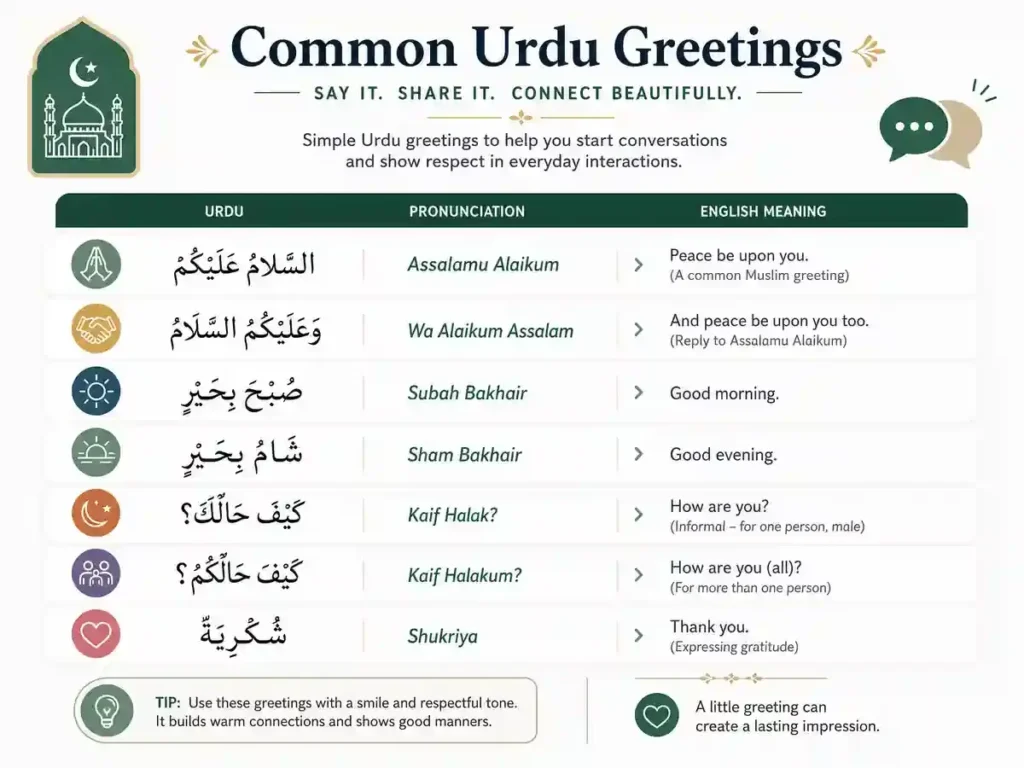
| Urdu (Script) | Roman Urdu (Transliteration) | English Meaning | Used For |
|---|---|---|---|
| السلام علیکم | Assalamu Alaikum | Peace be upon you | Formal / religious greeting |
| وعلیکم السلام | Walaikum Assalam | And peace be upon you too | Reply to Assalamu Alaikum |
| آداب | Adaab | Greetings / My respects | Formal, secular greeting |
| سلام | Salaam | Peace / Hi | Casual, everyday greeting |
| خوش آمدید | Khush Aamdeed | Welcome | Welcoming a guest |
| تشریف رکھیے | Tashreef Rakhiye | Please have a seat | Formal hospitality |
| آپ کیسے ہیں؟ | Aap Kaise Hain? | How are you? (formal) | Respectful, elders/strangers |
| تم کیسے ہو؟ | Tum Kaise Ho? | How are you? (informal) | Friends, peers |
| کیا حال ہے؟ | Kya Haal Hai? | What’s up? / How’s it going? | Casual, informal |
| میں ٹھیک ہوں، شکریہ | Main Theek Hoon, Shukriya | I’m fine, thank you | Response to “how are you” |
| صبح بخیر | Subah Bakhair | Good morning | Morning greeting |
| شب بخیر | Shab Bakhair | Good night | Night farewell |
| خدا حافظ | Khuda Hafiz | God be with you (goodbye) | General farewell |
| اللہ حافظ | Allah Hafiz | May Allah protect you (goodbye) | Islamic-style farewell |
| پھر ملیں گے | Phir Milenge | See you again | Casual farewell |
| مبارک ہو | Mubarak Ho | Congratulations | Celebrations, good news |
| شکریہ | Shukriya | Thank you | Expressing gratitude |
| مہربانی | Meherbani | Kindness / Thank you for your kindness | Polite gratitude |
| معاف کیجیے | Maaf Kijiye | Excuse me / I’m sorry | Apology or getting attention |
Islamic Greetings in Urdu (With Deeper Meaning)
Because Urdu Greetings With English Meanings is spoken predominantly by Muslim communities in Pakistan and parts of India, many everyday greetings are rooted in Islamic tradition.
Assalamu Alaikum (السلام علیکم)
English meaning: “Peace be upon you.” This is the most widely used greeting among Muslims and Urdu speakers. It is appropriate in almost any setting — formal, informal, religious, or professional.
Walaikum Assalam (وعلیکم السلام)
English meaning: “And peace be upon you too.” This is the required response when someone greets you with Assalamu Alaikum. Not replying is considered impolite.
The Extended Version
Some speakers use the fuller, more formal version: Assalamu Alaikum wa Rahmatullahi wa Barakatuh — “Peace, mercy, and blessings of Allah be upon you.” This is common in religious gatherings, mosques, and formal Islamic correspondence.
Formal vs. Informal Urdu Greetings
One of the biggest mistakes learners make is using informal greetings with elders or strangers. Urdu, like many South Asian languages, has built-in respect levels.
Use formal greetings (“Aap”) with:
- Elders and grandparents
- Teachers and bosses
- Strangers
- In-laws
Use informal greetings (“Tum”) with:
- Close friends
- Siblings and cousins
- Children
- People younger than you
Example:
- Formal: Aap kaise hain? — “How are you?” (respectful)
- Informal: Tum kaise ho? — “How are you?” (casual)
Time-Based Urdu Greetings
| Time of Day | Urdu Greeting | English Meaning |
|---|---|---|
| Morning | Subah Bakhair | Good morning |
| Afternoon | Dopeher Bakhair | Good afternoon |
| Evening | Shaam Bakhair | Good evening |
| Night | Shab Bakhair | Good night |
How to Respond to Urdu Greetings
Knowing how to reply is just as important as knowing the greeting itself.
| Greeting | Correct Response | English Meaning |
|---|---|---|
| Assalamu Alaikum | Walaikum Assalam | And peace be upon you too |
| Aap kaise hain? | Main theek hoon, shukriya. Aap sunaiye? | I’m fine, thank you. How about you? |
| Kya haal hai? | Sab theek | All good |
| Khuda Hafiz | Khuda Hafiz | Goodbye (same phrase both ways) |
Common Mistakes Beginners Make
- Using “Khuda Hafiz” and “Allah Hafiz” interchangeably without knowing the difference — both mean goodbye, but “Allah Hafiz” leans more religious and is preferred by some Islamic scholars over the Persian-influenced “Khuda Hafiz.”
- Skipping the reply to Assalamu Alaikum — this is considered rude; always respond with Walaikum Assalam.
- Using “tum” with elders — this can sound disrespectful even if unintentional.
- Mispronouncing “Adaab” as a religious greeting — it is actually a secular, cultural greeting historically used across faiths in South Asia, especially in formal or literary settings.
FAQs Urdu Greetings With English Meanings
What does “Assalamu Alaikum” mean in English?
Assalamu Alaikum means “Peace be upon you” in English. It is the most common Islamic and Urdu greeting, appropriate in formal and informal settings alike.
What is the reply to Assalamu Alaikum?
The correct reply is Walaikum Assalam, meaning “And peace be upon you too.”
How do you say “hello” in Urdu?
The closest equivalent to a casual “hello” is “Salaam”, while “Assalamu Alaikum” is used for a more complete, respectful greeting.
What is the difference between “Khuda Hafiz” and “Allah Hafiz”?
Both mean “goodbye” or literally “may God protect you.” Khuda Hafiz comes from Persian influence and is more traditional, while Allah Hafiz is the Arabic-based version preferred by some for its direct Islamic terminology. Both are widely understood and accepted.
How do you say “good morning” in Urdu?
“Good morning” in Urdu is “Subah Bakhair,” which literally translates to “morning with goodness.”
Is “Adaab” a religious greeting?
No. Adaab is a secular, respectful greeting meaning “greetings” or “my respects.” It is commonly used in formal, literary, and cultural settings, historically by people of different faiths across South Asia.
How do you say “thank you” in Urdu?
“Thank you” in Urdu is “Shukriya.” A more heartfelt version is “Meherbani,” meaning “thank you for your kindness.”
Final Thoughts Urdu Greetings With English Meanings
Urdu Greetings With English Meanings are a beautiful blend of respect, faith, and culture. Learning them properly — not just the words, but the context — helps you communicate with genuine warmth and respect, whether you’re speaking to elders, friends, or new acquaintances.
If you want to go beyond greetings and translate full sentences, phrases, or documents between Urdu and English accurately, explore more guides and tools on UrduToEnglishTranslate.com.