
Urdu Sentence Structure Compared With English
Learning Urdu Sentence Structure Compared With English becomes much easier when you understand its sentence structure. Words alone cannot create natural conversations. You must know where each word belongs. That is why sentence structure forms the foundation of Urdu grammar.
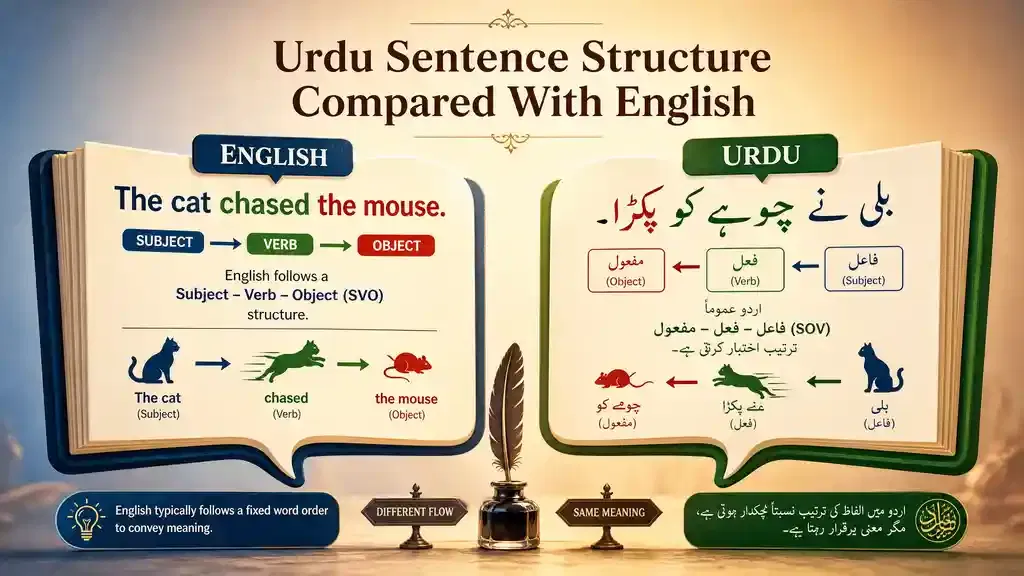
English speakers often find Urdu confusing at first. English usually follows a Subject-Verb-Object (SVO) order. Urdu follows a Subject-Object-Verb (SOV) order. This simple difference changes how every sentence works. Many learners also struggle with verb placement, postpositions, gender agreement, and honorific expressions.
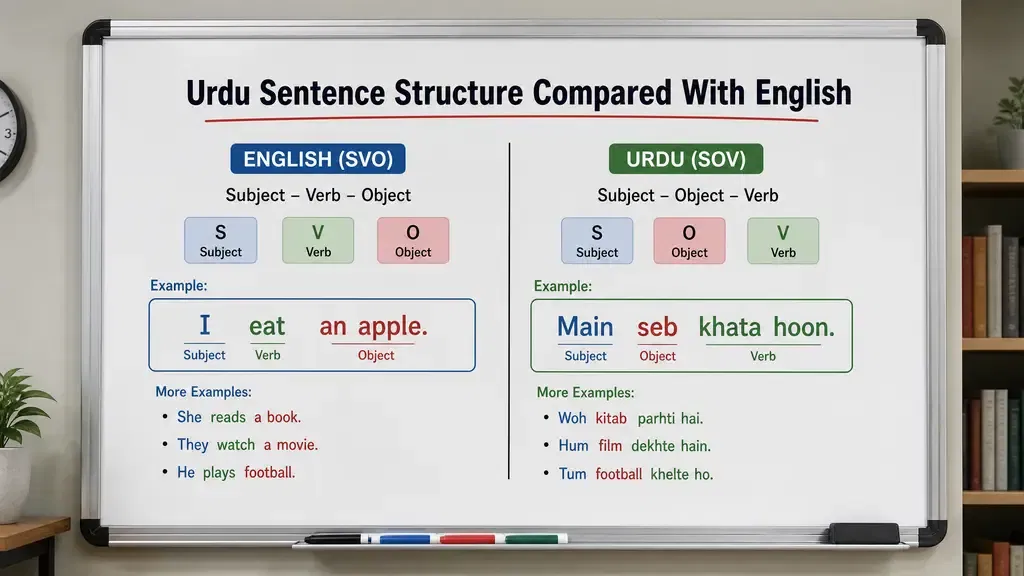
For example, English says, “I eat an apple.” Urdu says, “Main seb khata hoon.” The verb comes at the end. Direct word-for-word translation sounds unnatural. Learning the correct pattern helps you speak and write with confidence.
This guide explains every major difference between Urdu Sentence Structure Compared With English structure. You will learn word order, sentence formation, grammar rules, and common learner mistakes. Each topic includes clear explanations and practical examples. You will also discover tips that make sentence building easier.
The explanations reflect well-established principles from modern linguistics and Urdu Sentence Structure Compared With English grammar. Resources from organizations such as the Center for Language Engineering (CLE), University of Engineering and Technology Lahore, and linguistic references on Indo-Aryan languages support these concepts.
By the end of this guide, you will understand how Urdu Sentence Structure Compared With Englishwork naturally. You will build correct sentences, avoid common grammar mistakes, and translate ideas between English and Urdu with greater accuracy.
.
What Is Urdu Sentence Structure Compared With English?
Urdu Sentence Structure Compared With English the order of words in a sentence. It follows a clear pattern that helps readers and listeners understand the meaning. Once you learn this pattern, building Urdu sentences becomes much easier.
Understanding Urdu Word Order
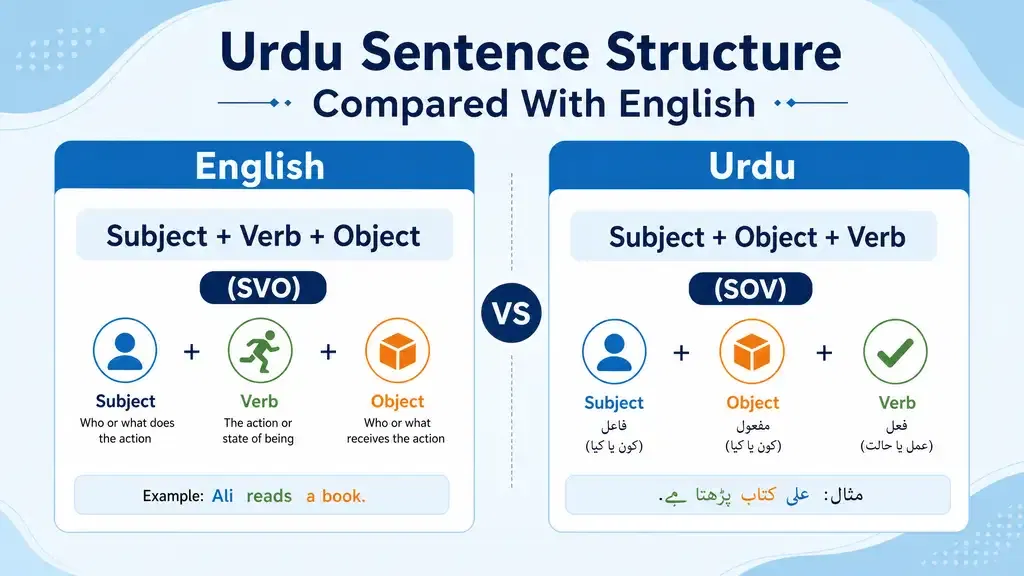
Urdu Sentence Structure Compared With English uses a Subject-Object-Verb (SOV) word order. The subject comes first. The object comes next. The verb always appears at the end. This order differs from English, which follows a Subject-Verb-Object (SVO) pattern.
Let’s break down each part.
- Subject (فاعل): The person or thing performing the action.
- Object (مفعول): The person or thing receiving the action.
- Verb (فعل): The action or state of the subject.
Together, they create the basic Urdu sentence pattern:
Subject + Object + Verb (SOV)
Examples of the SOV Pattern
| English (SVO) | Roman Urdu (SOV) | Urdu |
| I read a book. | Main kitab parhta hoon. | میں کتاب پڑھتا ہوں۔ |
| She drinks tea. | Woh chai peeti hai. | وہ چائے پیتی ہے۔ |
| They play cricket. | Woh cricket khelte hain. | وہ کرکٹ کھیلتے ہیں۔ |
| We watch television. | Hum television dekhte hain. | ہم ٹیلی ویژن دیکھتے ہیں۔ |
Notice that every Urdu Sentence Structure Compared With English places the verb at the end. This rule stays the same in most everyday conversations. As you learn more grammar, you will see that tenses and helping verbs also appear near the end of the sentence.
Linguists classify Urdu as an SOV language, just like Hindi, Japanese, and Turkish. This structure reflects the grammar of the Indo-Aryan language family. Understanding this pattern helps English speakers think in Urdu instead of translating word by word. That habit leads to more natural speaking and writing.
Urdu vs English Sentence Structure
Now that you know the basic Urdu Sentence Structure Compared With English pattern, let’s compare it with English. This comparison helps you see where both languages differ and why direct translation often creates awkward sentences.
Subject Placement
Both Urdu Sentence Structure Compared With English usually place the subject at the beginning of a sentence. This similarity helps English speakers identify who performs the action. However, Urdu often drops the subject when the context already makes it clear.
Urdu Examples
- Main bazaar ja raha hoon.
میں بازار جا رہا ہوں۔ - Ayesha kitab parh rahi hai.
عائشہ کتاب پڑھ رہی ہے۔
English Examples
- I am going to the market.
- Ayesha is reading a book.
| Feature | Urdu | English |
| Subject Position | Usually first | Usually first |
| Subject Omission | Common in conversation | Rare |
| Subject Agreement | Matches gender and number | Matches person and number |
Verb Placement
The biggest difference appears in the verb position. English places the main verb after the subject. Urdu places the complete verb phrase near the end of the sentence. This rule applies in simple, continuous, perfect, and future tenses.
Urdu Sentence Structure Compared With English also uses auxiliary verbs like ہے (hai), تھا (tha), and ہوں (hoon) after the main verb. Compound verbs combine two verbs to add meaning, such as دیکھ لینا (dekh lena) or کھا لینا (kha lena). Light verbs like دینا (dena), لینا (lena), and جانا (jana) change the nuance without replacing the main action.
English: She has finished her work.
Roman Urdu: Us ne apna kaam mukammal kar liya hai.
Urdu: اس نے اپنا کام مکمل کر لیا ہے۔
Here, the main action and helping verb appear together at the end.
Object Placement
Urdu Sentence Structure Compared With English places the object before the verb. English places it after the verb. This difference affects both direct and indirect objects.
Direct Object
English: I bought a laptop.
Roman Urdu: Main ne laptop khareeda.
Urdu: میں نے لیپ ٹاپ خریدا۔
Indirect Object
English: He gave his friend a gift.
Roman Urdu: Us ne apne dost ko tohfa diya.
Urdu: اس نے اپنے دوست کو تحفہ دیا۔
Urdu uses postpositions such as کو (ko) to show the indirect object instead of relying only on word order.
Complete Sentence Comparison
| English | Roman Urdu | Urdu Script | Literal Translation | Natural Translation | Grammar Explanation |
| I drink water. | Main pani peeta hoon. | میں پانی پیتا ہوں۔ | I water drink. | I drink water. | Urdu follows Subject-Object-Verb order. |
| She is writing a letter. | Woh khat likh rahi hai. | وہ خط لکھ رہی ہے۔ | She letter writing is. | She is writing a letter. | The complete verb phrase stays at the end. |
| We watched the movie. | Hum ne film dekhi. | ہم نے فلم دیکھی۔ | We movie watched. | We watched the movie. | The object comes before the verb. |
| They will help us. | Woh hamari madad karenge. | وہ ہماری مدد کریں گے۔ | They our help will do. | They will help us. | Future tense verbs remain at the end. |
Understanding these patterns helps you stop translating word by word. Instead, you begin thinking in Urdu Sentence Structure Compared With English. That habit leads to smoother conversations, clearer writing, and more accurate translations.
Understanding SOV vs SVO
One of the biggest differences between Urdu Sentence Structure Compared With English is word order. Linguists describe this order using two abbreviations: SOV and SVO. Understanding these patterns helps you build natural sentences instead of translating every word directly.
What Is SOV?
SOV stands for Subject-Object-Verb. The subject performs the action, the object receives it, and the verb completes the sentence. Urdu Sentence Structure Compared With English follows this pattern in most statements.
Examples
| English | Roman Urdu | Urdu Script |
| I eat rice. | Main chawal khata hoon. | میں چاول کھاتا ہوں۔ |
| She opened the door. | Us ne darwaza khola. | اس نے دروازہ کھولا۔ |
| We study Urdu. | Hum Urdu parhte hain. | ہم اردو پڑھتے ہیں۔ |
In every example, the verb appears last. This order stays consistent across everyday Urdu.
Common Mistakes
Many English speakers keep the English word order while speaking Urdu Sentence Structure Compared With English. This mistake makes sentences sound unnatural.
Main khata hoon chawal.
Main chawal khata hoon.
Another common mistake involves helping verbs.
Woh hai kitab parh rahi.
Woh kitab parh rahi hai.
Always place the complete verb phrase at the end of the sentence.
Why Urdu Uses SOV
Urdu Sentence Structure Compared With English did not adopt the SOV pattern by chance. It developed over centuries through the evolution of the Indo-Aryan language family. Early languages such as Sanskrit and Prakrit also followed Subject-Object-Verb order. Urdu inherited this structure and continues to use it today.
Persian later shaped Urdu Sentence Structure Compared With English vocabulary, literary style, and expression. However, it did not replace the underlying sentence pattern. Instead, Persian strengthened several grammatical features, including compound verbs and formal expressions, while the SOV structure remained stable.
Modern linguistic research classifies Urdu as a head-final language. In head-final languages, important elements such as verbs usually appear near the end of a sentence. This structure also appears in languages like Hindi, Japanese, Korean, and Turkish.
The Center for Language Engineering (CLE), UET Lahore, and standard linguistic studies on Indo-Aryan languages describe SOV as the core sentence pattern of modern Urdu Sentence Structure Compared With English. Once you think in this order, speaking and translating Urdu becomes much easier and more natural.
Sentence Components Compared
Understanding each Urdu Sentence Structure Compared With English component helps you build correct Urdu sentences. While Urdu and English share many grammar elements, they often use them differently. Learning these differences improves both speaking and translation.
Subject
The subject performs the action. Both Urdu Sentence Structure Compared With English usually place it at the beginning.
Examples
- English: Ahmed studies every day.
- Roman Urdu: Ahmed har roz parhta hai.
- Urdu: احمد ہر روز پڑھتا ہے۔
In spoken Urdu Sentence Structure Compared With English, speakers sometimes omit the subject because the verb already provides enough context.
Verb
Verbs carry the action and show tense.
- Main verb: The primary action.
Parhna (to read), likhna (to write) - Helping verb: Supports the main verb.
hai, tha, hoon, hain - Compound verb: Combines two verbs to express a complete idea.
Parh liya, dekh liya, likh diya - Light verb: Adds meaning without changing the main action.
Common light verbs include dena, lena, jana, and parna.
Object
The object receives the action.
- Direct object: Receives the action directly.
English: She bought a dress.
Roman Urdu: Us ne libas khareeda. - Indirect object: Receives the direct object.
English: He gave his sister a gift.
Roman Urdu: Us ne apni behan ko tohfa diya.
Adjectives
Adjectives describe nouns. They usually appear before the noun in both languages.
Examples
- English: A beautiful garden
- Roman Urdu: Khoobsurat bagh
- Urdu: خوبصورت باغ
Some Urdu adjectives change to match the gender and number of the noun.
Adverbs
Adverbs describe verbs, adjectives, or other adverbs. They often appear before the verb in Urdu.
Examples
- English: He speaks slowly.
- Roman Urdu: Woh ahista bolta hai.
- Urdu: وہ آہستہ بولتا ہے۔
Pronouns
Pronouns replace nouns in both languages. Urdu also uses different pronouns to show respect.
| English | Urdu Use |
| You (formal) | آپ |
| You (informal) | تم |
| You (very informal) | تو |
Choosing the correct pronoun shows politeness and social awareness.
Nouns
Urdu Sentence Structure Compared With English nouns have gender and number. These features affect adjectives and verbs.
Examples
- Larka achha hai. (Boy)
- Larki achhi hai. (Girl)
The adjective changes because the noun’s gender changes.
Postpositions vs Prepositions
This is one of the biggest grammar differences between Urdu and English.
English uses prepositions before the noun.
- The book is on the table.
Urdu uses postpositions after the noun.
- Kitab mez par hai.
- کتاب میز پر ہے۔
Common Urdu Sentence Structure Compared With English postpositions include ko, se, mein, par, and tak. They express relationships such as direction, location, possession, and movement. Learning them helps you create natural Urdu sentences without relying on English grammar patterns.
Urdu Grammar Rules That English Speakers Must Know
Learning vocabulary is only the first step. You also need grammar rules that connect words correctly. Urdu Sentence Structure Compared With English grammar depends on agreement between nouns, verbs, and pronouns. Mastering these rules makes your sentences sound natural.
Gender Agreement
Every Urdu noun has a grammatical gender. Verbs and many adjectives change to match it.
| English | Roman Urdu | Urdu |
| The boy is tall. | Larka lamba hai. | لڑکا لمبا ہے۔ |
| The girl is tall. | Larki lambi hai. | لڑکی لمبی ہے۔ |
Common mistakes
Larki lamba hai.
Larki lambi hai.
Many English speakers forget to change the adjective and verb according to gender.
Number Agreement
Singular and plural nouns require different verb forms.
| Singular | Plural |
| Bacha khel raha hai. | Bachay khel rahe hain. |
| بچہ کھیل رہا ہے۔ | بچے کھیل رہے ہیں۔ |
Always match the verb with the subject’s number.
Verb Agreement
Urdu Sentence Structure Compared With English verbs agree with the subject in person, gender, and number. This agreement changes across different tenses.
| English | Roman Urdu | Urdu |
| I write. | Main likhta hoon. | میں لکھتا ہوں۔ |
| She writes. | Woh likhti hai. | وہ لکھتی ہے۔ |
| They write. | Woh likhte hain. | وہ لکھتے ہیں۔ |
Pay attention to verb endings because they carry important grammatical information.
Honorific System
Urdu uses different pronouns to express respect. Choosing the right form is part of speaking politely.
| Pronoun | Usage | Example |
| آپ | Formal and respectful | Aap kaise hain? |
| تم | Informal | Tum kahan ja rahe ho? |
| تو | Very informal | Tu kya kar raha hai? |
Use آپ with elders, teachers, strangers, and professional contacts. Use تم with friends or people your own age. Use تو only with close relationships where it feels natural.
Tense Agreement
Urdu Sentence Structure Compared With English places the complete verb phrase at the end, but the verb changes to show time.
| Tense | English | Roman Urdu | Urdu |
| Present | I eat mangoes. | Main aam khata hoon. | میں آم کھاتا ہوں۔ |
| Past | I ate mangoes. | Main ne aam khaya. | میں نے آم کھایا۔ |
| Future | I will eat mangoes. | Main aam khaunga. | میں آم کھاؤں گا۔ |
Notice how each tense changes the verb while keeping the same sentence order. Once you understand gender, number, honorifics, and tense agreement together, you can build accurate Urdu sentences with confidence.
Sentence Types Compared
Urdu Sentence Structure Compared With English use the same basic sentence types. However, they form them in different ways. Understanding these patterns helps you speak naturally and avoid direct translation mistakes.
Simple Sentences
A simple sentence contains one independent idea.
| English | Roman Urdu | Urdu |
| I read books. | Main kitaben parhta hoon. | میں کتابیں پڑھتا ہوں۔ |
| She cooks dinner. | Woh khana pakati hai. | وہ کھانا پکاتی ہے۔ |
Urdu keeps the verb at the end.
Negative Sentences
Urdu Sentence Structure Compared With English usually forms negative sentences by adding نہیں (nahin) before the main verb or verb phrase.
| English | Roman Urdu | Urdu |
| I do not understand. | Main nahin samajhta hoon. | میں نہیں سمجھتا ہوں۔ |
| They are not ready. | Woh tayyar nahin hain. | وہ تیار نہیں ہیں۔ |
Unlike English, Urdu does not use helping verbs such as do or does for negation.
Questions
Yes/No Questions
Urdu often begins with کیا (Kya) to form a yes/no question.
| English | Roman Urdu | Urdu |
| Are you tired? | Kya aap thak gaye hain? | کیا آپ تھک گئے ہیں؟ |
| Is he at home? | Kya woh ghar par hai? | کیا وہ گھر پر ہے؟ |
WH Questions
Question words usually appear near the beginning of the sentence.
| English | Roman Urdu | Urdu |
| Where do you live? | Aap kahan rehte hain? | آپ کہاں رہتے ہیں؟ |
| Why are you late? | Aap dair se kyun aaye? | آپ دیر سے کیوں آئے؟ |
Commands
Commands give instructions or directions.
| English | Roman Urdu | Urdu |
| Close the door. | Darwaza band karo. | دروازہ بند کرو۔ |
| Please sit down. | Baith jaiye. | بیٹھ جائیے۔ |
Urdu changes the verb according to the level of politeness.
Requests
Requests sound softer than commands. Speakers often use polite expressions.
| English | Roman Urdu | Urdu |
| Please help me. | Bara-e-meherbani meri madad kijiye. | براہِ مہربانی میری مدد کیجیے۔ |
| Could you repeat that? | Kya aap dobara keh sakte hain? | کیا آپ دوبارہ کہہ سکتے ہیں؟ |
Compound Sentences
A compound sentence joins two independent clauses with a conjunction.
| English | Roman Urdu | Urdu |
| I studied, and I passed. | Main ne parhai ki aur main kamyab hua. | میں نے پڑھائی کی اور میں کامیاب ہوا۔ |
Common Urdu conjunctions include اور (aur), لیکن (lekin), and یا (ya).
Complex Sentences
A complex Urdu Sentence Structure Compared With English contains one main clause and one dependent clause.
| English | Roman Urdu | Urdu |
| I stayed home because it rained. | Main ghar raha kyun ke barish hui. | میں گھر رہا کیونکہ بارش ہوئی۔ |
Words such as کیونکہ (kyun ke), اگر (agar), and جب (jab) connect ideas.
Conditional Sentences
Conditional sentences describe possible or imagined situations.
| English | Roman Urdu | Urdu |
| If you study, you will succeed. | Agar aap parhenge, to kamyab honge. | اگر آپ پڑھیں گے تو کامیاب ہوں گے۔ |
| If it rains, we will stay home. | Agar barish hui, to hum ghar rahenge. | اگر بارش ہوئی تو ہم گھر رہیں گے۔ |
The word اگر (agar) introduces the condition, while تو (to) often introduces the result.
Passive Voice
English uses the passive voice more often than Urdu Sentence Structure Compared With English. Everyday Urdu usually prefers active sentences because they sound clearer and more natural.
| Type | English | Roman Urdu | Urdu |
| Active | Ali wrote the letter. | Ali ne khat likha. | علی نے خط لکھا۔ |
| Passive | The letter was written by Ali. | Khat Ali ke zariye likha gaya. | خط علی کے ذریعے لکھا گیا۔ |
Use the passive voice when the action matters more than the person performing it. In daily conversation, active voice remains the preferred choice in both clarity and fluency.
Word Order Rules in Urdu
Urdu Sentence Structure Compared With English follows a clear word order, but some sentence parts can move for emphasis or style. Learning these rules helps you build natural sentences and avoid common translation errors.
Basic Word Order Rules
Most Urdu sentences follow this pattern:
Subject → Object → Verb
The verb usually appears at the end of the sentence. Modifiers come before the words they describe, while postpositions come after nouns or pronouns.
Follow these basic rules:
- Place the subject first.
- Put the object before the verb.
- Keep the main verb and helping verb together at the end.
- Place adjectives before nouns.
- Put adverbs near the verb.
- Use postpositions after nouns or pronouns.
Exceptions
Urdu allows some flexibility in conversation and literature.
- Speakers may move an object to the beginning for emphasis.
- The subject may disappear if the context is clear.
- Poets and writers often change word order for rhythm or style.
- Short replies may contain only the important words.
These changes do not alter the core grammar. The verb usually stays near the end.
Common Learner Mistakes
Many English speakers follow English word order while speaking Urdu.
Main khata hoon roti.
Main roti khata hoon.
Another common mistake is placing postpositions before nouns.
Par mez kitab hai.
Kitab mez par hai.
Learners also separate the helping verb from the main verb.
Main hoon Urdu seekh raha.
Main Urdu seekh raha hoon.
Examples
| English | Roman Urdu | Urdu |
| We watch television. | Hum television dekhte hain. | ہم ٹیلی ویژن دیکھتے ہیں۔ |
| She opened the window. | Us ne khirki kholi. | اس نے کھڑکی کھولی۔ |
| The children play outside. | Bachay bahar khelte hain. | بچے باہر کھیلتے ہیں۔ |
| I am learning Urdu. | Main Urdu seekh raha hoon. | میں اردو سیکھ رہا ہوں۔ |
Linguists describe Urdu Sentence Structure Compared With English as a head-final language. This structure keeps verbs and grammatical markers near the end of the sentence. Once you practice this pattern regularly, you will stop translating from English and begin thinking naturally in Urdu.
English to Urdu Sentence Transformation
Translating Urdu Sentence Structure Compared With English is more than replacing words. You must also change the sentence structure. The best approach is to transform the sentence step by step. This method creates natural Urdu instead of a word-for-word translation.
Step-by-Step Method
Follow these five simple steps:
Step 1: Identify the subject.
Step 2: Find the verb and determine its tense.
Step 3: Identify the object and any modifiers.
Step 4: Rearrange the sentence into the Urdu pattern: Subject → Object → Verb.
Step 5: Adjust the verb for gender, number, and honorific level.
Always read the final sentence aloud. If it sounds like translated English, revise the word order.
Examples
| English Sentence | Roman Urdu | Urdu Script |
| I am reading a newspaper. | Main akhbar parh raha hoon. | میں اخبار پڑھ رہا ہوں۔ |
| She bought a new phone. | Us ne naya phone khareeda. | اس نے نیا فون خریدا۔ |
| We will visit Lahore tomorrow. | Hum kal Lahore jayenge. | ہم کل لاہور جائیں گے۔ |
| They are watching a movie. | Woh film dekh rahe hain. | وہ فلم دیکھ رہے ہیں۔ |
Notice that every Urdu Sentence Structure Compared With English places the complete verb phrase at the end. The meaning stays the same, but the structure changes.
Visual Flow
English Sentence
│
▼
Identify Subject
│
▼
Find Object
│
▼
Identify Verb and Tense
│
▼
Reorder to SOV
(Subject → Object → Verb)
│
▼
Apply Gender, Number,
and Honorific Agreement
│
▼
Natural Urdu Sentence
This transformation process works for most everyday Urdu Sentence Structure Compared With English. As your grammar improves, you will recognize sentence patterns quickly and arrange words naturally without translating each one individually.
Urdu to English Sentence Transformation
Translating Urdu Sentence Structure Compared With English requires more than changing Urdu words into English words. You must also reorganize the sentence. Urdu follows the Subject-Object-Verb (SOV) pattern, while English uses Subject-Verb-Object (SVO). Changing the word order is the key to producing clear and natural English.
Step-by-Step Method
Follow these simple steps when translating Urdu into English:
Step 1: Identify the subject.
Step 2: Find the main verb and its tense.
Step 3: Identify the object and any modifiers.
Step 4: Rearrange the sentence into the English pattern: Subject → Verb → Object.
Step 5: Add articles, prepositions, or auxiliary verbs if English grammar requires them.
Finally, read the sentence naturally. Avoid translating every Urdu word in the same order.
Examples
| Urdu Script | Roman Urdu | Natural English |
| میں کتاب پڑھتا ہوں۔ | Main kitab parhta hoon. | I read a book. |
| وہ چائے پی رہی ہے۔ | Woh chai pee rahi hai. | She is drinking tea. |
| ہم کل کراچی جائیں گے۔ | Hum kal Karachi jayenge. | We will go to Karachi tomorrow. |
| اس نے دروازہ بند کیا۔ | Us ne darwaza band kiya. | He closed the door. |
| بچے پارک میں کھیل رہے ہیں۔ | Bachay park mein khel rahe hain. | The children are playing in the park. |
Notice that English moves the verb before the object. It also uses articles such as a, an, and the, which Urdu does not have. In many cases, English also requires auxiliary verbs like is, are, was, or will to express tense correctly.
Instead of translating word by word, focus on conveying the meaning in natural English. This approach produces accurate translations and improves both writing and conversation skills.
Translation Challenges
Many learners know Urdu Sentence Structure Compared With English vocabulary but still produce unnatural translations. The problem usually comes from translating each word instead of the whole idea. Good translation focuses on meaning, grammar, and context. Professional translators rarely translate word by word because every language follows its own rules.
Translation studies, including the work of linguist Eugene Nida, emphasize that natural meaning matters more than matching every individual word. This principle helps learners communicate clearly in both languages.
Literal Translation
A literal translation keeps the original word order and meaning as closely as possible. While this method works for some simple sentences, it often creates awkward English or Urdu.
| Urdu | Literal Translation | Natural English |
| میں نے کھانا کھایا۔ | I food ate. | I ate food. |
| وہ گھر جا رہا ہے۔ | He home going is. | He is going home. |
Literal translation is useful for learning grammar, but it rarely sounds natural.
Contextual Translation
Contextual translation focuses on the speaker’s intended meaning. It considers culture, grammar, and the situation instead of translating every word.
| English | Roman Urdu | Urdu |
| Take your time. | Aaram se kariye. | آرام سے کیجیے۔ |
| I’m just kidding. | Main sirf mazak kar raha hoon. | میں صرف مذاق کر رہا ہوں۔ |
These translations communicate the message rather than copying the Urdu Sentence Structure Compared With English.
Natural Translation
Natural translation produces Urdu Sentence Structure Compared With English that sound as if a native speaker wrote them. It follows the grammar and style of the target language while preserving the original meaning.
| English | Literal Urdu | Natural Urdu |
| It’s raining cats and dogs. | بلیاں اور کتے برس رہے ہیں۔ | بہت زور کی بارش ہو رہی ہے۔ |
| I missed the bus. | میں نے بس کھو دی۔ | میری بس چھوٹ گئی۔ |
| Break a leg! | ٹانگ توڑ دو! | کامیابی ہو! |
These examples show why direct translation often fails. Idioms, expressions, and everyday phrases require cultural understanding as well as grammar knowledge.
The best translators first understand the message, then rewrite it naturally in the target language. This approach produces accurate, fluent, and reader-friendly translations.
Common Sentence Structure Mistakes
Every English speaker makes grammar mistakes while learning Urdu Sentence Structure Compared With English. Most errors come from applying English rules to Urdu. The good news is that you can avoid them by recognizing common patterns. The following examples explain the mistake, show the correct sentence, and provide a simple learning tip.
| Mistake | Wrong Sentence | Correct Sentence | Explanation | Learning Tip |
| Wrong verb placement | Main parhta hoon kitab. | Main kitab parhta hoon.میں کتاب پڑھتا ہوں۔ | Urdu places the verb at the end. | Always follow Subject → Object → Verb. |
| Wrong postpositions | Main par school jata hoon. | Main school jata hoon.میں اسکول جاتا ہوں۔ | Urdu uses postpositions only when needed. | Learn postpositions as part of complete phrases. |
| Gender errors | Meri behan thaka hua hai. | Meri behan thaki hui hai.میری بہن تھکی ہوئی ہے۔ | Adjectives and verbs must match the noun’s gender. | Check whether the noun is masculine or feminine. |
| Tense mistakes | Main kal bazaar jata hoon. | Main kal bazaar gaya tha.میں کل بازار گیا تھا۔ | The verb must match the time of the action. | Identify the tense before translating. |
| Honorific mistakes | Tum kaise hain? | Aap kaise hain?آپ کیسے ہیں؟ | Use respectful pronouns with elders and strangers. | Default to آپ in formal situations. |
| Word order mistakes | Us ne khaya seb. | Us ne seb khaya.اس نے سیب کھایا۔ | The object comes before the verb. | Place the object before the complete verb phrase. |
| Question formation | Aap ja rahe hain kya? | Kya aap ja rahe hain?کیا آپ جا رہے ہیں؟ | Standard Urdu often begins yes/no questions with کیا. | Start yes/no questions with کیا. |
| Negative sentences | Main jata nahin hoon school. | Main school nahin jata hoon.میں اسکول نہیں جاتا ہوں۔ | نہیں usually comes before the main verb or verb phrase. | Place نہیں before the verb phrase. |
| Direct translation errors | Main ek faisla banaya. | Main ne ek faisla kiya.میں نے ایک فیصلہ کیا۔ | Many English expressions do not translate word for word. | Translate the meaning, not each individual word. |
These mistakes appear frequently because Urdu Sentence Structure Compared With English follow different grammar systems. Practice complete sentence patterns instead of memorizing isolated words. Read authentic Urdu, listen to native speakers, and compare correct examples regularly. Over time, the right word order and grammar will become natural, making your Urdu more accurate and fluent.
Visual Sentence Pattern Charts
Visual patterns make Urdu Sentence Structure Compared With English grammar easier to remember. Instead of memorizing rules, you can follow simple sentence maps. These charts highlight the biggest structural difference between Urdu and English and show how words connect to form complete sentences.
SOV Diagram
Urdu follows the Subject → Object → Verb (SOV) pattern.
Subject
│
▼
Object
│
▼
Verb
Example
Roman Urdu: Main kitab parhta hoon.
Urdu: میں کتاب پڑھتا ہوں۔
| Subject | Object | Verb |
| Main | Kitab | Parhta hoon |
SVO Diagram
English follows the Subject → Verb → Object (SVO) pattern.
Subject
│
▼
Verb
│
▼
Object
Example
English: I read a book.
| Subject | Verb | Object |
| I | Read | A book |
Sentence Building Flow
Build Urdu sentences in this order.
Choose the Subject
│
▼
Add the Object
│
▼
Select the Main Verb
│
▼
Add the Helping Verb
(if required)
│
▼
Check Gender and Tense
│
▼
Complete Urdu Sentence
Example
Subject → Ali
Object → Letter
Verb → Wrote
Final Sentence:
Ali ne khat likha.
علی نے خط لکھا۔
Grammar Tree
The grammar tree shows how every sentence component connects.
Sentence
│
┌───────────────┼───────────────┐
│ │ │
Subject Object Verb Phrase
│ │ │
│ │ ┌──────┴──────┐
│ │ │ │
Pronoun Noun Main Verb Helping Verb
│ │
└───────┬───────┘
│
Adjectives / Postpositions
│
Adverbs
These visual charts summarize the grammar rules covered in previous sections. Use them as quick revision tools while practicing sentence building. With regular practice, the SOV pattern becomes natural, and translating between Urdu and English becomes much easier.
Urdu Sentence Pattern Formula
Urdu follows a consistent Urdu Sentence Structure Compared With English pattern across different tenses and sentence types. The verb changes, but the basic Subject → Object → Verb (SOV) order remains the same. Learning these formulas helps you build correct sentences without memorizing hundreds of examples.
Present Tense Formula
Subject + Object + Main Verb + Helping Verb
Example
Roman Urdu: Main Urdu seekhta hoon.
Urdu: میں اردو سیکھتا ہوں۔
English: I learn Urdu.
Past Tense Formula
Subject + Object + Main Verb (Past Form) + Helping Verb (if required)
Example
Roman Urdu: Main ne Urdu seekhi.
Urdu: میں نے اردو سیکھی۔
English: I learned Urdu.
Future Tense Formula
Subject + Object + Future Verb
Example
Roman Urdu: Main Urdu seekhoon ga.
Urdu: میں اردو سیکھوں گا۔
English: I will learn Urdu.
Question Formula
Yes/No Questions
Kya + Subject + Object + Verb
Example
Roman Urdu: Kya aap Urdu bolte hain?
Urdu: کیا آپ اردو بولتے ہیں؟
English: Do you speak Urdu?
WH Questions
Question Word + Subject + Object + Verb
Example
Roman Urdu: Aap kahan rehte hain?
Urdu: آپ کہاں رہتے ہیں؟
English: Where do you live?
Negative Sentence Formula
Subject + Object + Nahin + Verb
Example
Roman Urdu: Main chai nahin peeta hoon.
Urdu: میں چائے نہیں پیتا ہوں۔
English: I do not drink tea.
Passive Voice Formula
Object + Passive Verb + Gaya/Gayi/Gaye + Helping Verb
Example
Roman Urdu: Khat likha gaya.
Urdu: خط لکھا گیا۔
English: The letter was written.
Passive sentences appear more often in formal writing than in daily conversation.
Imperative Formula
Verb (+ Object if needed)
Example
Roman Urdu: Darwaza band kijiye.
Urdu: دروازہ بند کیجیے۔
English: Please close the door.
The verb changes according to the level of politeness.
Conditional Formula
Agar + Condition + To + Result
Example
Roman Urdu: Agar aap mehnat karenge, to kamyab honge.
Urdu: اگر آپ محنت کریں گے تو کامیاب ہوں گے۔
English: If you work hard, you will succeed.
| Sentence Type | Urdu Formula | Example |
| Present | Subject + Object + Verb + Helping Verb | Main kitab parhta hoon. |
| Past | Subject + Object + Past Verb | Main ne kitab parhi. |
| Future | Subject + Object + Future Verb | Main kitab parhoon ga. |
| Question | Kya + Subject + Object + Verb | Kya aap tayyar hain? |
| Negative | Subject + Object + Nahin + Verb | Main chai nahin peeta hoon. |
| Passive | Object + Passive Verb | Khat likha gaya. |
| Imperative | Verb (+ Object) | Andar aaiye. |
| Conditional | Agar + Condition + To + Result | Agar barish hui, to hum ghar rahenge. |
These formulas cover the most common Urdu sentence patterns. Practice them with different vocabulary to build accurate and natural sentences quickly.
Learn Urdu Sentence Building Step-by-Step
Learning Urdu Sentence Structure Compared With English becomes easier when you practice one level at a time. Start with simple patterns, then add grammar rules and longer sentences. This method builds confidence and improves accuracy.
Beginner Level
Begin with short sentences that follow the basic Subject → Object → Verb (SOV) pattern.
Focus on:
- Common nouns
- Personal pronouns
- Daily verbs
- Present tense
- Simple vocabulary
Example
English: I drink water.
Roman Urdu: Main pani peeta hoon.
Urdu: میں پانی پیتا ہوں۔
Practice one sentence pattern until it feels natural.
Intermediate Level
Add more grammar to your sentences.
Learn to use:
- Adjectives
- Adverbs
- Past tense
- Future tense
- Questions
- Negative sentences
- Postpositions
Example
English: She bought a beautiful dress yesterday.
Roman Urdu: Us ne kal khoobsurat libas khareeda.
Urdu: اس نے کل خوبصورت لباس خریدا۔
Notice how every new word still follows the Urdu sentence pattern.
Advanced Level
Practice longer and more natural sentences.
Include:
- Compound sentences
- Complex sentences
- Conditional sentences
- Honorific expressions
- Passive voice
- Idiomatic expressions
Example
English: If you study every day, you will improve your Urdu quickly.
Roman Urdu: Agar aap har roz parhenge, to aap ki Urdu jaldi behtar ho jayegi.
Urdu: اگر آپ ہر روز پڑھیں گے تو آپ کی اردو جلدی بہتر ہو جائے گی۔
Practice Strategy
Follow this routine every day.
- Learn five new words.
- Build five simple sentences.
- Change them into negative sentences.
- Turn them into questions.
- Translate them into English.
- Read them aloud.
- Compare your sentences with native examples.
Regular practice improves grammar faster than memorizing rules alone.
Exercises
Test your understanding before moving to the next lesson.
Rearrange the Words
Create a correct Urdu sentence.
Words:
- kitab
- Main
- parhta hoon
Answer
Main kitab parhta hoon.
میں کتاب پڑھتا ہوں۔
Fill in the Blank
Complete the sentence.
Main chai ______ hoon.
Options:
- peeta
- peeti
Answer
Peeta (for a male speaker)
Main chai peeta hoon.
Translation Practice
Translate into Urdu.
English:
She is writing a letter.
Answer
Roman Urdu: Woh khat likh rahi hai.
Urdu: وہ خط لکھ رہی ہے۔
Error Correction
Find and correct the mistake.
Main khata hoon seb.
Answer
Main seb khata hoon.
میں سیب کھاتا ہوں۔
The object comes before the verb.
Sentence Building
Build a complete Urdu sentence using these words.
- Ali
- school
- jana
Answer
Roman Urdu: Ali school jata hai.
Urdu: علی اسکول جاتا ہے۔
These exercises reinforce the grammar rules explained throughout this guide. Repeat them with different vocabulary every day. Consistent practice will help you think in Urdu instead of translating directly from English.
Urdu vs English Grammar Comparison
Urdu Sentence Structure Compared With English share many grammar concepts, but they apply them differently. Understanding these differences helps you avoid common mistakes and build natural sentences. The comparison below highlights the most important grammar features for English speakers learning Urdu.
| Grammar Feature | Urdu | English | Difficulty Level | Example | Learning Tip |
| Sentence Order | Subject → Object → Verb (SOV) | Subject → Verb → Object (SVO) | ⭐⭐⭐ | Main kitab parhta hoon. → I read a book. | Always place the verb at the end in Urdu. |
| Verb Position | Usually at the end | After the subject | ⭐⭐⭐ | Woh chai peeti hai. → She drinks tea. | Build the sentence first, then add the verb. |
| Articles | No articles like a, an, or the | Uses articles regularly | ⭐⭐ | I bought a book. → Main ne kitab khareedi. | Do not translate English articles into Urdu. |
| Prepositions/Postpositions | Uses postpositions after nouns | Uses prepositions before nouns | ⭐⭐⭐ | Mez par kitab hai. → The book is on the table. | Learn postpositions with complete phrases. |
| Gender | Nouns, verbs, and many adjectives follow gender | Mostly natural gender | ⭐⭐⭐⭐ | Larka thak gaya. / Larki thak gayi. | Memorize each noun with its gender. |
| Plural Forms | Verbs change with singular and plural subjects | Verbs change less often | ⭐⭐ | Bacha khel raha hai. / Bachay khel rahe hain. | Match the verb with the subject’s number. |
| Honorifics | Different pronouns show respect | One common you | ⭐⭐⭐ | Aap, Tum, Tu | Use Aap until you know the relationship. |
| Question Formation | Often begins with Kya | Uses auxiliary verbs like Do and Does | ⭐⭐ | Kya aap tayyar hain? | Start yes/no questions with Kya. |
| Negation | Uses Nahin before the verb phrase | Uses not with auxiliary verbs | ⭐⭐ | Main nahin jata hoon. | Place Nahin before the main verb phrase. |
| Tense Formation | Verb endings change with gender and number | Verb changes mainly with tense and person | ⭐⭐⭐ | Main gaya. / Main gayi. | Check both tense and gender before speaking. |
Although Urdu and English organize grammar differently, both languages follow clear patterns. Focus on one rule at a time instead of learning everything together. Practice complete sentences every day, compare them with native examples, and pay attention to word order. This approach builds accuracy, improves fluency, and helps you think naturally in both languages.
Frequently Asked Questions
What is Urdu sentence structure?
Urdu sentence structure is the way words are arranged to form meaningful sentences. Urdu usually follows the Subject-Object-Verb (SOV) pattern.
Is Urdu SOV or SVO?
Urdu is an SOV (Subject-Object-Verb) language. The verb usually appears at the end of the sentence.
Why is Urdu different from English?
Urdu and English belong to different language families. They developed different grammar rules, word order, and sentence patterns over many centuries.
How do you form Urdu sentences?
Start with the subject, place the object next, and finish with the verb. Then adjust the verb for tense, gender, and number.
Can English speakers learn Urdu easily?
Yes. English speakers can learn Urdu with regular practice. Understanding sentence structure makes the learning process much easier.
Why is the verb at the end in Urdu?
Urdu follows the Subject-Object-Verb pattern inherited from the Indo-Aryan language family. This structure places the main verb at the end.
How do questions work in Urdu?
Yes/no questions often begin with کیا (Kya). WH questions use words such as کون (Who), کیا (What), کہاں (Where), and کیوں (Why).
What are Urdu postpositions?
Postpositions are words placed after nouns or pronouns. Examples include پر (par), میں (mein), سے (se), and کو (ko).
How do tenses work in Urdu?
Urdu uses different verb forms for the present, past, and future. The verb also changes according to gender and number.
What is the biggest grammar difference between Urdu and English?
The biggest difference is word order. Urdu follows SOV, while English follows SVO.
Conclusion
Understanding Urdu sentence structure is the key to speaking and writing naturally. Instead of memorizing random phrases, learn the grammar patterns that connect words into meaningful sentences. Once you understand these patterns, every new sentence becomes easier to build.
Practice the Subject-Object-Verb (SOV) pattern every day. Start with short sentences and gradually move to longer conversations. Read Urdu books, listen to native speakers, and write your own examples. Daily practice improves both accuracy and confidence.
Focus on grammar before translation. A strong grammar foundation helps you recognize correct word order, choose the right verb forms, and avoid common learner mistakes. It also makes translating between Urdu and English much more accurate.
Avoid translating every word directly. Natural Urdu follows its own grammar, expressions, and sentence patterns. Think about the meaning first, then express that meaning using correct Urdu structure. This approach produces fluent and authentic communication.
Learning a language takes time, but consistent practice brings steady progress. Review the sentence formulas, complete the exercises, and compare your work with native examples. With patience and regular practice, you will understand Urdu sentence structure, build correct sentences with confidence, and communicate more naturally in real-life situations.