
Urdu Tenses Explained in English
Learning Urdu Tenses Explained in English helps you speak, write, and understand Urdu with confidence. Tenses show when an action happens. They help you describe the present, recall the past, and talk about the future. Every meaningful Urdu sentence depends on correct tense usage.
If you are an English speaker, Urdu tenses may seem different at first. Urdu verbs change according to gender, number, and helping verbs. English relies more on fixed verb forms. Once you understand these patterns, Urdu grammar becomes much easier.
This guide is designed for beginners, students, translators, travelers, and English speakers who want to build a strong foundation in Urdu grammar. It explains every tense in simple English. Each lesson includes clear rules, easy formulas, practical examples, and common mistakes. You will also find comparison tables, practice exercises, and learning tips that improve both speaking and writing.
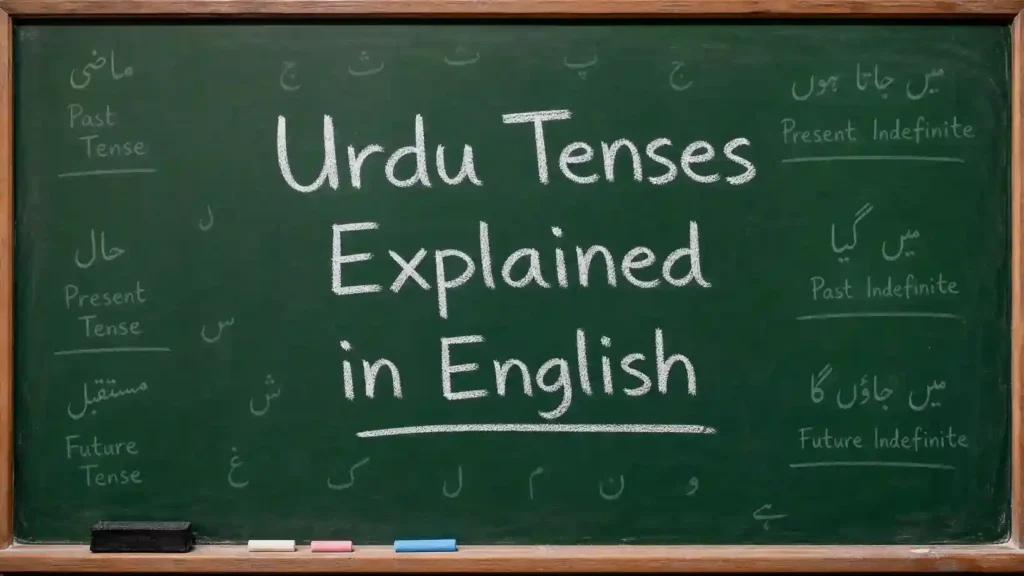
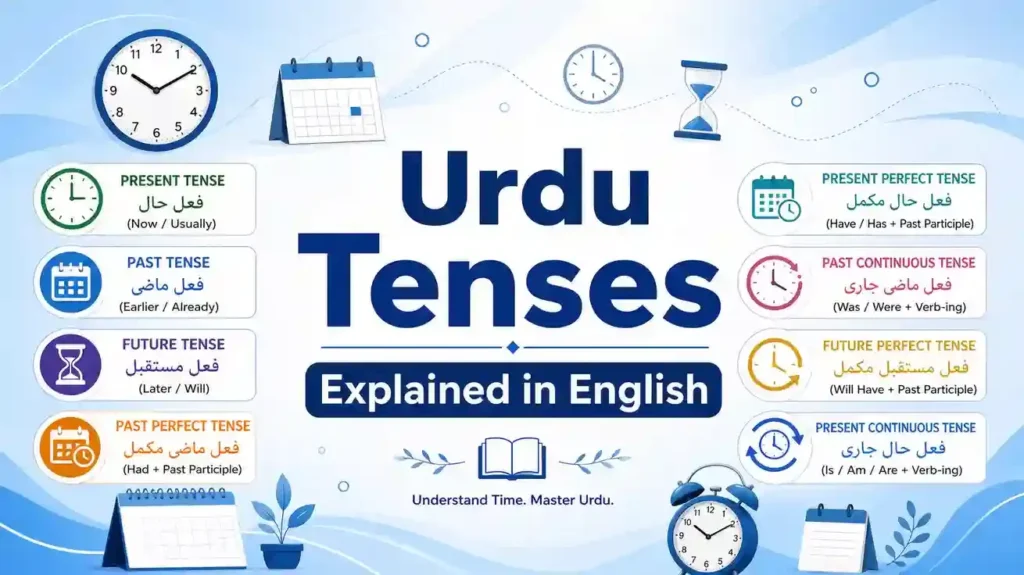
Urdu has twelve commonly taught tense forms. They fall into three main groups: Present, Past, and Future. Each group includes Indefinite, Continuous, Perfect, and Perfect Continuous forms. Together, these tenses help you express everyday conversations, completed actions, ongoing activities, and future plans accurately.
By the end of this guide, you will know how Urdu Tenses Explained in English work, form correct sentences, avoid common errors, and confidently translate between Urdu and English. This step-by-step approach follows widely accepted Urdu grammar principles taught by educational institutions and language experts, making it a reliable resource for long-term learning.
What Are Urdu Tenses?
Urdu Tenses Explained in English when an action happens and how it continues or finishes. They form the foundation of Urdu grammar. Every correct Urdu sentence depends on choosing the right tense and verb form.
Unlike English, Urdu verbs change according to gender, number, person, and helping verbs. These changes help express time and the state of an action. For example, the verb ending changes for masculine and feminine subjects. Helping verbs such as ہے (hai), تھا (tha), and ہوگا (hoga) complete the tense and make the sentence meaningful.
Urdu also separates tense from aspect. Tense tells you when an action takes place. Aspect shows whether the action is complete, ongoing, or repeated. For example, میں لکھتا ہوں (Main likhta hoon – I write) uses the present tense. میں لکھ رہا ہوں (Main likh raha hoon – I am writing) uses the present tense with a continuous aspect. Understanding this difference helps you build accurate Urdu sentences.
Helping verbs play a vital role because they show time, continuity, and completion. Without them, many Urdu sentences sound incomplete or incorrect. Learning these patterns makes speaking and writing much easier.
Urdu Tense Chart
The table below gives you a quick overview of all 12 Urdu tenses. It shows each tense, its Urdu name, sentence formula, English equivalent, a simple example, and its primary use. Use this chart as a quick reference before studying each tense in detail.
| Tense Name | Urdu Name | Basic Formula | English Equivalent | Example | Usage |
| Present Indefinite | حال مطلق | Subject + Verb + ہے/ہیں | I write | میں خط لکھتا ہوں۔ (I write a letter.) | Habits, routines, facts |
| Present Continuous | حال جاری | Subject + Verb + رہا/رہی/رہے + ہے | I am writing | میں خط لکھ رہا ہوں۔ | Ongoing actions |
| Present Perfect | حال کامل | Subject + Verb + چکا/چکی/چکے + ہے | I have written | میں خط لکھ چکا ہوں۔ | Completed present actions |
| Present Perfect Continuous | حال کامل جاری | Subject + Verb + رہا/رہی + ہے + Time | I have been writing | میں دو گھنٹے سے لکھ رہا ہوں۔ | Actions continuing until now |
| Past Indefinite | ماضی مطلق | Subject + Verb + تھا/تھی (when needed) | I wrote | میں نے خط لکھا۔ | Completed past actions |
| Past Continuous | ماضی جاری | Subject + Verb + رہا/رہی/رہے + تھا | I was writing | میں خط لکھ رہا تھا۔ | Ongoing past actions |
| Past Perfect | ماضی کامل | Subject + Verb + چکا/چکی + تھا | I had written | میں خط لکھ چکا تھا۔ | Actions completed before another past event |
| Past Perfect Continuous | ماضی کامل جاری | Subject + Verb + رہا/رہی + تھا + Time | I had been writing | میں ایک گھنٹے سے لکھ رہا تھا۔ | Continuous actions before a past event |
| Future Indefinite | مستقبل مطلق | Subject + Verb + گا/گی/گے | I will write | میں خط لکھوں گا۔ | Future plans and predictions |
| Future Continuous | مستقبل جاری | Subject + Verb + رہا/رہی + ہوگا | I will be writing | میں خط لکھ رہا ہوں گا۔ | Actions in progress in the future |
| Future Perfect | مستقبل کامل | Subject + Verb + چکا/چکی + ہوگا | I will have written | میں خط لکھ چکا ہوں گا۔ | Actions completed before a future time |
| Future Perfect Continuous | مستقبل کامل جاری | Subject + Verb + رہا/رہی + ہوگا + Time | I will have been writing | میں دو گھنٹے سے لکھ رہا ہوں گا۔ | Actions continuing up to a future point |
Understanding the Urdu Verb System
The Urdu Tenses Explained in English verb system forms the backbone of Urdu grammar. Every correct sentence begins with a main verb and follows specific grammar rules. Unlike English, Urdu verbs change according to gender, number, and person. They also use helping verbs to express time and aspect. Once you understand these patterns, forming Urdu sentences becomes much easier.
A main verb describes the action or state. For example, لکھنا (likhna) means to write, and کھانا (khana) means to eat. The verb stem is the base form after removing نا (na). For example, the stem of لکھنا is لکھ (likh). Urdu builds different tenses by adding endings and helping verbs to this stem.
Helping verbs, also called auxiliary verbs, complete the meaning of a sentence. Common helping verbs include ہے (hai), ہیں (hain), تھا (tha), تھی (thi), ہوں (hoon), and ہوگا (hoga). They show whether an action happens now, happened before, or will happen later.
Urdu also follows strict verb agreement rules. The verb changes to match the subject’s gender, number, and person. A masculine speaker says, میں خوش ہوں (Main khush hoon) and میں لکھتا ہوں (Main likhta hoon). A feminine speaker says, میں لکھتی ہوں (Main likhti hoon). Plural subjects use different verb endings, while first, second, and third-person subjects take suitable helping verbs.
How Urdu Tenses Are Formed
Urdu Tenses Explained in English follow a clear pattern. Every sentence combines a subject, a verb root, and a helping verb. The verb then changes to match the gender, number, and person of the subject. Learning this structure helps you build correct Urdu sentences without memorizing hundreds of separate forms.
Every sentence begins with the subject, such as میں (I), تم (you), or وہ (he/she). Next comes the verb root, which carries the main meaning. For example, the verb لکھنا (likhna) has the root لکھ (likh). Urdu adds different endings and helping verbs to this root to create present, past, and future tenses.
Helping verbs complete the tense. Words like ہے (hai), ہیں (hain), تھا (tha), تھی (thi), گا (ga), and گی (gi) show the time and aspect of an action. They also agree with the subject.
Urdu verbs must match the subject’s gender and number. A masculine speaker says میں پڑھتا ہوں (Main parhta hoon), while a feminine speaker says میں پڑھتی ہوں (Main parhti hoon). Singular and plural subjects also use different verb forms and helping verbs.
Urdu normally follows the Subject–Object–Verb (SOV) word order. The verb usually appears at the end of the sentence, unlike English, which follows the Subject–Verb–Object (SVO) pattern.
Basic Urdu Sentence Structure Formula
| Sentence Type | Formula | Example |
| Present Indefinite | Subject + Object + Verb + Helping Verb | میں کتاب پڑھتا ہوں۔ (I read a book.) |
| Present Continuous | Subject + Object + Verb + رہا/رہی/رہے + Helping Verb | میں کتاب پڑھ رہا ہوں۔ (I am reading a book.) |
| Past Indefinite | Subject + Object + Verb | میں نے کتاب پڑھی۔ (I read a book.) |
| Future Indefinite | Subject + Object + Verb + گا/گی/گے | میں کتاب پڑھوں گا۔ (I will read a book.) |
Types of Urdu Tenses Explained in English
Urdu Tenses Explained in English grammar divides tenses into three main categories: Present, Past, and Future. These categories help speakers describe actions happening now, actions completed in the past, and actions expected in the future. Each category contains four tense forms: Indefinite, Continuous, Perfect, and Perfect Continuous. Together, they create the twelve commonly taught Urdu tenses used in everyday conversation and formal writing.
Each tense follows a specific pattern. Urdu forms tenses by combining a subject, a verb root, and a helping verb. The verb also changes according to the gender, number, and person of the subject. This agreement makes Urdu different from English, where verbs usually change less often. Understanding these patterns helps learners build correct sentences with confidence.
The Present Tenses describe habits, ongoing actions, completed actions, and activities that started in the past and continue today. Past Tenses explain completed events, actions in progress in the past, and events completed before another past action. Future Tenses express future plans, ongoing future actions, and actions expected to finish before a specific future time.
Learning Urdu tenses step by step builds a strong grammar foundation. Start with the Present Indefinite Tense, then move to the remaining present, past, and future forms. This learning sequence improves speaking, writing, reading, and translation skills while helping you understand natural Urdu conversations more easily.
Urdu Helping Verbs Used in Every Tense
Helping verbs, also called auxiliary verbs, complete the meaning of a sentence. They show time, continuity, completion, and agreement with the subject. In Urdu, the main verb alone often cannot express a complete idea. A helping verb tells the reader or listener when an action happens and whether it is ongoing or finished. Learning these words makes Urdu sentence formation much easier.
The table below explains the most common helping verbs used in Urdu tenses.
| Helping Verb | English Meaning | Used In | Example |
| ہے (Hai) | Is | Present Singular | وہ طالب علم ہے۔ (He is a student.) |
| ہیں (Hain) | Are | Present Plural / Formal | وہ خوش ہیں۔ (They are happy.) |
| تھا (Tha) | Was | Past Masculine Singular | وہ گھر میں تھا۔ (He was at home.) |
| تھی (Thi) | Was | Past Feminine Singular | وہ گھر میں تھی۔ (She was at home.) |
| تھے (Thay) | Were | Past Masculine Plural | وہ اسکول میں تھے۔ (They were at school.) |
| تھیں (Theen) | Were | Past Feminine Plural | لڑکیاں تیار تھیں۔ (The girls were ready.) |
| گا (Ga) | Will | Future Masculine Singular | وہ آئے گا۔ (He will come.) |
| گی (Gi) | Will | Future Feminine Singular | وہ آئے گی۔ (She will come.) |
| گے (Gay) | Will | Future Plural / Respectful | وہ آئیں گے۔ (They will come.) |
| رہا (Raha) | Continuing | Masculine Continuous | وہ پڑھ رہا ہے۔ (He is studying.) |
| رہی (Rahi) | Continuing | Feminine Continuous | وہ پڑھ رہی ہے۔ (She is studying.) |
| رہے (Rahay) | Continuing | Plural Continuous | وہ پڑھ رہے ہیں۔ (They are studying.) |
| چکا (Chuka) | Has/Had Completed | Masculine Perfect | میں کام کر چکا ہوں۔ (I have finished the work.) |
| چکی (Chuki) | Has/Had Completed | Feminine Perfect | وہ آ چکی ہے۔ (She has arrived.) |
| چکے (Chukay) | Have/Had Completed | Plural Perfect | وہ جا چکے ہیں۔ (They have left.) |
Urdu Subject-Verb Agreement
Subject-verb agreement is one of the most important rules in Urdu Tenses Explained in English grammar. In Urdu, the verb changes to match the gender, number, and person of the subject. This rule makes Urdu different from English, where verbs usually change only with the subject or tense. Learning subject-verb agreement helps you build natural and grammatically correct Urdu sentences.
Subject-Verb Agreement Rules
| Agreement Type | Rule | Example |
| Masculine | Use masculine verb endings such as -تا (-ta). | میں اسکول جاتا ہوں۔ (I go to school.) |
| Feminine | Use feminine verb endings such as -تی (-ti). | میں اسکول جاتی ہوں۔ (I go to school.) |
| Singular | Use singular helping verbs with one subject. | وہ خوش ہے۔ (He/She is happy.) |
| Plural | Use plural helping verbs with more than one subject. | وہ خوش ہیں۔ (They are happy.) |
| First Person | The speaker refers to themselves using میں or ہم. | میں کتاب پڑھتا ہوں۔ (I read a book.) |
| Second Person | The listener is addressed with تم or آپ. | آپ کتاب پڑھتے ہیں۔ (You read a book.) |
| Third Person | The sentence talks about someone else using وہ or یہ. | وہ کتاب پڑھتا ہے۔ (He reads a book.) |
Key Rules to Remember
A masculine subject takes masculine verb forms, while a feminine subject takes feminine forms. For example, وہ کھاتا ہے means He eats, and وہ کھاتی ہے means She eats. The helping verb also changes with the subject.
Urdu also distinguishes between singular and plural subjects. A singular subject uses helping verbs like ہے (hai) or تھا (tha). A plural subject uses ہیں (hain) or تھے (thay). Respectful forms such as آپ also take plural verb forms, even when referring to one person.
Urdu Pronouns Used in Tenses
Pronouns replace nouns and identify who performs the action in a sentence. Every Urdu tense begins with a subject pronoun, making pronouns an essential part of sentence formation. They also determine the correct verb ending and helping verb. Unlike English, Urdu verbs change according to the person, gender, and number of the subject. Learning these common pronouns makes it easier to use all 12 Urdu tenses correctly.
The table below lists the most common Urdu pronouns used in everyday conversation and grammar.
| Urdu Pronoun | Roman Urdu | English Meaning | Person | Example |
| میں | Main | I | First Person Singular | میں کتاب پڑھتا/پڑھتی ہوں۔ (I read a book.) |
| ہم | Hum | We | First Person Plural | ہم بازار جاتے ہیں۔ (We go to the market.) |
| تم | Tum | You (informal) | Second Person Singular/Plural | تم اچھا لکھتے ہو۔ (You write well.) |
| آپ | Aap | You (formal/respectful) | Second Person | آپ کیسے ہیں؟ (How are you?) |
| وہ | Woh | He / She / They | Third Person | وہ اسکول جاتا ہے۔ (He goes to school.) |
| یہ | Yeh | This / He / She | Third Person (Near) | یہ میری کتاب ہے۔ (This is my book.) |
| اس | Is | Him / Her / It | Third Person Object | میں نے اس کو دیکھا۔ (I saw him/her.) |
| ان | Un | Them | Third Person Plural Object | میں نے ان کو بلایا۔ (I called them.) |
| اسے | Use | Him / Her | Third Person Object | اسے اردو پسند ہے۔ (He/She likes Urdu.) |
| انہیں | Unhein | Them | Third Person Plural Object | انہیں جواب معلوم ہے۔ (They know the answer.) |
Urdu Verb Conjugation Explained
Verb conjugation means changing a verb to match the Urdu Tenses Explained in English, person, gender, and number of the subject. In Urdu, every verb starts with an infinitive form and changes into different stems before adding the correct endings and helping verbs. Understanding this process makes it easier to form accurate sentences in all 12 Urdu tenses.
The infinitive is the basic dictionary form of a verb. It usually ends with نا (na). For example, لکھنا (likhna) means to write, پڑھنا (parhna) means to read, and کھانا (khana) means to eat. To create different tenses, Urdu removes نا and uses the remaining verb stem.
The present stem expresses actions happening now or regularly. The past stem describes completed actions in the past, while the future stem combines with future endings to express upcoming actions. Urdu also adds different endings to match masculine, feminine, singular, and plural subjects.
Urdu Verb Conjugation Pattern
| Form | Description | Example (لکھنا – To Write) |
| Infinitive | Base form ending in نا | لکھنا (Likhna) |
| Present Stem | Used in present tenses | لکھ (Likh) |
| Past Stem | Used in past tenses | لکھا / لکھی / لکھے (Likha / Likhi / Likhe) |
| Future Stem | Used with future endings | لکھوں، لکھے، لکھیں (Likhun, Likhe, Likhein) |
Common Urdu Verb Endings
| Ending | Usage | Example |
| -تا (-ta) | Masculine singular | پڑھتا (Parhta) |
| -تی (-ti) | Feminine singular | پڑھتی (Parhti) |
| -تے (-te) | Masculine plural or respectful | پڑھتے (Parhte) |
| -ا (-a) | Masculine past form | لکھا (Likha) |
| -ی (-i) | Feminine past form | لکھی (Likhi) |
| -ے (-e) | Masculine plural past form | لکھے (Likhe) |
| -وں (-un) | First person future | لکھوں (Likhun) |
| -یں (-ein) | Plural or respectful future | لکھیں (Likhein) |
Urdu Tenses Compared with English Tenses
Urdu and English both use tenses to describe time and actions, but they follow different grammar systems. English mainly changes verbs according to tense, while Urdu uses a combination of verb forms, helping verbs, gender agreement, and sentence structure. Understanding these differences helps English speakers learn Urdu faster and avoid common translation mistakes.
The biggest difference appears in verb agreement. English verbs usually stay the same for most subjects, but Urdu verbs change according to the subject’s gender and number. Urdu also follows a different word order, which makes sentence formation unique.
Urdu Tenses vs English Tenses Comparison Table
| Grammar Feature | Urdu Tenses | English Tenses |
| Word Order | Urdu follows Subject + Object + Verb (SOV) order. The verb usually comes at the end. | English follows Subject + Verb + Object (SVO) order. The verb usually comes after the subject. |
| Helping Verbs | Urdu uses helping verbs like ہے، ہیں، تھا، تھے، گا، گی، گے to show time and meaning. | English uses helping verbs like is, am, are, was, were, will, have, has. |
| Agreement | Urdu verbs agree with the subject’s gender, number, and person. | English verbs have limited agreement, mainly with third-person singular subjects. |
| Gender | Urdu verbs change for masculine and feminine subjects. Example: جاتا (goes masculine), جاتی (goes feminine). | English verbs usually do not change based on gender. |
| Continuous Forms | Urdu uses رہا، رہی، رہے with helping verbs to show ongoing actions. | English uses verb + ing with forms of be. |
| Perfect Forms | Urdu uses چکا، چکی، چکے with helping verbs to show completed actions. | English uses has/have/had + past participle. |
Frequently Asked Questions
What are Urdu tenses?
Urdu tenses show when an action happens and explain whether the action is complete, ongoing, or repeated. Urdu uses verb forms, helping verbs, and agreement rules to express present, past, and future actions. Learning Urdu tenses helps you create correct sentences and understand everyday conversations.
How many tenses are used in Urdu?
Urdu commonly uses 12 tense forms, similar to the traditional English tense system. These include four Present Tenses, four Past Tenses, and four Future Tenses. Each group contains Indefinite, Continuous, Perfect, and Perfect Continuous forms.
Is Urdu tense structure different from English?
Yes, Urdu and English use different tense structures. English mainly changes verb forms, while Urdu uses helping verbs, verb endings, and agreement rules. Urdu also follows Subject–Object–Verb (SOV) order, while English follows Subject–Verb–Object (SVO) order.
Which Urdu tense should beginners learn first?
Beginners should start with the Present Indefinite Tense. It helps you describe daily habits, routines, and general facts. After mastering this tense, learners can move to continuous, perfect, past, and future forms.
How do Urdu helping verbs work?
Urdu helping verbs add important information about time, completion, and continuity. Words like ہے (hai), تھا (tha), گا (ga), and رہا (raha) work with main verbs to complete the meaning of a sentence.
What is the easiest Urdu tense?
The Present Indefinite Tense is usually the easiest tense for beginners. It uses simple sentence patterns and appears frequently in daily conversations. Learners can quickly practice it with common verbs.
How do I master Urdu verb conjugation?
To master Urdu Tenses Explained in English verb conjugation, learn verbs step by step. Start with the infinitive form, identify the verb stem, and practice endings for masculine, feminine, singular, and plural subjects. Regular speaking and writing practice improves accuracy.
Why do Urdu verbs change according to gender?
Urdu Tenses Explained in English verbs change according to gender because Urdu grammar uses gender agreement. A masculine subject and feminine subject often require different verb endings. For example, جاتا (jata) is masculine, while جاتی (jati) is feminine.
How long does it take to learn Urdu tenses?
The learning time depends on your practice routine and previous language experience. A beginner can understand basic Urdu Tenses Explained in English patterns within weeks with regular study. Becoming fluent requires continuous speaking, reading, and writing practice.
Are Urdu tenses difficult for English speakers?
Urdu Tenses Explained in English may feel challenging at first because of different word order, gender agreement, and verb changes. However, consistent practice makes them easier. English speakers can learn Urdu Tenses Explained in English effectively by focusing on sentence patterns and everyday examples.
Conclusion
Learning Urdu Tenses Explained in English builds a strong foundation for speaking, writing, and understanding the Urdu language. Tenses help you express actions clearly by showing when something happens, whether it is happening now, happened in the past, or will happen in the future. In this guide, you learned the complete structure of Urdu tenses, including Present, Past, and Future tenses, along with Indefinite, Continuous, Perfect, and Perfect Continuous forms. You also explored how Urdu uses helping verbs, verb conjugation, gender agreement, number agreement, and sentence patterns to create meaningful sentences.
The key to mastering Urdu Tenses Explained in English is regular practice. Start by using simple daily sentences, practice common verbs, and compare Urdu sentence structures with English. After understanding tenses, continue your learning journey by exploring related topics such as Urdu Pronouns With English Meanings, Urdu Sentence Structure Compared With English, Urdu Verb Forms, Daily Use Urdu Sentences, and Urdu Questions and Answers in English. These lessons will help you improve your vocabulary, grammar, and communication skills.