
Urdu Days of the Week
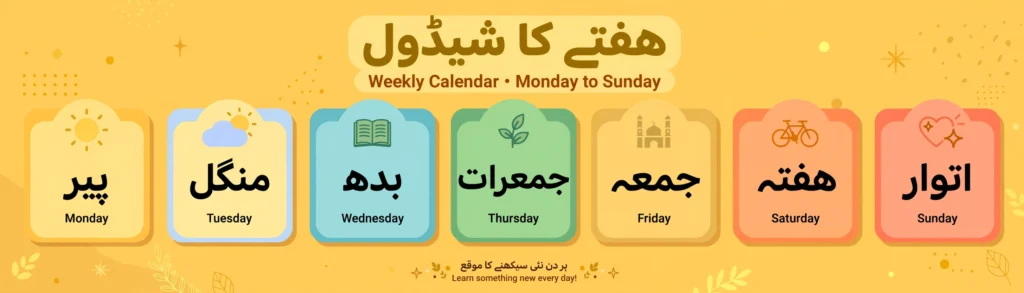
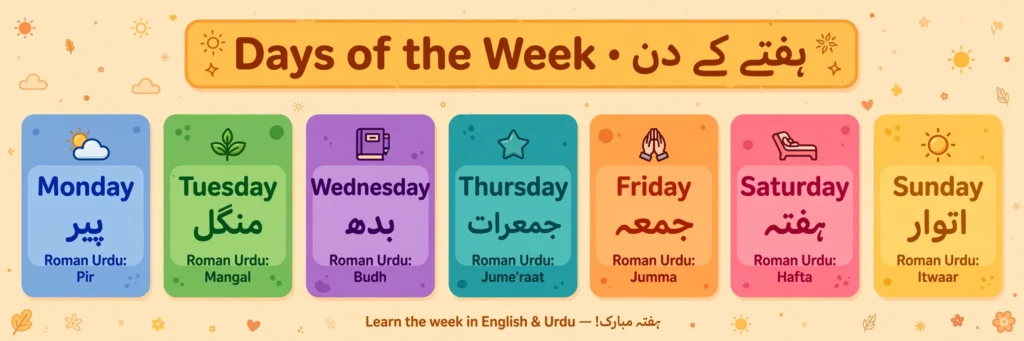
The seven Urdu Days of the Week have familiar names in Urdu. These names help learners talk about dates, schedules, routines, and weekly events. Sunday is called اتوار (Itwaar). Monday is پیر (Peer), and سوموار (Somwaar) is another common form. Tuesday is منگل (Mangal). The name has links to the traditional planetary name for Mars. Wednesday is بدھ (Budh).
The seven Urdu Days of the Week have familiar names in Urdu. These names help learners talk about dates, schedules, routines, and weekly events. Sunday is called اتوار (Itwaar). Monday is پیر (Peer), and سوموار (Somwaar) is another common form. Tuesday is منگل (Mangal). The name has links to the traditional planetary name for Mars. Wednesday is بدھ (Budh).
This name relates to the traditional name for Mercury. Thursday is جمعرات (Jumeraat). خمیس (Khamis) also appears as an alternative name. Friday is جمعہ (Jumma). The word comes from Arabic and relates to gathering for the weekly prayer. Saturday is ہفتہ (Hafta). It can also refer to a week, depending on the context. سنیچر (Sanichar) and شنبہ (Shanbah) also occur in different contexts.
Roman Urdu spellings can vary between sources. For example, writers may use Itwaar or Itwar. They may also write Juma or Jumma. The Urdu script stays more consistent than Roman Urdu. Learning these names helps beginners understand everyday Urdu conversations. It also builds useful vocabulary for calendars, appointments, school schedules, and travel plans. Standard Urdu educational materials list these weekday forms for language learners.
This guide to Urdu Days of the Week starts with Monday.
Monday to Sunday in Urdu Detailed Meaning and Usage
Monday — پیر / سوموار
Monday is called پیر (Peer) in everyday Urdu. You may also see سوموار (Somwaar) and the Persian-derived دوشنبہ (Do-shanbah). Pearson lists پیر and سوموار as Urdu names for Monday. UrduPod101 also teaches both forms. Rekhta records سوموار as a Sanskrit-origin word for Monday. It links the name with Soma, the traditional name associated with the Moon.
The word پیر also has Persian meanings such as an elder or spiritual guide. Rekhta separately records its use for Monday. A useful sentence is میں پیر کو اسکول جاتا ہوں۔ (Main Peer ko school jaata hoon.), meaning “I go to school on Monday.”
Tuesday — منگل
Tuesday is called منگل (Mangal) in Urdu. Its simple pronunciation is mun-gal. The word has Sanskrit roots and carries several meanings. Rekhta defines منگل as Tuesday, Mars, and auspiciousness or good fortune. The link with Mars comes from the older planetary naming system for weekdays. This makes منگل more than a simple calendar word.
It also carries the idea of something fortunate or auspicious. The longer form منگل وار (Mangalwaar) appears in related South Asian usage, while modern Urdu commonly uses منگل. A natural sentence is منگل کو ہمارا امتحان ہے۔ (Mangal ko hamaara imtihaan hai.), meaning “Our exam is on Tuesday.”
Wednesday — بدھ
Wednesday is known as بدھ (Budh) in Urdu. The common Roman Urdu spelling is Budh, and learners can pronounce it close to budh. The word belongs to the older Sanskrit-derived weekday system. It also connects with Mercury, the planet linked with Wednesday in that tradition. Urdu uses the short form بدھ in everyday speech, while بدھوار (Budhwaar) appears as a longer form in related languages and historical usage.
Urdu learners should also remember that بدھ can have other meanings outside the weekday context. Context makes the intended meaning clear. For example, بدھ کو میری اردو کی کلاس ہے۔ (Budh ko meri Urdu ki class hai.) means “My Urdu class is on Wednesday.” Pearson and UrduPod101 both list بدھ as the standard Urdu word for Wednesday.
Thursday — جمعرات
Thursday is called جمعرات (Jumeraat) in Urdu. Its common Roman Urdu forms include Jumeraat, Jumerat, and Jumayraat. A simple pronunciation is ju-meh-raat. Rekhta defines جمعرات as Thursday and describes it as the day before Friday. It also records پنج شنبہ as another name. Urdu speakers may also know the Arabic form خمیس (Khamis) for Thursday.
Learners often confuse جمعرات with جمعہ because the words look similar. The easiest way to remember them is simple: جمعرات means Thursday, while جمعہ means Friday. A natural example is ہم جمعرات کو لاہور جائیں گے۔ (Hum Jumeraat ko Lahore jaayenge.), meaning “We will go to Lahore on Thursday.”
Friday — جمعہ
Friday is called جمعہ (Jumma) in Urdu. You may also see Juma or Jummah in Roman Urdu. The pronunciation is close to jum-ma. The word comes from Arabic and carries an important religious meaning in Urdu. Friday is linked with the weekly Muslim congregation and نمازِ جمعہ. This makes جمعہ both a weekday name and an important religious term.
Urdu learners may also encounter expressions such as شبِ جمعہ and جمعۃ المبارک in cultural or religious contexts. A useful sentence is جمعہ کو ہم نمازِ جمعہ ادا کرتے ہیں۔ (Jumma ko hum Namaz-e-Jumma ada karte hain.), meaning “We offer the Friday prayer on Friday.” Pearson and UrduPod101 list جمعہ as the standard Urdu name for Friday.
Saturday — ہفتہ / سنیچر
Saturday is commonly called ہفتہ (Hafta) in Urdu. Its usual pronunciation is haf-ta. You may also encounter سنیچر (Sanichar) and شنبہ (Shanbah) in different contexts. Rekhta gives ہفتہ a Persian origin and records two important meanings: Saturday and a period of seven days, or “week.” This double meaning matters for Urdu learners.
The phrase ہفتہ کو means “on Saturday,” while ایک ہفتہ means “one week.” The word therefore works as both a weekday name and a time-period word. A simple example is ہفتہ کو ہمارا اسکول بند ہوتا ہے۔ (Hafta ko hamaara school band hota hai.), meaning “Our school is closed on Saturday.” Pearson lists ہفتہ as the standard Urdu term for Saturday.
Sunday — اتوار
Sunday is called اتوار (Itwaar) in Urdu. Common Roman Urdu spellings include Itwaar, Itwar, and Aitwaar. The basic pronunciation is it-waar. Rekhta identifies اتوار as a Sanskrit-origin word and defines it as the day between Saturday and Monday. It also records اتوار as an older spelling. The word belongs to the older South Asian system of weekday names. That system connects several weekdays with celestial bodies. Modern Urdu normally uses اتوار in everyday speech and writing. A natural sentence is اتوار کو ہماری
Read the Urdu Days of the Week aloud to build fluency.
Where Do Urdu Day Names Come From?
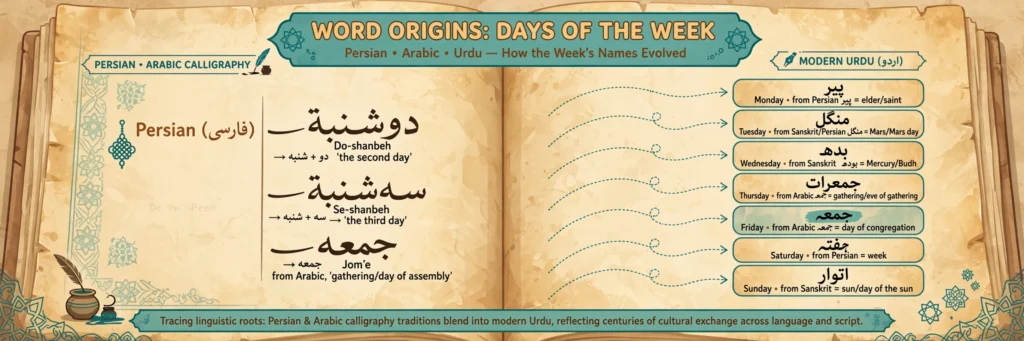
Urdu weekday names come from more than one linguistic tradition. They reflect the long history of Urdu and South Asian languages. Sanskrit and Indo-Aryan vocabulary forms one important layer. Persian added another layer through centuries of cultural contact. Arabic added strong religious vocabulary, especially around Friday. Modern Urdu uses these layers together in everyday speech.
The Urdu Days of the Week become easier with daily practice.
Several Urdu weekday names connect with the older South Asian planetary system. سوموار (Somwaar) means Monday and links with Soma, the Moon. منگل (Mangal) means Tuesday and connects with Mars. بدھ (Budh) means Wednesday and connects with Mercury. اتوار (Itwaar) represents Sunday and has Sanskrit origins.Rekhta identifies these words as Sanskrit-origin weekday terms.
This planetary pattern helps explain several Urdu names. The older system linked each weekday with a celestial body. These bodies included the Sun, Moon, Mars, Mercury, Jupiter, Venus, and Saturn. Urdu retained some names while replacing others through language contact.
Persian also influenced Urdu weekday vocabulary. The Persian shanbeh system uses numbers with shanbeh. Examples include دوشنبہ (Doshambah) and پنج شنبہ (Panjshanbah). These forms appear in older Urdu and Persianate usage. They offer an important second naming system alongside common Urdu forms.
Arabic influence becomes especially clear with جمعہ (Jumma). The word comes from Arabic and relates to gathering. Muslims gather for the weekly congregational prayer on Friday. جمعرات (Jumeraat) also relates to the terminology surrounding Friday. A study of rural Pakistan describes these Thursday and Friday terms as Arabic-derived or Arabic-influenced.
Origins add depth to the Urdu Days of the Week.
ہفتہ (Hafta) shows another Persian connection. The word relates to the number seven. It can mean both Saturday and a week in Urdu. Rekhta records both meanings and connects the word with Persian haft. Not every historical explanation has equal evidence. Some word origins have clear dictionary records. Other explanations depend on historical interpretation or later usage. A reliable guide should separate established etymology from popular explanations.
The result is a mixed Urdu weekday system. منگل and بدھ preserve older South Asian connections. پیر reflects a different history from سوموار. جمعہ carries clear Arabic and Islamic associations. ہفتہ preserves a Persian connection with the number seven. Together, these names show how Urdu developed through language contact.
Alternative Names of the Urdu Days of the Week
Urdu has several names for some days of the week. These forms come from different language traditions. Some remain common in modern Urdu. Others appear in literary, historical, Persian, or regional contexts. You should not treat every form as equally common today. The table below explains their differences.
History makes the Urdu Days of the Week memorable.
پیر and سوموار — Monday
پیر (Peer) is the most familiar everyday Urdu name for Monday. سوموار (Somwaar) is another established Urdu name. Rekhta identifies سوموار as Sanskrit in origin and defines it as Monday, پیر, and دوشنبہ.پیر also has a Persian lexical history and carries other meanings, such as an elder or spiritual guide. Therefore, پیر suits everyday Urdu, while سوموار appears often in Hindi-influenced, literary, and formal contexts.
دوشنبہ — Monday
دوشنبہ (Doshambah) comes from Persian. Rekhta defines it as Monday and gives پیر and سوموار as equivalents. Persian uses دو شنبہ as its Monday name. The word دو means “two,” while شنبہ forms the base of the Persian weekday system. The University of Texas Persian program lists دو شنبه as Monday.In Urdu, دوشنبہ now sounds more literary or historical than پیر.
جمعرات and خمیس — Thursday
جمعرات (Jumeraat) is the standard everyday Urdu name for Thursday. Rekhta also lists پنج شنبہ as another name for Thursday. خمیس (Khamis) is an Arabic word for Thursday. Arabic uses the word for the fifth weekday in its traditional counting system. Pakistani regional languages also use خمیس. For example, Sindhi teaching material gives خمیس for Thursday. In standard modern Urdu, جمعرات remains the more familiar choice.
ہفتہ, سنیچر, and شنبہ — Saturday
ہفتہ (Hafta) is the most familiar Urdu name for Saturday. It has an important second meaning: week. Rekhta traces the word to Persian and records both meanings. سنیچر (Sanichar) is also used for Saturday. Urdu language discussions record ہفتہ and سنیچر as two established names. شنبہ (Shanbah) has Persian origins and directly means Saturday. Rekhta also lists it as a Persian-origin word. Thus, ہفتہ works best as the common Urdu form, while سنیچر and شنبہ appear in other usage traditions.
سہ شنبہ — Tuesday
سِہ شنبہ (Seh-shambah) is the Persian name for Tuesday. Rekhta identifies its origin as Persian and defines it as منگل, or Tuesday. The Persian system counts the weekdays from شنبہ. The word سہ means “three,” so سہ شنبہ follows the Persian numbered pattern. Modern Urdu speakers normally say منگل. You may encounter سہ شنبہ in older Urdu writing or Persian-influenced contexts.
چہار شنبہ — Wednesday
چہار شنبہ (Chahaar-shambah) is the Persian-derived name for Wednesday. Rekhta marks it as Persian in origin and defines it as بدھ or بدھوار. The Persian word چہار means “four.” The name therefore follows the numbered Persian weekday pattern. The University of Texas Persian program lists چهار شنبه for Wednesday. Modern Urdu usually prefers بدھ, while چہار شنبہ carries a more literary or historical tone.
پنج شنبہ — Thursday
پنج شنبہ (Panj-shambah) is another Persian-derived name for Thursday. Rekhta lists it directly as a word for Thursday. The Persian word پنج means “five.” Persian therefore builds the name from “five” plus شنبہ. The University of Texas lists پنج شنبه as Thursday in Persian. Modern Urdu normally uses جمعرات, so پنج شنبہ is better understood as a Persian or historical alternative.
The Persian Weekday Pattern
The Persian alternatives follow a clear counting pattern. شنبہ means Saturday. یک شنبہ means Sunday, دوشنبہ means Monday, سہ شنبہ means Tuesday, چہار شنبہ means Wednesday, and پنج شنبہ means Thursday. The University of Texas lists this complete Persian sequence. Older Urdu sources also recorded these forms beside everyday Urdu names. A historical Urdu grammar compares پیر or سوموار with دوشنبہ, منگل with سہ شنبہ, and بدھ with چہار شنبہ.
Which Names Should You Use?
For everyday Urdu, use پیر، منگل، بدھ، جمعرات، جمعہ، ہفتہ، اتوار. These forms give learners the clearest modern vocabulary. Use سوموار when you need an established alternative for Monday. You may encounter خمیس through Arabic, Islamic, Sindhi, or other regional contexts. Persian forms such as دوشنبہ، سہ شنبہ، چہار شنبہ، پنج شنبہ remain valuable for historical and comparative study. They also help explain Urdu’s strong connection with Persian.
The key point is simple: these names are related, but they are not equally common. Modern Urdu favors one set, while older and neighboring traditions preserve others. Understanding that difference helps learners read Urdu across books, newspapers, religious texts, and regional sources.
How to Use Days in Urdu Sentences
Knowing weekday names is only the first step. You also need to know how Urdu uses them in sentences. Urdu often places کو (ko) after a specific day. This pattern usually matches the English word “on.” For example, پیر کو means “on Monday,” while جمعہ کو means “on Friday.” Pearson’s Urdu specification teaches these constructions as standard patterns for learners.
Compare forms across the Urdu Days of the Week here.
Using کو With a Specific Day
Use کو when you mention a particular day for an action or event. The basic pattern is [day] + کو. For example, میں پیر کو بازار جاؤں گا۔ means “I will go to the market on Monday.” You can use the same pattern with every weekday. منگل کو، بدھ کو، جمعرات کو، جمعہ کو، ہفتہ کو، and اتوار کو all express “on” a specific day.
Using Every With a Day
Use ہر (har) to express repeated actions. ہر جمعہ means “every Friday,” while ہر جمعہ کو gives the fuller form “every Friday.” You can also say ہر پیر کو for “every Monday.” Urdu learning materials use forms such as ہر منگل, ہر بدھ, and ہر جمعرات.
Talking About Next and Previous Days
Use اگلے (agle) for the next occurrence and پچھلے (pichhle) for the previous period. اگلے پیر means “next Monday.” پچھلے پیر means “last Monday.” You can also say اگلے ہفتے for “next week” and پچھلے ہفتے for “last week.” Pearson’s Urdu materials include اگلا دن, اگلے دن, today, tomorrow, yesterday, and week among core time vocabulary.
Talking About This Week
Use اس (is) to mean “this” with time expressions. اس ہفتے means “this week.” You can also use a weekday after اس when the context makes the meaning clear. For example, اس جمعہ کو means “this Friday.” In everyday speech, اس ہفتے often gives the clearest meaning when you discuss the current week.
Talking About Morning and Evening
Urdu links a day with another noun through the possessive structure. پیر کی صبح means “Monday morning.” جمعہ کی شام means “Friday evening.” The pattern is [day] + کی + [time of day]. Pearson gives examples such as پیر کی صبح (کو) and پیر کی شام (کو) in its Urdu specification.
Why Some Weekday Words Change Form
Some Urdu day names change slightly before certain endings. جمعہ commonly becomes جمعے in phrases such as جمعے کو. Similarly, ہفتہ becomes ہفتے in ہفتے کو and اس ہفتے. These forms follow normal Urdu grammatical patterns. Beginners should learn them as complete phrases instead of memorizing only the dictionary form.
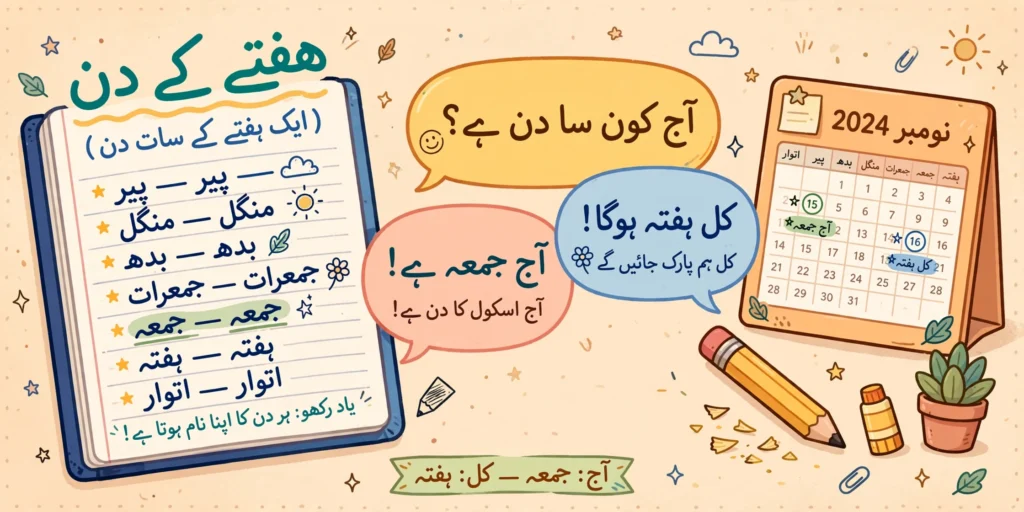
Mini-Dialogue: Asking About Today
سوال: آج کون سا دن ہے؟
جواب: آج بدھ ہے۔
Roman Urdu: Aaj kaun sa din hai?
Aaj Budh hai.
English: “What day is today?”
“Today is Wednesday.”
This simple exchange helps learners use weekday vocabulary naturally. Urdu learning materials also teach آج کیا دن ہے؟ for “What day is it?”
Mini-Dialogue: Asking About Tomorrow
سوال: کل کون سا دن ہے؟
جواب: کل جمعہ ہوگا۔
Roman Urdu: Kal kaun sa din hai?
Kal Jumma hoga.
English: “What day is tomorrow?”
“Tomorrow will be Friday.”
The word کل can mean either “yesterday” or “tomorrow.” Context tells you which meaning applies. Pearson’s Urdu vocabulary lists کل for both time references.
Useful Urdu Patterns for Weekdays
These patterns cover most everyday situations:
پیر کو — on Monday
ہر جمعہ کو — every Friday
اگلے پیر — next Monday
پچھلے ہفتے — last week
اس ہفتے — this week
پیر کی صبح — Monday morning
جمعہ کی شام — Friday evening
ہفتے کو — on Saturday
جمعے کو — on Friday
These phrases help learners move beyond simple translation. They show how Urdu speakers discuss schedules, routines, appointments, classes, travel, and weekly events. The patterns also appear in formal Urdu teaching materials and beginner language lessons.
Every learner should master the Urdu Days of the Week.
A Simple Rule to Remember
Use کو for a specific day. Use ہر for repeated days. Use اگلے for the next occurrence. Use پچھلے for a previous day or week. Use اس for the current week. Use کی when you connect a day with morning or evening. Once you learn these patterns, you can build many Urdu sentences without memorizing each one separately.
Urdu Time Vocabulary Related to Days
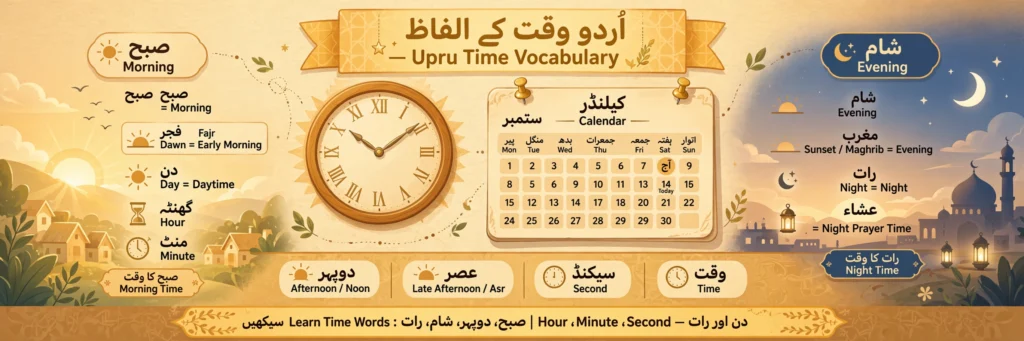
Urdu uses several everyday words to describe days, weeks, and nearby points in time. These words appear often in conversations about schedules, appointments, school, work, and travel. Learning them makes weekday vocabulary more useful in real situations.
Practice the Urdu Days of the Week in daily sentences.
آج (aaj) means “today.” It refers to the present day or the day happening now. کل (kal) needs more attention because it can mean yesterday or tomorrow. The surrounding sentence usually makes the meaning clear. Pearson’s Urdu materials also list کل for both meanings. Rekhta also records آج as the current day.
پرسوں (parson) can mean “the day after tomorrow” or “the day before yesterday.” Context decides which meaning the speaker intends. Pearson distinguishes these uses in its Urdu vocabulary materials. Rekhta also records both future and past meanings for پرسوں.
The word دن (din) means “day.” It can refer to a calendar day, daytime, or a period of time. Urdu often combines دن with weekday names and time expressions. Rekhta defines it as a day, daytime, and a broader period of time.
ہفتہ (hafta) has a special role in Urdu. It can mean “week” and “Saturday.” Rekhta traces it to Persian and records both meanings. Context tells you which meaning applies. For example, ایک ہفتہ means “one week,” while ہفتہ کو means “on Saturday.” This double meaning makes ہفتہ an important word for Urdu learners.
ہفتے کے دن means “the days of the week.” The expression connects ہفتہ with دن and refers to the complete weekly cycle. You can use it when discussing the seven Urdu weekdays: پیر، منگل، بدھ، جمعرات، جمعہ، ہفتہ، اتوار.
اگلے ہفتے (agle hafte) means “next week.” پچھلے ہفتے (pichhle hafte) means “last week.” اس ہفتے (is hafte) means “this week.” These expressions help speakers describe events in relation to the present week. They appear naturally in sentences about plans, schedules, classes, and appointments.
ہر ہفتے (har hafte) means “every week.” The expression shows a repeated action or event. For example, ہم ہر ہفتے اردو پڑھتے ہیں۔ means “We study Urdu every week.” Rekhta also records ہفتہ بہ ہفتہ for something that happens every seven days.
ہفتے کا آخر (hafte ka aakhir) means “the end of the week.” In modern conversation, speakers may also use ویک اینڈ (weekend) for the weekend. Pearson’s Urdu materials list ہفتہ اتوار and ویک اینڈ for this concept.
These time words connect weekday names with real-life communication. Once you understand آج، کل، پرسوں، اس ہفتے، اگلے ہفتے، پچھلے ہفتے، and ہر ہفتے, you can describe both specific days and wider periods naturally.
Urdu vs Hindi vs Persian vs Arabic Day Names
Urdu weekday names reflect several languages and traditions. Urdu belongs to the Indo-Aryan language family. Its vocabulary also includes many Persian and Arabic words. This layered history appears clearly in the names of the days.
Patterns stick when you repeat the Urdu Days of the Week.
| Naming system | Sunday | Monday | Tuesday | Wednesday | Thursday | Friday | Saturday |
| Common Urdu | اتوار | پیر | منگل | بدھ | جمعرات | جمعہ | ہفتہ |
| Urdu alternatives | ایتوار | سوموار، دوشنبہ | منگل وار، سہ شنبہ | بدھوار، چہار شنبہ | خمیس، پنج شنبہ | جمعة | سنیچر، شنبہ |
| Hindi / Sanskrit-derived | रविवार | सोमवार | मंगलवार | बुधवार | गुरुवार | शुक्रवार | शनिवार |
| Persian | یک شنبہ | دو شنبہ | سه شنبہ | چهار شنبہ | پنج شنبہ | جمعه | شنبه |
| Arabic | الأحد | الاثنين | الثلاثاء | الأربعاء | الخميس | الجمعة | السبت |
The Sanskrit and Indo-Aryan system links each day with a celestial body. Somavāra links Monday with the Moon. Maṅgalavāra links Tuesday with Mars. Budhavāra links Wednesday with Mercury. The same system names Thursday through Saturday after Jupiter, Venus, and Saturn.
Modern Hindi keeps this planetary pattern. Its weekday names include रविवार, सोमवार, मंगलवार, बुधवार, गुरुवार, शुक्रवार, and शनिवार. Hindwi also identifies रविवार as Sanskrit-origin and connects it with the Sun.
Persian uses a different naming pattern. It builds most weekday names from numbers plus شنبہ (shanbeh). دوشنبہ means Monday, سه شنبہ means Tuesday, and چهار شنبہ means Wednesday. پنج شنبہ means Thursday. Persian uses جمعه for Friday and شنبه for Saturday.
Arabic follows another clear pattern. The first five names connect with numbers. الأحد refers to one, الاثنين to two, and الثلاثاء to three. The sequence continues through الخميس, linked with five. الجمعة means Friday and relates to gathering. السبت means Saturday and has an older Semitic history.
Urdu combines these traditions in a practical way. منگل and بدھ preserve older Indo-Aryan links. پیر stands alongside the Sanskrit-derived سوموار. جمعرات and جمعہ show strong Arabic influence. ہفتہ comes through Persian and can mean both Saturday and a week. Rekhta records these meanings and related forms.
Time words pair naturally with the Urdu Days of the Week.
This explains why Urdu can have several names for one weekday. The names did not come from one source. They developed through long contact between South Asian, Persian, and Arabic language traditions.
The Key Difference
The Sanskrit-derived system focuses on celestial bodies. The Persian system mainly counts from Saturday. The Arabic system mainly counts from Sunday through Thursday. Friday has a religious meaning in Arabic. Urdu preserves parts of all these traditions.
That mixture gives Urdu its distinctive weekday vocabulary. It also explains forms such as پیر، سوموار، دوشنبہ for Monday. These words refer to the same day, but they belong to different naming traditions.
Frequently Asked Questions

What are the seven days of the week in Urdu?
The seven days are اتوار، پیر، منگل، بدھ، جمعرات، جمعہ، ہفتہ. They mean Sunday, Monday, Tuesday, Wednesday, Thursday, Friday, and Saturday. Pearson’s Urdu curriculum uses these forms for language learners.
Across languages, the Urdu Days of the Week stand out.
What is Monday called in Urdu?
Monday is پیر (Peer) in common Urdu. سوموار (Somwaar) is another established name. Some older Persian-influenced sources also use دوشنبہ.
What is Tuesday called in Urdu?
Tuesday is منگل (Mangal). The word also connects with Mars in the traditional South Asian planetary weekday system.
What is Wednesday called in Urdu?
Wednesday is بدھ (Budh). You may also find the longer form بدھوار in related South Asian usage.
What is Thursday called in Urdu?
Thursday is جمعرات (Jumeraat). خمیس and پنج شنبہ also occur as alternative names in different linguistic traditions.
What is Friday called in Urdu?
Friday is جمعہ (Jumma or Juma). The term comes from Arabic and relates to gathering. It also names the weekly Friday prayer.
What is Saturday called in Urdu?
Saturday is ہفتہ (Hafta) in common Urdu. سنیچر and شنبہ also occur. Rekhta records both Saturday and week as meanings of ہفتہ.
What is Sunday called in Urdu?
Sunday is اتوار (Itwaar). You may also see the spelling اتوار in older or variant usage.
Is Monday called پیر or سوموار?
Both names refer to Monday. پیر is common in everyday Urdu, while سوموار remains an established alternative. Pearson lists both forms.
Does ہفتہ mean Saturday or week?
It can mean both. ہفتہ کو means “on Saturday,” while ایک ہفتہ means “one week.” Rekhta records both meanings and traces the word to Persian.
Is جمعرات Thursday or Friday?
جمعرات means Thursday. جمعہ means Friday. These words look similar, so beginners often confuse them.
These answers clarify the Urdu Days of the Week quickly.
How do you say “on Monday” in Urdu?
You can say پیر کو or پیر کے دن. Urdu commonly uses کو with a specific day. Pearson includes پیر کے دن (کو) in its Urdu vocabulary.
How do you say “every Monday” in Urdu?
The common expression is ہر پیر کو. It means “every Monday.” Pearson also lists ہر پیر کو among
Conclusion
Learning the days of the week in Urdu goes beyond memorizing seven words. The names اتوار، پیر، منگل، بدھ، جمعرات، جمعہ، and ہفتہ reflect Urdu’s rich linguistic history. Some names connect with older Indo-Aryan and planetary traditions. Others show Persian or Arabic influence.
Keep reviewing the Urdu Days of the Week every morning.
Understanding alternative forms also makes Urdu easier to read and understand. You may encounter سوموار، دوشنبہ، خمیس، پنج شنبہ، سنیچر، or شنبہ in different sources and contexts. Their usage can vary by region, period, and language tradition.
For everyday communication, focus first on the common Urdu forms. Then learn useful patterns such as پیر کو, ہر جمعہ, اگلے ہفتے, and پچھلے ہفتے. These expressions help you discuss schedules, routines, appointments, and plans naturally.
Why Roman Urdu Has No Standard Spelling
100 Common Urdu Words With English Meanings
Once you understand both the common names and their linguistic background, the Urdu calendar becomes much easier to remember. More importantly, you gain a deeper view of how Urdu, Hindi, Persian, Arabic, and South Asian language traditions have shaped everyday Urdu vocabulary.
You now know the Urdu Days of the Week confidently.