
Why Roman Urdu Has No Standard Spelling
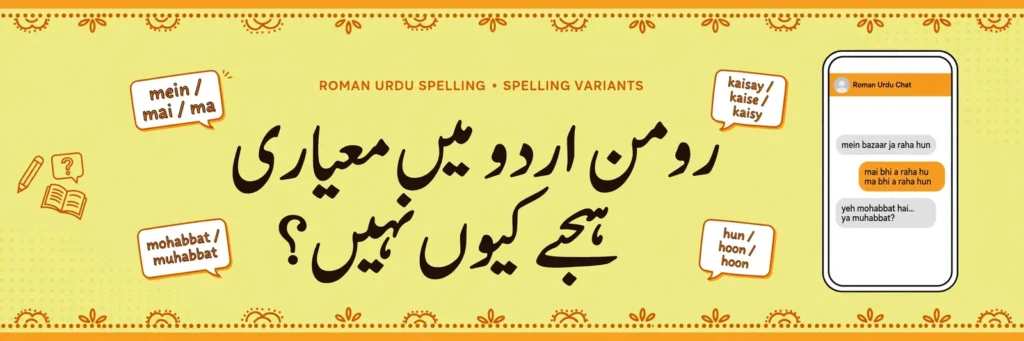
Roman Urdu lives in your WhatsApp chats, Facebook comments, and YouTube titles. Yet no two people spell it the same way. One person writes “mein.” Another writes “mai.” A third writes “ma.” All three mean میں. Nobody corrects anyone. Everyone understands anyway.
This complete guide explains Why Roman Urdu Has No Standard Spelling. It answers the question from every angle. You will travel through 200 years of history. You will see how missionaries, British officers, and Ayub Khan shaped Roman Urdu. You will learn why Urdu’s sounds break the English alphabet. You will discover how hidden vowels force writers to guess.
You will also meet the institutions that never acted. No academy standardized Roman Urdu. No dictionary lists its spellings. No school teaches its rules. You will see how phones and SMS rewarded speed over consistency. You will read real examples of one word with five spellings.
The guide compares Roman Urdu with languages that fixed this problem. China imposed Pinyin. Turkey switched scripts in 1928. Indonesia and Malaysia unified their spelling systems in 1972.
Finally, you will see what scientists found in real Roman Urdu data. You will learn why AI cannot fix the spelling. By the end, you will understand the full picture. Let’s begin.
How Roman Urdu Was Born: A 200-Year Timeline

To understand Why Roman Urdu Has No Standard Spelling, start with its history. Roman Urdu did not appear with mobile phones. Its roots go back over 200 years. In 1803, John Gilchrist published Aesop’s Fables in Roman Hindi-Urdu. Gilchrist worked at Fort William College in Calcutta. The college trained British officers in Indian languages. His book counts as the earliest known Roman printing of the language. In the 1800s, Christian missionaries used Roman letters for Bible translations. They also printed dictionaries and grammars in Roman Urdu.
The script served outsiders, not native writers. British officers tried Roman Urdu too. They found Nastaliq too hard to learn. Some officials wanted Roman letters for all Indian languages. Traditional scholars resisted. The Perso-Arabic script survived. During World War II, teachers taught Roman Urdu to British soldiers. Then came the boldest proposal. President Ayub Khan ruled Pakistan from 1958 to 1969. He suggested switching Urdu to the Latin alphabet. He took inspiration from Atatürk’s 1928 Turkish reform.
Officials never implemented the plan. Pakistan kept the Perso-Arabic script after 1947. Roman Urdu lived on only in the proposal’s memory. Computers arrived in the 1980s and 1990s. They shipped with zero Urdu support. Early users had no choice but Roman letters. The real explosion came with mobile phones. Handsets shipped without Urdu keyboards.
People typed Urdu with English letters instead. SMS, Yahoo Messenger, and Orkut spread the habit. Facebook and WhatsApp finished the job. Speed mattered more than consistency. A 2014 study found 84% of sampled Hindi Facebook posts used Roman script. The Express Tribune traces this full journey from missionaries to smartphones.
Too Many Sounds, Too Few Letters
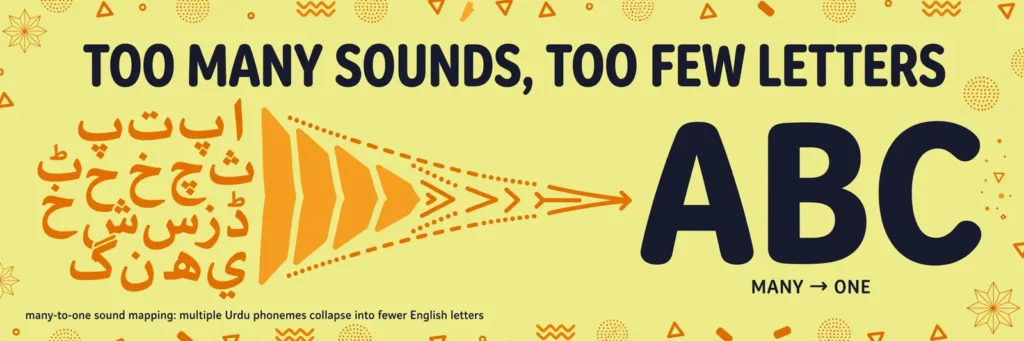
Linguistics gives the deepest answer to Why Roman Urdu Has No Standard Spelling. Urdu holds far more sounds than the English alphabet can handle. One estimate squeezes 38 Urdu consonants into 21 English ones. Something has to give. Several Urdu letters collapse into one Roman letter.
The letters ز, ذ, ض, and ظ all become “z.” The letters س, ث, and ص all become “s.” The letters ح, ہ, and ھ all become “h.” The letters ک and ق both become “k.” Careful writers reserve “q” for ق. Most writers ignore the difference. Readers cannot reverse the process. They cannot tell which Urdu letter the writer meant. Some Urdu sounds have no English equivalent at all.
Retroflex consonants like ٹ, ڈ, and ڑ do not exist in English. Writers improvise with capital T, D, and R. Nobody taught this convention. Users invented it and copied each other. Aspirated sounds like کھ and گھ need two Roman letters. Urdu writes each with one letter plus ھ. Word-final nasalization adds another gap. Urdu nasalizes vowels in words like میں. Roman writers add a plain “n” or skip it. Both “mein” and “mei” appear.
Vowels cause the worst chaos. Urdu script usually skips short-vowel marks. Writers guess the vowel each time. Corpus data proves the mess. The sound /e/ appears as “e,” “ai,” “i,” or “ee” in real tweets. The sound /u/ appears as “u,” “oo,” or “o.” No rule guides these choices. Habit does. A 2026 peer-reviewed study documents these mappings in detail.
The Vowel Problem: Urdu’s Missing Marks
Urdu hides its short vowels. The script writes consonants in full. It marks short vowels with tiny signs above or below letters. Zabar (َ) adds an “a” sound. Zer (ِ) adds an “i” sound. Pesh (ُ) adds a “u” sound. Everyday Urdu skips these marks entirely. Native readers infer vowels from context. They learned the words as children. Roman Urdu cannot skip vowels.
Every vowel needs a visible letter. Writers must guess what the script hides. Take محبت. The visible letters are م ح ب ت. The true pattern is ma-hab-bat. The script never shows it. So writers produce “mohabbat,” “muhabbat,” or even “mahabbat.” Long vowels create their own mess. The letter و becomes “o,” “oo,” or “u.”
The letter ی becomes “i,” “ee,” or “e.” The letter ے becomes “e” or “ai.” Doubled consonants add confusion. Urdu marks doubling with a small ّ sign. Roman writers double the letter or skip it. “Mohabbat” and “mohabat” both circulate. Each choice looks reasonable. None is official. This guessing game sits at the heart of why Roman Urdu has no standard spelling.
Nobody Makes the Rules
Every standard needs an enforcer. Why Roman Urdu Has No Standard Spelling has none. Pakistan’s National Language Promotion Department started in 1979. It was first called Muqtadra Qaumi Zaban. It standardizes Urdu-script spelling and publishes dictionaries. It never issued a Roman Urdu standard. No public record shows it even discussed one. Schools teach no Roman Urdu curriculum.
No dictionary covers Roman spellings. No style guide exists. Compare this with French. France runs the Académie Française. It guards French spelling by law. Pakistan built no equivalent for Roman Urdu. The NLPD publishes Urdu dictionaries and a thesaurus. Every entry uses Urdu script. Roman spellings appear nowhere in its system. Online debates fill the vacuum.
Quora users argue over “Walima” versus “Valima.” Goodreads threads debate “mohabbat” versus “muhabbat.” These threads always reach the same verdict. One user summed it up: there are no hard and fast rules for transliteration. Without an authority, every writer becomes their own authority. Folk standards fill the gap. Drama subtitles, meme pages, and influencers model spellings. Millions copy them.
But no model carries official weight. A viral spelling is still just a habit. This institutional gap explains a big part of why roman urdu has no standard spelling.
Your Phone Killed Consistency
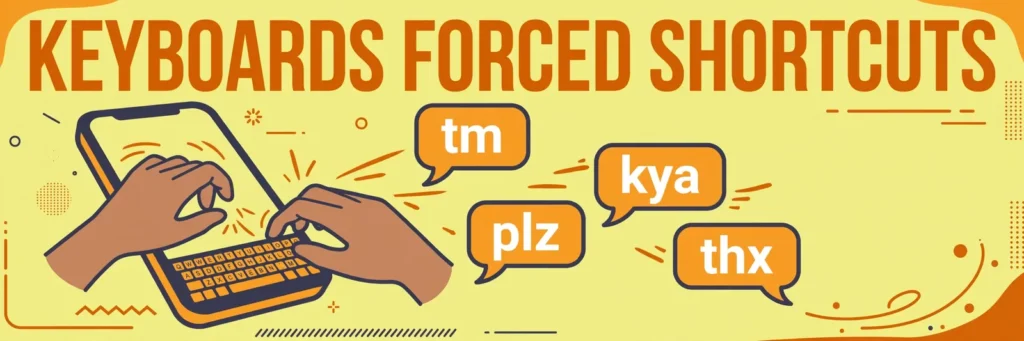
Early mobile phones shipped without Urdu keyboards. Users fell back on QWERTY. They saw no reason to switch keyboards or install fonts. SMS made brevity pay. Each message allowed only 160 characters. Writers dropped vowels to save space. “Kya kar rahe ho” became “kya kr rahe ho.” “Tomorrow” shrank to “2mro.”
Fancy diacritics had no chance. Researchers note that phone-friendly spelling avoids diacritics entirely. Old systems used marks like ṭ and ḍ. Phone keyboards could not type them. People replaced them with plain letters. Early predictive text made things worse. T9 dictionaries knew English only. They “corrected” Roman Urdu into English words.
Users disabled the feature or fought it daily. Platforms then normalized the habit. Yahoo Messenger and MSN chat rooms acted as laboratories. Users copied each other’s shortcuts. Facebook and WhatsApp scaled the chaos to millions. Smartphones changed little. Urdu keyboards exist today. But switching keyboards mid-chat feels slow.
Roman stays the default. WhatsApp forwards, memes, and status updates travel in Roman. Every phone renders plain ASCII perfectly. Speed won. Consistency lost. This trade-off is a daily reason why Roman Urdu has no standard spelling.
You Spell What You Hear
Roman Urdu has no spelling book. So writers spell by sound. Sounds differ by region. Spellings follow. Punjabi speakers often write “ni” instead of “nahin.” Their pronunciation shapes their typing. Researchers blame accents for variants like “khoobsorat” and “khubsuret.” The same word sounds different in Karachi and Lahore.
The spelling changes with it. More examples prove the pattern. The word تو appears as “tou” or “to.” The word کیوں appears as “kyun” or “kiun.” Each variant mirrors a regional accent. English mixing adds more noise. Pakistanis blend English into Urdu daily. They write “Pakistan ka future bright hai.” Sometimes Roman spellings crash into real English words.
The Urdu word “had” means “limit.” English readers see the past tense of “have.” The word بس creates a funnier crash. It means “enough” in Urdu. English readers see a vehicle. Context saves the reader every time. No dictionary does. No rulebook resolves these collisions. The writer’s ear decides everything. It is one more reason why Roman Urdu has no standard spelling.
Same Word, Five Spellings: The Proof
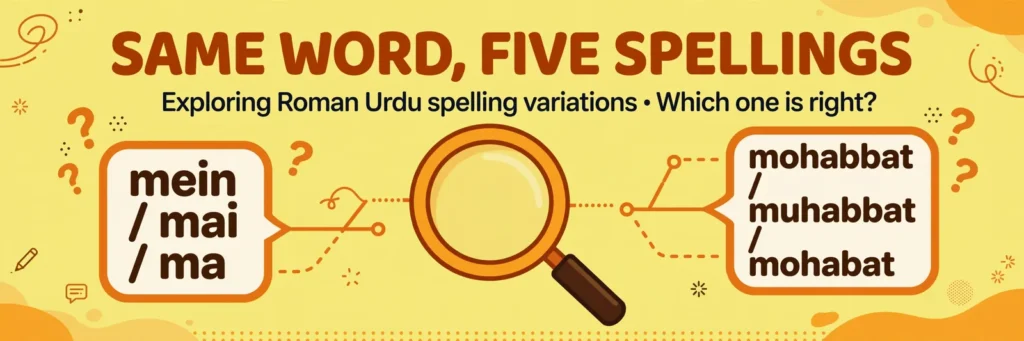
The table below shows eleven common words. Each has several Roman spellings. The last column explains the mechanism behind the variation. This is the clearest proof of why roman urdu has no standard spelling.
| Word (Urdu Script) | Meaning | Roman Variants | Why It Varies |
|---|---|---|---|
| محبت | love | mohabbat / muhabbat / mohabat | The short vowel on م is unwritten. Speakers shift a toward u. Fast typists drop the doubled consonant. |
| شکریہ | thank you | shukriya / shukria / shukriyaa | Final ی/ے maps to i, ee, e, or ai. Some writers double the vowel for emphasis. |
| ضروری | necessary | zaroori / zaruri / zarori | Writers disagree on the vowel sound: o or u. Both look right to different ears. |
| خوبصورت | beautiful | khoobsorat / khuobsrt / khubsuret / khobsorat | Accent differences change the vowels. SMS habits drop vowels entirely. |
| ہے | is | hai / hay / he / hei | Final ے becomes e, ai, or ee. The letter y often acts as a vowel. |
| کون | who | kaun / kon | The diphthong او becomes “au” or “o” by writer choice. |
| احتجاج | protest | ahtejaj / ehtijaj / aehtajaaj | The first short vowel is unwritten. Writers guess a, e, or ae. |
| نہیں | no / not | nahin / nahi / ni | Punjabi-influenced speakers shorten it to “ni.” Others keep the full form. |
| مجھے | to me | mujhe / mujhay / mughay | The جھ sound has no English match. Writers try jh, gh, or plain j. |
| بہت | very / much | bahut / bohat / buhat | The unwritten vowel after ب could be a or o. Writers split both ways. |
| چاہیے | want / need | chahiye / chahye / chahie | The یے ending maps to iye, ye, or ie. Nobody agrees. |
The Standards Nobody Uses
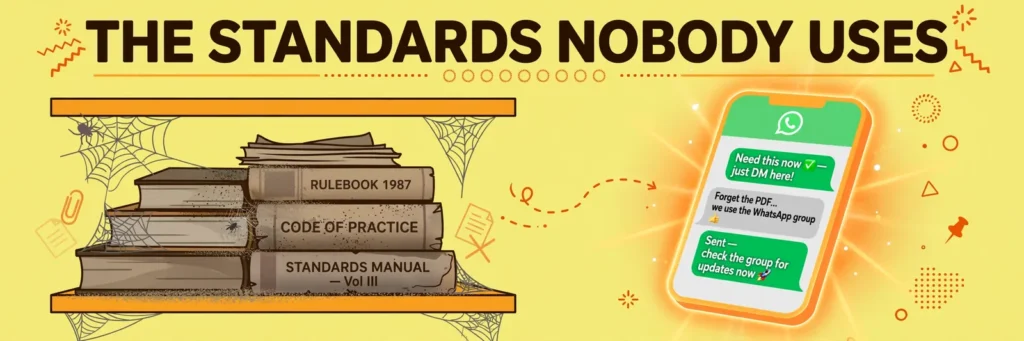
People did try to standardize Roman Urdu. Every attempt failed. These failures show why Roman Urdu has no standard spelling even today. The Hunterian system dates to the 1800s. Pakistan uses it for place names on maps. It writes “Lahore” and “Karachi” without special marks. Mapmakers needed ASCII-friendly names. The system never aimed at sentences or chats.
A UN committee proposed a system in 1972. No country ever used it. Uddin and Begum published an ASCII-only system in 1992. It promised one-to-one letter mapping. Nobody adopted it. Germany’s DIN 31635 covers Urdu romanization. It serves libraries, not chat apps. The Hamari Boli Initiative launched in 2011. It wanted to fix the script divide.
It gained no traction. These systems love diacritics: ā, ī, ū, ṭ, ḍ. Librarians can type them. Phone users cannot. That single fact killed every academic proposal. Four reasons explain every failure. First, no institution enforced the rules. Foreign map agencies and academics wrote the standards. Schools and tech companies ignored them. Second, diacritic schemes failed on phone keyboards. Users could not type special marks. Third, network effects locked in bad habits.
Billions of casual messages already existed. Each social circle reinforced its own spellings. Fourth, people saw no need. They understood each other fine without rules. You can read the official UN romanization documents yourself. They show how far formal systems sit from street usage.
What If Urdu Had a Pinyin?
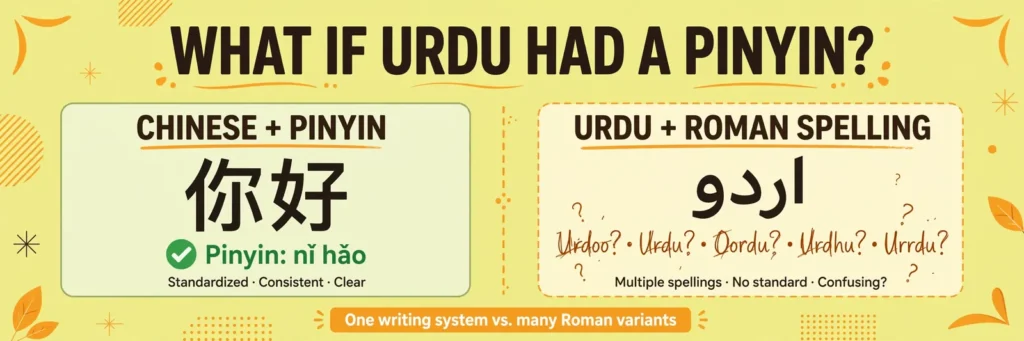
China solved this exact problem. In 1958, the Chinese state imposed Hanyu Pinyin. It replaced all rival romanizations. ISO adopted it in 1982. The UN followed in 1986. Schools teach it. Dictionaries use it. The whole world accepted one system. Turkey ran the same playbook earlier. In 1928, Atatürk switched Turkish from the Arabic to the Latin script.
The state enforced the change within months. Schools, newspapers, and laws moved together. Indonesia and Malaysia pulled off a joint reform in 1972. They unified their spelling systems by agreement. Both countries teach the shared system today. Roman Urdu never got this treatment. No state mandated a system. No curriculum taught one.
No international body adopted one. Could Pakistan still do it? Theory says yes. Practice says no. A standard needs enforcement to work. It needs schools, keyboards, and autocorrect behind it. Roman Urdu already has billions of messages in the wild. No decree can recall them. The realistic future is slow bottom-up convergence. Researchers already see spellings drifting toward consistency. But no committee will vote it into existence.
That enforcement gap is the deepest reason why Roman Urdu has no standard spelling while Pinyin succeeded. Read about how Pinyin won to see what enforcement looks like.
Why This Actually Matters
Classrooms feel the damage first. Teachers in Karachi, Islamabad, and Peshawar report the same trend. Pupils cannot read Nastaliq headlines. Some submit full assignments in Roman Urdu. One teacher requested “a Roman copy” of an Urdu reader.
The request sparked public outrage. Critics called it surrender. Defenders called it realism. The script weakens with each generation that types more than it reads. Culture warriors fight over the meaning. Purists call Roman Urdu a cultural loss. They see the Perso-Arabic script as heritage. Pragmatists answer with numbers. Roman Urdu keeps young people writing Urdu at all.
Without it, many would switch to English entirely. Both camps describe the same reality. Roman Urdu dominates digital life. Formal doors stay shut. No government office accepts Roman Urdu documents. Courts, schools, and banks require Urdu script or English. The variation itself blocks official use. A legal document cannot spell one word five ways.
What the Data Shows: Inside Roman Urdu Research
Scientists study this chaos up close. Their findings explain why Roman Urdu has no standard spelling at the data level. A 2026 peer-reviewed study analyzed thousands of real Roman Urdu tweets. It mapped each Urdu sound to its Roman spellings.
The vowel /e/ surfaced as “e,” “ai,” “i,” and “ee.” The vowel /u/ surfaced as “u,” “oo,” and “o.” The mappings followed habits, not rules. Sentiment-analysis researchers hit the same wall. A 2022 study in Applied Sciences built Roman Urdu datasets for emotion detection. Variant spellings exploded the vocabulary. The model met the “same” word in five disguises. It treated each disguise as a new word. Accuracy suffered.
Normalization researchers now build “unifiers.” These tools map variants like “mohabbat” and “muhabbat” to one standard form. A well-known 2020 paper on lexical normalization guides this work. The tools live in labs. They have not reached your keyboard. Tokenizers addanother wrinkle. They split text into chunks for AI models. Variant spellings split unpredictably. The same sentence tokenizes three different ways. Models learn noise instead of language.
Can AI Fix Roman Urdu Spelling?

Many users expect autocorrect to save them. It cannot. Autocorrect needs a “correct” form to suggest. Roman Urdu has none. Your keyboard learns your personal habits instead. It reinforces your spellings, right or wrong. Google Translate admits the problem openly. It handles Roman Urdu as informal, non-standard input.
Translation quality drops compared to Urdu script. The engine guesses through the variants. Sometimes it guesses wrong. Researchers proposed a smarter fix: normalization layers. These layers would standardize spellings before processing. Labs test them on research datasets. No major keyboard or app ships one yet. AI safety adds urgency. A 2026 analysis flagged a blind spot. Harmful content hides behind spelling variants.
Moderation models trained on standard text miss the disguised versions. Each variant acts as camouflage. The honest answer disappoints. AI reflects the chaos. It cannot legislate order. Only human institutions can do that. Their absence is the final reason why Roman Urdu has no standard spelling.
9 Tips for More Consistent Roman Urdu
No official rules exist. But you can still write cleaner Roman Urdu. These nine tips help. They cannot fix why Roman Urdu has no standard spelling. But they reduce daily confusion. First, pick one spelling for each word. Use it every time. Readers learn your style. Second, keep your vowels. Dropping vowels saves space. It also confuses readers. Third, write “hai” instead of “ha.” The full form looks cleaner. Fourth, use “oo” for long و.
Write “khoobsorat,” not “khobsorat.” Fifth, reserve “q” for ق. Write “qalam,” not “kalam.” Your reader sees the difference. Sixth, use capital T, D, and R for retroflex sounds. Write “Tooti,” not “tooti.” Seventh, show nasalization with “n.” Write “mein,” not “mei.” Eighth, spell English words in English. Write “future,” not “fiuchar.” Ninth, read your message aloud before sending. Your ear catches mistakes your eyes miss. None of these tips is official. All of them reduce confusion.
Roman Hindi Has the Same Problem
Urdu is not alone. Hindi faces the exact same chaos. Hindi and Urdu share grammar and everyday words. They differ mainly in script. Roman Hindi writers guess spellings the same way. A 2014 study found 84% of sampled Hindi Facebook posts used Roman script. Bollywood lyrics circulate in Roman Hindi. YouTube titles use it too. The causes match perfectly. No academy controls Roman Hindi either. Phone keyboards pushed the same shortcuts.
Vowel guessing works the same way. Hindi’s Devanagari script also hides sounds. It drops the inherent “a” vowel in many words. Writers must decide between “Ram” and “Rama.” Researchers study both together. A 2026 paper on Roman Hindi-Urdu orthography covers the shared problem. The two languages will likely converge together. Or they will stay messy together.
The Future of Roman Urdu Spelling
What happens next? Five predictions look safe. First, no official standard will appear soon. No institution wants the job. Second, spellings will slowly converge on their own. Researchers already see the drift. Popular variants win over rare ones. Third, keyboards will get smarter. Future autocorrect may learn Why Roman Urdu Has No Standard Spelling variants.
It will suggest your circle’s favorite spelling. Fourth, translation apps will add normalization layers. They will clean variants before translating. Google Translate may lead this change. Fifth, Roman Urdu will keep growing. Young users type it daily. The script divide will widen further. Schools will keep fighting it. None of this needs a committee. The crowd already votes with every message.
FAQs About Roman Urdu Spelling
Readers ask these questions about Why Roman Urdu Has No Standard Spelling again and again.
Is mohabbat or muhabbat the correct spelling?
Technically, “mohabbat” matches the Urdu script. The word محبت carries a zabar (a-sound) on م. But most speakers pronounce it closer to “muhabbat.” No official body settles the debate. Use “mohabbat” in formal writing. Expect “muhabbat” in chats.
Walima or Valima — which is correct?
Both appear in real usage. Urdu’s و can sound like “w” or “v” depending on the speaker. Quora debates on this exact question end the same way every time. No hard and fast rules govern transliteration. Pick one spelling and stay consistent.
Can I write exams in Roman Urdu?
No. Pakistani exams require the Urdu script (Nastaliq). Teachers already complain that students lean too hard on Roman Urdu. Learn the script for any formal purpose. Roman Urdu works for chats, not classrooms.
Will Roman Urdu ever get a standard spelling?
Probably not by decree. Standards need enforcement, and no institution has stepped up. Phone keyboards and network effects favor the status quo. Researchers do see slow natural convergence. But a voted-in standard looks unlikely.
Is Roman Urdu killing the Urdu script?
Tempers run high on both sides. Teachers report students who cannot read Nastaliq headlines. Purists call Why Roman Urdu Has No Standard Spelling a cultural loss. Pragmatists say it keeps Urdu alive among youth who would otherwise switch to English. Both sides agree on one fact. Roman Urdu dominates digital life.
What is the difference between romanization and transliteration?
Romanization converts a whole writing system into Roman letters. Transliteration maps letters one by one. For Urdu, neither process has a popular standard. Writers mix both approaches by instinct.
Do any dictionaries list Roman Urdu spellings?
No major dictionary standardizes Roman Urdu spellings. Learner books show ad-hoc romanizations. They differ from publisher to publisher. None carries official status.
Why does Google Translate struggle with Roman Urdu?
It expects standard input. Roman Urdu’s variants look like typos to the engine. It labels the input informal and non-standard. Quality drops compared to Urdu-script translation.
Is it ‘adab’ or ‘adaab’?
Write ‘adaab’ for greetings. The word آداب has a long ‘a’ sound. Doubling the vowel shows the length. ‘Adab’ spells ادب, which means literature or manners. Different word, different meaning.
What does ‘2mro’ mean in Roman Urdu chats?
It means ‘tomorrow.’ SMS users replaced ‘to’ with ‘2’ to save characters. So ‘2mro’ reads as ‘to-morrow.’ You will also see ‘4’ used for ‘for’ in mixed chats.
Can Roman Urdu be used for poetry?
Yes. Poets share Roman Urdu couplets on Instagram and Facebook daily. The ghazal tradition survives in Roman letters. Purists prefer Urdu script. Readers enjoy both.
How do I type in Urdu script instead of Roman Urdu?
Install an Urdu keyboard like Gboard’s Urdu layout. Switch keyboards when you want proper script. Most Pakistanis keep both keyboards active. Use Roman for speed and script for formality.
Conclusion
Why Roman Urdu has no standard spelling comes down to clear reasons. Nobody designed it. Urdu’s sounds overflow the English alphabet. Hidden vowels force guesswork. No authority enforces rules. Phones rewarded speed over consistency. Standards failed without enforcement. Other countries show what enforcement looks like. Pakistan never attempted it. The result is a living, messy, human system. It works because readers understand it anyway.
Want to master Roman Urdu yourself? Start with our Roman Urdu to Urdu: How Transliteration Works guide and 100 Common Roman Urdu Phrases With English Meanings.