
Roman Urdu to Urdu: How Transliteration Works
Type kya haal hai on your phone and watch it turn into کیا حال ہے — that magic is called transliteration. If you have ever wondered exactly Roman Urdu to Urdu: How Transliteration Works, this guide explains the whole process step by step. Transliteration means converting text from one script to another without changing the language: the words stay Urdu, only the letters change from Roman (English) to the Urdu script.
In this complete guide to Roman Urdu to Urdu: How Transliteration Works you will learn the full letter-by-letter mapping, the five key rules that govern the conversion, 40 common words and 20 sentences transliterated for practice, the mistakes beginners make, and the best tools that do it for you. By the end, you will understand exactly what happens every time Roman Urdu becomes Urdu script.
What Is Transliteration?
Transliteration is the process of writing the sounds of one language using the alphabet of another. When we talk about Roman Urdu to Urdu: How Transliteration Works, we mean taking Urdu words written in English letters (like shukriya) and rewriting them in the Urdu script (شکریہ). The pronunciation stays the same — only the writing system changes.
This is different from translation. Translation changes the meaning from one language to another (Urdu to English), while transliteration changes only the script within the same language. That is why understanding Roman Urdu to Urdu: How Transliteration Works is so useful: millions of Pakistanis type in Roman Urdu daily, and transliteration is the bridge that connects their typing to proper Urdu script.
How Roman Urdu to Urdu Transliteration Works: The Process
At its core, Roman Urdu to Urdu: How Transliteration Works follows three simple steps. First, the system (or your brain) reads the Roman letters and identifies each sound. Second, each sound is matched to its Urdu-script equivalent using a letter mapping — for example, sh becomes ش and kh becomes خ. Third, the Urdu letters are joined correctly, because Urdu script is cursive: letters change shape depending on whether they connect to neighbours.
The tricky part is that the mapping is not always one-to-one. A single Roman letter can represent several Urdu letters — s might become س, ص, or ث depending on the word. Good transliteration, whether done by a person who understands Roman Urdu to Urdu: How Transliteration Works or by software, uses context and dictionary knowledge to pick the right letter every time.
Consonant Mapping: Roman Letters to Urdu Script
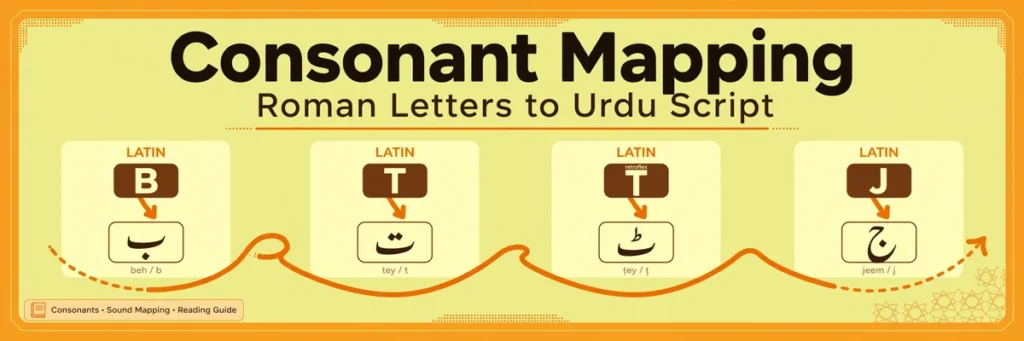
The foundation of Roman Urdu to Urdu: How Transliteration Works is the consonant map below. Learn these correspondences and you can transliterate most Urdu words. Notice the special cases: capital T, D, and R represent the hard retroflex sounds (ٹ, ڈ, ڑ), and pairs like kh, gh, th, and sh each map to a single Urdu letter.
Pay special attention to letters with multiple Urdu forms. The Roman h is usually ہ, but in Arabic-origin words it becomes ح (as in haal → حال). Similarly, s is normally س, but becomes ص in words like sabir → صابر. Context — not just letters — decides the final script.
| Roman | Urdu Script | Example |
|---|---|---|
| b | ب | bhai → بھائی |
| p | پ | pyaar → پیار |
| t | ت | tum → تم |
| T | ٹ | toot → ٹوٹ |
| th | تھ | thoda → تھوڑا |
| j | ج | jaan → جان |
| ch | چ | chai → چائے |
| h | ہ | hai → ہے |
| H | ح | haal → حال |
| kh | خ | khana → کھانا |
| d | د | dil → دل |
| D | ڈ | darna → ڈرنا |
| dh | دھ | dhoop → دھوپ |
| r | ر | raat → رات |
| R | ڑ | kapra → کپڑا |
| z | ز | zindagi → زندگی |
| s | س | salaam → سلام |
| sh | ش | shukriya → شکریہ |
| k | ک | kya → کیا |
| g | گ | ghar → گھر |
| l | ل | log → لوگ |
| m | م | main → میں |
| n | ن | nahi → نہیں |
| n (nasal) | ں | mein → میں |
| w | و | wahan → وہاں |
| y | ی | yaar → یار |
| f | ف | fikar → فکر |
| q | ق | qalam → قلم |
| gh | غ | gham → غم |
Vowels and Special Sounds
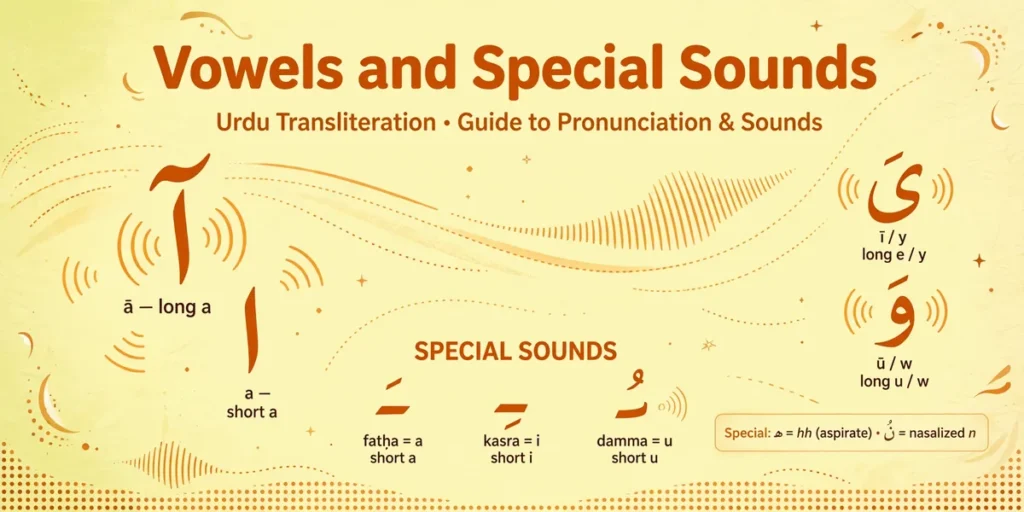
Vowels are where Roman Urdu to Urdu: How Transliteration Works gets interesting. Short vowels (a, i, u) are usually written as tiny diacritic marks — zabar, zer, pesh — or left out entirely in everyday writing. That is why dil becomes دل with no visible vowel mark: native readers know the i sound belongs there.
Long vowels get full letters: aa becomes آ or ا, ee becomes ی, and oo becomes و. Diphthongs like ai (اے) and au (او) each have their own forms. Master this table and the vowel half of Roman Urdu to Urdu: How Transliteration Works will feel natural.
| Roman | Urdu Script | Example |
|---|---|---|
| a (short) | zabar mark | kal → کل |
| aa | آ / ا | aap → آپ |
| i (short) | zer mark | dil → دل |
| ee | ی | meetha → میٹھا |
| u (short) | pesh mark | tum → تم |
| oo | و | door → دور |
| e | ے | ke → کے |
| ai | اے | hai → ہے |
| au | او | aur → اور |
| o | او | woh → وہ |
| an (nasal) | ں | mein → میں |
| kh | خ | khush → خوش |
5 Key Rules of Roman Urdu to Urdu Transliteration
Letter maps alone are not enough — these five rules explain the logic behind Roman Urdu to Urdu: How Transliteration Works in real words:
- One Roman letter can map to several Urdu letters. The Roman s may become س, ص, or ث; z may become ز, ذ, ض, or ظ; h may become ہ or ح. The correct choice depends on the word’s origin — usually its Arabic or Persian root.
- Short vowels are often invisible. In Roman Urdu to Urdu: How Transliteration Works, the a in kal, the i in dil, and the u in tum disappear into diacritics or nothing at all: کل, دل, تم. Do not look for a full letter for every vowel you hear.
- Double letters signal single special sounds. kh → خ, gh → غ, ch → چ, sh → ش, th → تھ, dh → دھ. When you see two Roman letters acting as one sound, they almost always become one Urdu letter.
- Capital letters mark hard sounds. Writers use T → ٹ, D → ڈ, R → ڑ, and H → ح to distinguish them from their soft cousins ت, د, ر, and ہ. Reading capitals correctly is essential to Roman Urdu to Urdu: How Transliteration Works.
- Nasal sounds use noon ghunna (ں). The n in mein (میں), nahin (نہیں), and haan (ہاں) is not a full ن — it is the nasal ں, written without dots. Getting this right instantly improves your transliteration.
40 Common Words: Roman Urdu to Urdu Script
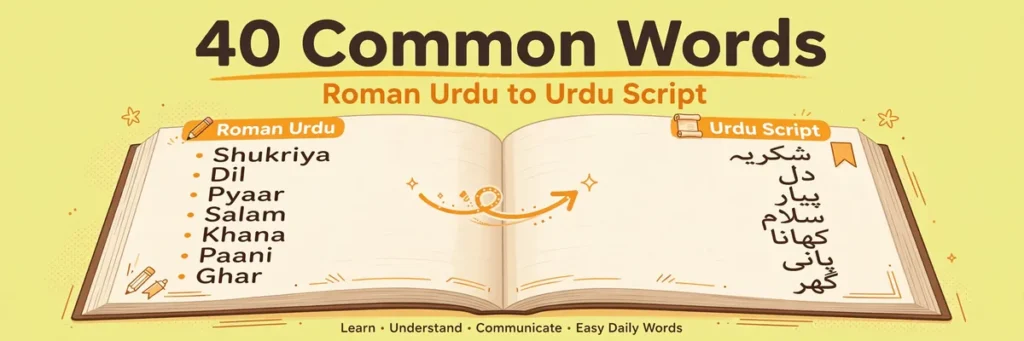
Time to practice. The table below shows Roman Urdu to Urdu: How Transliteration Works in action on 40 everyday words — greetings, feelings, home life, and daily essentials. Read the Roman column first, guess the Urdu script, then check the answer. Notice how the rules from the previous section apply: the invisible short vowels in دل and تم, the kh → خ in کھانا, and the nasal ں in میں.
Try covering the right column and transliterating each word yourself before peeking. This single exercise teaches more about Roman Urdu to Urdu: How Transliteration Works than memorizing the mapping tables alone, because your brain learns to apply the rules automatically.
| Roman Urdu | Urdu Script |
|---|---|
| Assalam-o-Alaikum | السلام علیکم |
| Wa Alaikum Assalam | وعلیکم السلام |
| Shukriya | شکریہ |
| Meherbani | مہربانی |
| Khuda Hafiz | خدا حافظ |
| Allah Hafiz | اللہ حافظ |
| Kya haal hai | کیا حال ہے |
| Main theek hoon | میں ٹھیک ہوں |
| Khush aamdeed | خوش آمدید |
| Mubarak ho | مبارک ہو |
| Bohot khoob | بہت خوب |
| Zabardast | زبردست |
| Kamaal hai | کمال ہے |
| Dil | دل |
| Pyaar | پیار |
| Mohabbat | محبت |
| Dosti | دوستی |
| Yaar | یار |
| Bhai | بھائی |
| Ghar | گھر |
| Khana | کھانا |
| Pani | پانی |
| Chai | چائے |
| Waqt | وقت |
| Din | دن |
| Raat | رات |
| Subah | صبح |
| Shaam | شام |
| Bazaar | بازار |
| Dukaan | دکان |
| Kitab | کتاب |
| Qalam | قلم |
| Ustaad | استاد |
| Bachay | بچے |
| Ammi | امی |
| Abbu | ابو |
| Khushi | خوشی |
| Gham | غم |
| Zindagi | زندگی |
| Duniya | دنیا |
20 Sentences: Roman Urdu to Urdu Script
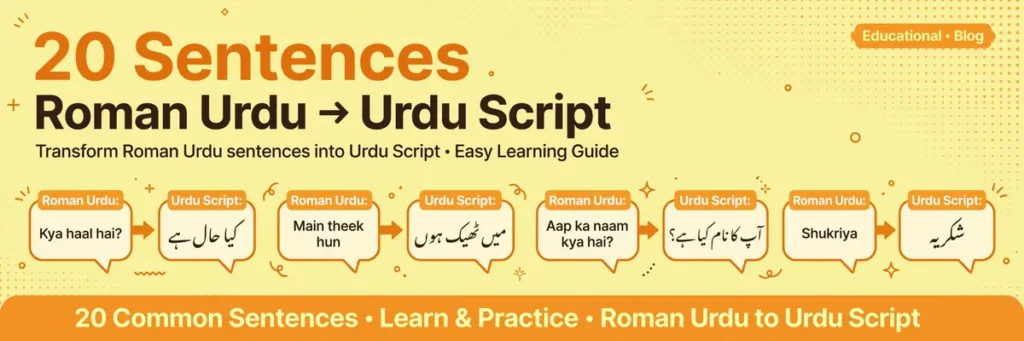
Words are the building blocks, but sentences show the real flow of Roman Urdu to Urdu: How Transliteration Works. In the table below, watch how words join together and how short vowels vanish: Mujhe bhook lagi hai becomes مجھے بھوک لگی ہے — the u in mujhe and the a in lagi are felt, not written.
Read each Roman sentence aloud first, then study its Urdu script form. Saying the sounds while looking at the script trains the exact skill that Roman Urdu to Urdu: How Transliteration Works is all about: hearing Roman letters and seeing Urdu script in your mind.
| Roman Urdu | Urdu Script |
|---|---|
| Mujhe bhook lagi hai | مجھے بھوک لگی ہے |
| Kya aap chai piyenge | کیا آپ چائے پئیں گے |
| Main kal bazaar gaya tha | میں کل بازار گیا تھا |
| Aap ka naam kya hai | آپ کا نام کیا ہے |
| Mujhe Urdu seekhni hai | مجھے اردو سیکھنی ہے |
| Mausam bohat acha hai | موسم بہت اچھا ہے |
| Woh mera dost hai | وہ میرا دوست ہے |
| Hum kal milenge | ہم کل ملیں گے |
| Kitne paise hue | کتنے پیسے ہوئے |
| Darwaza band kar do | دروازہ بند کر دو |
| Mujhe maaf kar den | مجھے معاف کر دیں |
| Allah aap ko khush rakhe | اللہ آپ کو خوش رکھے |
| Bachay school gaye hain | بچے اسکول گئے ہیں |
| Yeh kitaab meri hai | یہ کتاب میری ہے |
| Aap kahan rehte hain | آپ کہاں رہتے ہیں |
| Mujhe neend aa rahi hai | مجھے نیند آ رہی ہے |
| Khana tayyar hai | کھانا تیار ہے |
| Barish ho rahi hai | بارش ہو رہی ہے |
| Shukriya, aap ki meherbani | شکریہ، آپ کی مہربانی |
| Phir milenge, inshaAllah | پھر ملیں گے، انشاءاللہ |
7 Tips for Accurate Roman Urdu to Urdu Transliteration
Knowing the theory of Roman Urdu to Urdu: How Transliteration Works is one thing — doing it accurately every time is another. These seven practical tips will sharpen your skill fast:
- Memorize the mapping tables first. The consonant and vowel tables above are your foundation. Spend one focused session learning them before attempting full Roman Urdu to Urdu: How Transliteration Works practice.
- Say the word aloud. Your ears catch sounds your eyes miss. Pronouncing thanda slowly makes the تھ in ٹھنڈا obvious.
- Watch the capitals. T, D, R, and H are doing important work — they mark ٹ, ڈ, ڑ, and ح. Ignoring capitalization is the most common beginner error.
- Don’t write every short vowel. Resist turning dil into a fully voweled form. In standard Urdu script, short vowels stay invisible.
- Practice five words daily. Pick five words from the tables above each day and transliterate them from memory. Small daily reps beat weekend cramming.
- Check yourself with a tool. After manual practice, run your words through a transliteration tool to catch mistakes — instant feedback accelerates learning.
- Read real Urdu script. Nothing builds intuition like exposure. Read Urdu headlines, shop signs, or children’s books and notice how the script patterns match what you now know about Roman Urdu to Urdu: How Transliteration Works.
FAQs About Roman Urdu to Urdu Transliteration
What is transliteration?
Transliteration is converting text from one writing system to another without changing the language. In Roman Urdu to Urdu: How Transliteration Works, Urdu words written in English letters (shukriya) are rewritten in Urdu script (شکریہ) — the pronunciation stays identical.
What is the difference between transliteration and translation?
Transliteration changes only the script (Roman Urdu → Urdu script), while translation changes the meaning from one language to another (Urdu → English). Understanding Roman Urdu to Urdu: How Transliteration Works means mastering script conversion, not language conversion.
Is Roman Urdu to Urdu transliteration always exact?
Mostly, but not always. Because one Roman letter can map to several Urdu letters (like s → س, ص, ث), the correct choice depends on the word. This one-to-many mapping is the trickiest part of Roman Urdu to Urdu: How Transliteration Works.
Why do some Roman letters map to multiple Urdu letters?
Urdu inherited letters from Arabic and Persian that sound similar but are written differently — for example, ز, ذ, ض, and ظ all sound like z. History, not logic, decides which one a word uses, so memorizing common words is the practical shortcut.
What is the hardest part of Roman Urdu transliteration?
Two things: invisible short vowels (knowing that dil is دل with no written vowel) and choosing between look-alike letters (س vs ص, ہ vs ح, ت vs ٹ). Both become easy with the practice tables in this guide to Roman Urdu to Urdu: How Transliteration Works.
Can I use online tools for Roman Urdu to Urdu transliteration?
Yes — many keyboards and websites convert Roman Urdu to Urdu script automatically as you type. Try our free Urdu translator tool to see Roman Urdu to Urdu: How Transliteration Works in real time, then use this guide to understand what the tool is doing behind the scenes.
Conclusion
You now understand Roman Urdu to Urdu: How Transliteration Works — the letter mappings, the five key rules, and how 40 words and 20 sentences transform from Roman letters into beautiful Urdu script. Transliteration is a skill, not a talent: every word you convert by hand makes the next one easier.
Keep practicing with the tables above, and use a tool to double-check your work until the mappings feel automatic. Want to keep learning? Explore our 100 Common Roman Urdu Phrases With English Meanings, master Roman Urdu Sentences for Daily Conversation, discover Roman Urdu Slang and Their English Meanings, or start from Common Roman Urdu Words and Their English Meanings. Happy transliterating!