
Common Roman Urdu Spelling Mistakes
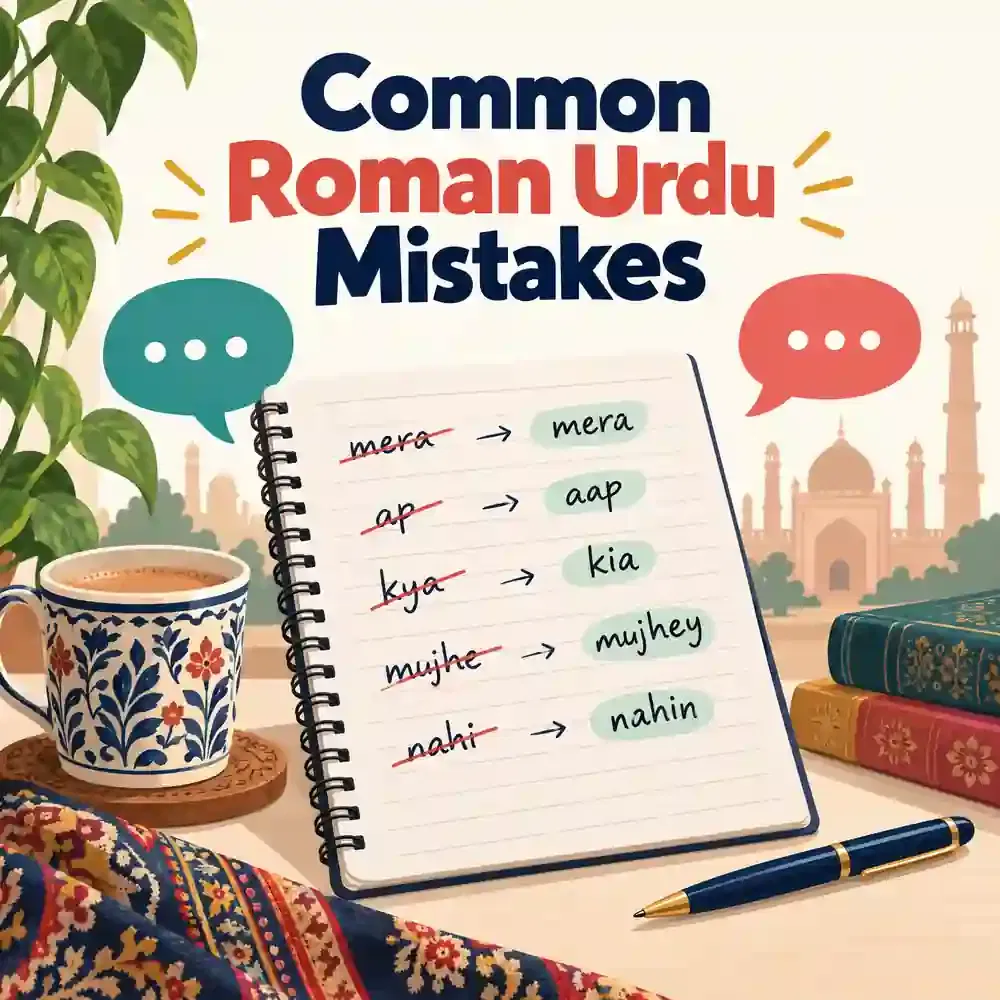
Common Roman Urdu Mistakes does not follow one universal spelling system. People write Urdu sounds with English letters in different ways. Academic research confirms this spelling variation across Roman Urdu text. One 2024 dataset found 5,244 Roman Urdu words with up to five spelling variants each.
So, not every different spelling counts as a mistake. Some forms work well in casual chats. Others make text harder to read. The goal should be clear and consistent Roman Urdu. Below are common Roman Urdu spelling mistakes and confusing variants.
| Common/Wrong | Recommended | Urdu | Explanation | Example |
| nahi | nahi / nahin | نہیں | Both forms appear widely. Use one form consistently. | Mujhe nahi pata. |
| muje | mujhe | مجھے | Mujhe represents the Urdu sound more clearly. | Mujhe ghar jana hai. |
| kia | kya | کیا | Kya keeps the consonant sound clear. | Tum ne kya kaha? |
| kese | kaise | کیسے | Kaise gives readers a clearer vowel pattern. | Aap kaise hain? |
| hy | hai | ہے | Hy works as texting shorthand. Hai suits normal writing. | Yeh mera ghar hai. |
| h | hai | ہے | Single-letter forms save typing time but reduce readability. | Woh yahan hai. |
| ap | aap | آپ | Aap clearly shows the long vowel. | Aap kahan ja rahe hain? |
| mjy | mujhe | مجھے | This abbreviation can slow down readers. | Mujhe ye kitab chahiye. |
| boht | bohat | بہت | Bohat makes the vowel easier to read. | Aaj bohat garmi hai. |
| bohot | bohat | بہت | Both forms appear in use. Bohat stays closer to common Urdu pronunciation. | Yeh bohat acha hai. |
| acha | achha | اچھا | Both forms appear in Roman Urdu. Achha shows the aspirated sound more clearly. | Yeh achha idea hai. |
| thik | theek | ٹھیک | Theek better signals the long vowel. | Sab theek hai. |
| karo | karo | کرو | This spelling already works well. Avoid unnecessary forms such as krro. | Apna kaam karo. |
| kr | kar | کر | Kr works in fast texting. Kar improves readability. | Yeh kaam kar lo. |
| mujy | mujhe | مجھے | The shortened form removes useful vowel information. | Mujhe samajh aa gaya. |
| kaisay | kaise | کیسے | Both can represent the same word. Kaise gives a simpler general style. | Aap kaise aaye? |
| larki | larki | لڑکی | Roman Urdu varies for the retroflex sound. Consistency matters more than forcing one universal form. | Woh larki meri dost hai. |
| q | kyun / kyoon | کیوں | Single-letter q can create confusion with other words. | Tum kyun nahi aaye? |
| nhi | nahi | نہیں | Nhi is common chat shorthand. It is less suitable for formal or educational writing. | Mujhe nahi pata. |
| apko | aap ko | آپ کو | Separating words improves readability. | Aap ko kya chahiye? |
| mujhe | mujhe | مجھے | Keep common words readable instead of shortening them without need. | Mujhe Urdu pasand hai. |

Roman Urdu Vowel Mistakes
Vowels cause many Roman Urdu spelling mistakes. Writers often use English letters to represent Urdu sounds. They may choose different letters for the same sound.
Common Roman Urdu Mistakes has no single spelling system. Research shows that users create many spelling variants for the same word. One dataset found 5,244 Roman Urdu words with one to five spelling variants.
This happens because Common Roman Urdu Mistakes often follows phonetic spelling. Writers spell words according to how they hear or pronounce them. Transliteration can also follow a fixed letter-to-letter system. These are different approaches.
A Simple Common Roman Urdu Mistakes Vowel Guide
| Sound pattern | Common forms | Example | Urdu | Pronunciation idea |
| a / aa | a, aa | kam / kaam | کم / کام | short a vs longer aa |
| i / ee | i, ee | din / deen | دن / دین | short i vs long ee |
| u / oo | u, oo | gul / gool | گُل / گول | short u vs long oo |
| e / ai / ay | e, ai, ay | mera / bhai / jaye | میرا / بھائی / جائے | different vowel patterns |
These spellings do not always map neatly to English vowel rules. Common Roman Urdu Mistakes has both short and long vowels, plus several other vowel qualities and diphthongs.
A vs Aa
Writers often use a and aa to show related vowel sounds.
Compare:
- kam — کم
- kaam — کام
- kal — کل
- kaal — کال
The extra a can show a longer vowel.
For example:
Mujhe yeh kaam karna hai. Here, aa helps readers recognize the longer vowel. Do not add aa randomly. It can change the word or make pronunciation unclear.
I vs Ee
Common Roman Urdu Mistakes writers often use i and ee for similar vowel sounds.
Examples include:
- din — دن
- deen — دین
- meri — میری
- meree — میری
The form ee often makes a long vowel more obvious. For general writing, avoid changing between forms without a reason. Yeh meri kitab hai. A reader can understand meree, but meri looks cleaner in most modern Roman Urdu.
U vs Oo
The same pattern appears with u and oo.
Examples:
- gul — گُل
- gool — گول
- dunya — دنیا
- doori — دوری
The spelling oo can signal a longer vowel.
However, Roman Urdu users do not follow this rule consistently. Some write u, while others prefer oo. Real-world Roman Urdu data contains many such spelling differences.
E vs Ai vs Ay
This group causes more confusion. Writers may use e, ai, or ay for sounds that feel similar.
Common examples include:
- mera — میرا
- bhai — بھائی
- kaisay — کیسے
- jaye — جائے
The choice often depends on pronunciation, typing habits, and personal spelling style.
For example:
Bhai, aap kaise hain?
A writer might instead use:
Bhai, aap kaisay hain? Both forms remain understandable. The difference mainly reflects the writer’s Roman Urdu style.
Why Do Roman Urdu Vowels Have So Many Spellings?
Common Roman Urdu Mistakes uses the Latin alphabet for Urdu. English letters do not provide a perfect one-to-one match for every Urdu sound.
Writers therefore develop their own conventions.
One person may write zindagi. Another may write zindagee. Both can represent the same Urdu word, زندگی. Researchers have documented this type of lexical variation in Roman Urdu.
Pronunciation also affects spelling choices. A writer may choose letters that feel closest to the sound they hear.
Typing speed adds another factor. Chat users often shorten words instead of showing every vowel.
So, vowel variation does not always mean poor Urdu knowledge.
How to Avoid Roman Urdu Vowel Mistakes
Use these simple Common Roman Urdu Mistakes vowel rules:
- Listen to the pronunciation first.
- Use aa for a clearly long “a” sound.
- Use ee when you need to show a long “i” sound.
- Use oo when it makes a long “u” sound clearer.
- Do not add vowels only because they look familiar.
- Keep the same spelling style throughout your text.
- Prefer spellings that most readers recognize quickly.
- Avoid texting shortcuts in formal or educational writing.
Roman Urdu Consonant and Sound Mistakes
Consonants cause many Common Roman Urdu spelling mistakes. Urdu has sounds that English letters cannot represent perfectly. Writers often combine two English letters to represent one Urdu sound. Common examples include kh, gh, bh, ph, th, and dh.
The main issue is not always a wrong spelling. Common Roman Urdu Mistakes has no single standard spelling system. People often spell words according to their pronunciation, typing habits, or personal style. Research also shows wide spelling variation in Roman Urdu text. Researchers use phonetic similarity, character patterns, and context to connect different spellings of the same word.
For example, kh commonly represents the Urdu sound خ. You can see it in words such as khana, khabar, and khubsurat. Writing kana instead of khana removes the sound that helps readers identify the original Urdu word. Using kh therefore gives readers a clearer pronunciation.
The same pattern appears with gh, which commonly represents غ. Words such as ghalat, gham, and ghair use this combination. Some people write galat instead of ghalat in casual messages. Readers may still understand the word from context. However, gh represents the original sound more clearly.
Aspirated consonants create another common problem. Common Roman Urdu Mistakes has aspirated sounds that involve a noticeable release of breath. Roman Urdu writers often show this sound by adding h after the consonant. For example, bhai represents بھائی, while bhool represents بھول. The same pattern appears in phool, thanda, and dhona.
This difference matters because ph and f do not represent the same sound. For example, phool represents پھول, while fool represents a different sound. However, everyday Roman Urdu does not always follow this distinction. Some writers use spellings based on their own pronunciation.
The same issue appears with th and dh. These combinations can represent aspirated Common Roman Urdu Mistakes consonants. The h helps readers understand that the sound differs from a simple t or d. Roman Urdu therefore uses English letters in ways that do not always follow English pronunciation rules.
The letter q creates another variation. Many transliteration systems use q for ق, such as qalam, qeemat, and qareeb. Everyday writers may use k instead, creating forms such as kalam, keemat, and kareeb. This does not always indicate poor spelling. It often reflects a more phonetic writing style.
The famous larki vs ladki example shows why Roman Urdu spelling needs context. The Urdu word لڑکی contains a retroflex consonant. Roman Urdu has no universally accepted everyday spelling for this sound. Writers may use larki, ladki, or a more formal transliteration with a special mark.
Calling one form automatically “wrong” can therefore mislead readers. These spellings show different ways of representing the same Urdu sound. Formal transliteration may preserve more information from the Urdu script. Everyday Roman Urdu usually favors simple spellings that people can type quickly.
This difference separates phonetic spelling from transliteration. Phonetic spelling focuses on how a word sounds. Transliteration focuses on representing the original script through another writing system. Common Roman Urdu Mistakes can use either approach, depending on the writer and purpose.
For general readers, clarity should come first. Use kh for خ and gh for غ when you want to show these sounds clearly. Use bh, ph, th, and dh when the extra h helps show aspiration. Use q when you want to preserve the distinction of ق. For words such as larki and ladki, recognize the variation instead of treating every difference as a spelling error.
The main rule is simple: Roman Urdu spelling should help readers recognize the word and understand its pronunciation. A different spelling does not always mean a mistake. The context, pronunciation, audience, and writing purpose all matter.
Common Roman Urdu Grammar Mistakes
Common Roman Urdu grammar mistakes often happen when learners apply English grammar patterns to Urdu. Roman Urdu uses Latin letters, but its grammar follows Urdu sentence patterns. Learners should understand subject, gender, number, and verb agreement to write Roman Urdu correctly.
Hai, Hain, and Hoon
One common mistake involves hai, hain, and hoon. The correct form depends on the subject. Use hoon with main, hai with most singular subjects, and hain with plural or respectful subjects. For example, “Main theek hoon” is correct, while “Main theek hai” is incorrect. Similarly, “Woh ghar par hai” works for a singular subject, while “Hum ghar par hain” uses the plural form.
Ka, Ki, and Ke
Learners also often confuse ka, ki, and ke. These words show possession or a relationship between nouns. Their form usually depends on the noun that follows. Use ka with a masculine singular noun, ki with a feminine noun, and ke with masculine plural nouns. For example, “Ali ka ghar,” “Sara ki kitaab,” and “Bachon ke khilone” follow the correct patterns. Using “Sara ka kitaab” creates a common agreement error.
Tha, Thi, and The
The forms tha, thi, and the describe past states and actions. Their use depends on gender and number. Use tha with a masculine singular subject, thi with a feminine singular subject, and the with masculine plural subjects. For example, “Ali ghar par tha,” “Sara ghar par thi,” and “Bachay ghar par the” follow the correct patterns. Learners often make mistakes when they use one form for every subject.

Pronouns
Pronouns also affect Roman Urdu grammar. Common pronouns include main, tum, aap, woh, yeh, and hum. The chosen pronoun can change the verb that follows it. For example, “Main ja raha hoon” uses main with hoon, while “Hum ja rahe hain” uses hum with hain. The pronoun aap usually takes plural agreement, even when you address one person. Therefore, “Aap kaise hain?” is correct.
Gender and Number Agreement
Roman Urdu follows grammatical gender and number. Adjectives and verbs can change according to the noun. For example, “Larka acha hai” uses a masculine adjective, while “Larki achi hai” uses a feminine form. Plural nouns also require agreement, such as “Larkay achay hain” and “Larkiyan achi hain.” English speakers often struggle with this rule because English adjectives usually do not change for gender.
Sentence Structure
Roman Urdu usually follows a Subject-Object-Verb (SOV) sentence structure. This means the verb often comes at the end of the sentence. For example, “Main kitaab parhta hoon” follows the natural Urdu order. English uses a different pattern in “I read a book.” Translating English word order directly can therefore create unnatural Roman Urdu sentences. Learning the basic SOV pattern helps learners form clearer sentences.
Understanding these Roman Urdu grammar rules makes writing and communication more accurate. Start with basic agreement rules, then practice pronouns, gender, nMake this section more SEO-focused
Common Roman Urdu Mistakes Slang and Texting
Common Roman Urdu Mistakes often changes in casual digital conversations. People shorten words to type faster. You may see forms like hy, h, kr, nhi, mjy, and ap in everyday messages. These forms work well when both people understand the context. However, they can reduce readability in longer or more formal content.
Common Roman Urdu Shortcuts
Common Roman Urdu Mistakes texting often removes vowels or shortens common words. For example, hy can represent hai, while h can also represent hai in very casual messages. Similarly, kr commonly represents kar, nhi represents nahin, mjy represents mujhe, and ap represents aap.
These shortcuts appear often on WhatsApp, SMS, and social media. They help people type quickly during casual conversations. However, they do not follow a standard spelling system. Different people may use different shortcuts for the same word.
When Is Shorthand Acceptable?
Shorthand works best in informal texting with friends, family, or people who understand your writing style. It can make quick conversations faster and more natural. You should avoid excessive shorthand in formal messages, academic work, professional communication, and public content.
For example, “Ap kb a rhy ho?” may work in a quick chat. A clearer version would say, “Aap kab aa rahe ho?” The second version takes slightly longer to type. It also makes the message easier to understand.
Casual Texting vs Readable Roman Urdu
Casual texting focuses on speed. Readable Roman Urdu focuses on clarity. Both styles can serve different purposes.
| Casual texting | Readable Roman Urdu |
| Ap kahan ho? | Aap kahan ho? |
| Mjy nhi pta | Mujhe nahi pata. |
| Main ghar ja rha hoon | Main ghar ja raha hoon. |
| Kr do pls | Kar do, please. |
| Kya kr rhy ho? | Kya kar rahe ho? |
How to Write Clear and Readable Roman Urdu
Clear Common Roman Urdu Mistakes helps readers understand your message without guessing. Roman Urdu has no single official spelling system. Writers can still follow simple rules for better readability. The goal is not perfect spelling. The goal is clear, consistent, and natural writing.
Keep Words Properly Spaced
Use spaces between separate words. Avoid joining several words into one long string. Proper spacing makes sentences easier to scan and understand.
Hard to read:
mujheajgharjana hai
Clear Roman Urdu:
Mujhe aaj ghar jana hai.
Keep common phrases together only when they form one natural expression. Avoid unnecessary spaces inside individual words.
Use Vowels Consistently
Roman Urdu uses English letters to represent Urdu sounds. Vowels can therefore vary between writers. One person may write kya, while another may use kia.
Choose one spelling and use it consistently within your content. Avoid switching between different forms without a reason.
For example, you could write:
- kya
- hai
- nahin
- mujhe
- aap
Consistency helps readers recognize words quickly. It also makes your Roman Urdu writing guide easier to follow.
Avoid Excessive Abbreviations
Short forms can make texting faster. They can also make Roman Urdu harder to understand. Forms such as kr, nhi, mjy, ap, and h suit casual chats. Complete words work better for guides, websites, educational content, and professional communication.
Compare:
Ap mjy bta do kya krna h.
with:
Aap mujhe bata do kya karna hai.
The second version takes more space. It also provides much better readability.
Use Punctuation
Punctuation gives Roman Urdu sentences structure. Use full stops, commas, question marks, and exclamation marks where they improve meaning.
Compare:
Aap kab aa rahe hain
with:
Aap kab aa rahe hain?
The question mark immediately shows the sentence’s purpose. Use commas when a natural pause helps separate ideas. Agar aap free hain, to mujhe bata dein. Avoid adding punctuation after every short phrase. Use it where it improves clarity.
Keep Your Spelling Consistent
Common Roman Urdu Mistakes does not have one universal spelling standard. You may find different spellings for the same Urdu word. This variation can confuse readers when it appears within the same article.
For example, choose either nahin or another established spelling. Do not switch between several forms without a clear reason.
The same rule applies to common words such as mujhe, aap, kya, and hai. Consistent spelling gives your content a cleaner and more professional appearance.
Roman Urdu Style Guide
Use this practical Roman Urdu Style Guide when writing longer content:
- Write complete words when readability matters.
- Keep separate words properly spaced.
- Choose simple and familiar spellings.
- Use vowels consistently.
- Limit texting abbr
Roman Urdu vs Transliteration and Language Variations
Common Roman Urdu Mistakes can look like standard transliteration, but the two are not always the same. Roman Urdu usually writes Urdu with the Latin alphabet. Writers often choose spellings based on sound, habit, or texting style. Transliteration follows a clearer system for representing the original script. Translation changes the meaning into another language.
Romanization vs Transliteration vs Translation
Romanization converts a language from its original script into the Latin alphabet. It can follow a standard system or a simpler phonetic style.
Transliteration maps characters from one script to another. A systematic method tries to represent the original letters consistently.
Translation works differently. It transfers meaning from one language into another. It does not simply change the writing system.
For example, an Urdu sentence can appear in Roman letters without becoming an English translation. The words remain Urdu. Only the script changes.
Phonetic Roman Urdu vs Systematic Transliteration
Most everyday Roman Urdu follows a phonetic approach. Writers choose letters that help readers reproduce the spoken sound. They may spell the same word in different ways.
A systematic transliteration system uses defined rules. The same Urdu character should normally receive the same Latin representation. This approach helps researchers, libraries, and language-technology systems process text consistently.
Everyday Roman Urdu has a different goal. It focuses on convenient reading and communication.
Why Can Kya and Kia Both Appear?
Roman Urdu does not have one universal spelling standard. This creates natural spelling variation.
Some writers use kya, while others write kia. Both forms can represent the same Urdu word. The choice often depends on pronunciation, regional habits, typing preferences, or personal style.
The same pattern appears with kaise and kese. Writers may choose different spellings while intending the same spoken word.
This variation does not always mean that one writer un

Frequently Asked Questions
Is Roman Urdu standardized?
No. Everyday Roman Urdu does not have one universal spelling standard. Different writers may use forms such as kya or kia, and nahi or nahin.
Is Roman Urdu grammatically correct?
Yes. Roman Urdu can follow correct Urdu grammar. Changing the script does not change Urdu grammar, sentence structure, gender, number, or verb agreement.
Is nahi or nahin correct in Roman Urdu?
Both forms can represent the Urdu word نہیں. Nahi is common in everyday online writing, while nahin can represent the pronunciation more explicitly.
Is kya or kia correct in Roman Urdu?
Both spellings are used. Kya is a common everyday spelling, while kia also appears in informal Roman Urdu. Consistency matters more than choosing one universal form.
How can I improve my Roman Urdu writing?
Use clear spellings, proper word spacing, basic punctuation, and correct Urdu grammar. Avoid excessive texting shortcuts and keep your spelling consistent throughout the content.
Should I use Roman Urdu or Urdu script?
Choose based on your audience and purpose. Roman Urdu works well for online communication and readers who prefer Latin letters. Urdu script is better when you need the standard written form of Urdu.
Conclusion
Roman Urdu makes Urdu easier to type and access across digital platforms. It uses the Latin alphabet while keeping the core structure of Urdu.
There is no single spelling rule for everyday Roman Urdu. Variations such as kya and kia, or nahi and nahin, are common. The key is clarity, consistency, and correct grammar.
Good Roman Urdu should be easy to read and understand. Avoid unnecessary abbreviations, keep words properly spaced, and follow basic Urdu grammar rules.
Whether you use Roman Urdu for texting, social media, websites, or everyday communication, choose a style that suits your audience. With regular practice and attention to spelling, you can write clear and natural Roman Urdu with confidence.