
How to Translate Roman Urdu Messages Into Natural English
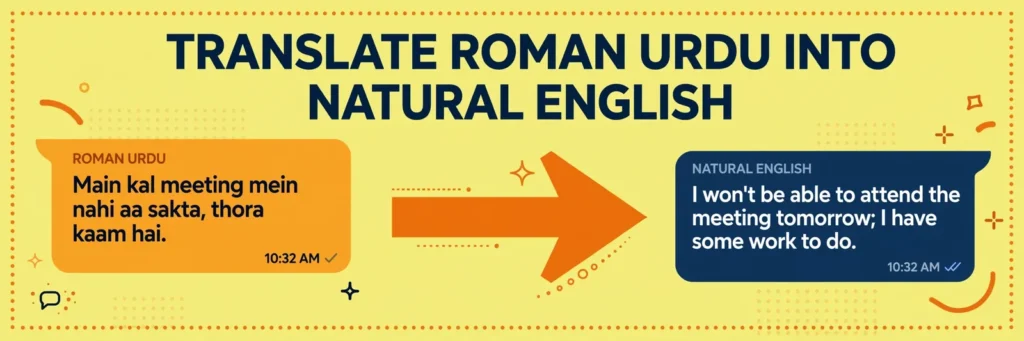
You open WhatsApp. A message reads: “yar kal mera scene on hai, tum time pe aa jana.” You get the meaning. But when you try to say it in English, it comes out broken. Learning how to translate Roman Urdu messages into natural English fixes exactly that.
This guide fixes that. You will learn a simple 5-step method called MINT. You will see 15 real messages translated the natural way. You will learn how to match tone, decode slang, and avoid the 7 mistakes that make translations sound stiff. In other words, this is how to translate Roman Urdu messages into natural English the right way.
By the end, any Roman Urdu message will turn into smooth, natural English. Funny, formal, or full of slang — all of them. You will know how to translate Roman Urdu messages into natural English for every chat you open. Let’s start.
Note: this guide covers Roman Urdu (Urdu written in English letters). If your WhatsApp messages are in Urdu script, see our guide: How to Translate Urdu WhatsApp Messages into English.
What “Natural English” Actually Means
Natural English sounds like a native speaker wrote it. It flows. It fits the situation. Nobody pauses to decode it.
Literal translation does the opposite. It swaps each Roman Urdu word for its English match. The result is technically related to the original. It just sounds wrong.
Look at this message: “mera dil nahi kar raha.”
Literal: “My heart is not doing.”
Natural: “I don’t feel like it.”
Both point at the same feeling. Only one sounds like English. That gap — between literal and natural — is the wh
Why Word-for-Word Translation Fails
Three structural differences break word-for-word translation. Once you see them, you will stop making the error.
1. Word order flips. Urdu follows Subject-Object-Verb order. English follows Subject-Verb-Object. “Mein ne us ko dekha” becomes “I him saw” if you translate in order. Natural English needs “I saw him.” You must rearrange, not just replace.
2. Idioms don’t survive the trip. Every language packs meaning into fixed phrases. “Tum ne to had kar di” literally means “you did the limit.” A native speaker says “You’ve gone too far.” The words differ completely. The meaning matches perfectly.
3. Small words go missing. Urdu often drops articles and helper verbs. “Wo teacher hai” maps word-for-word to “he teacher is.” English needs “He is a teacher.” You must add the small words Urdu skips.
The fix is simple: translate meaning, not words. (Curious how letters map between scripts first? Read our guide o.)n Roman Urdu to Urdu: How Transliteration Works
The 5-Step MINT Method
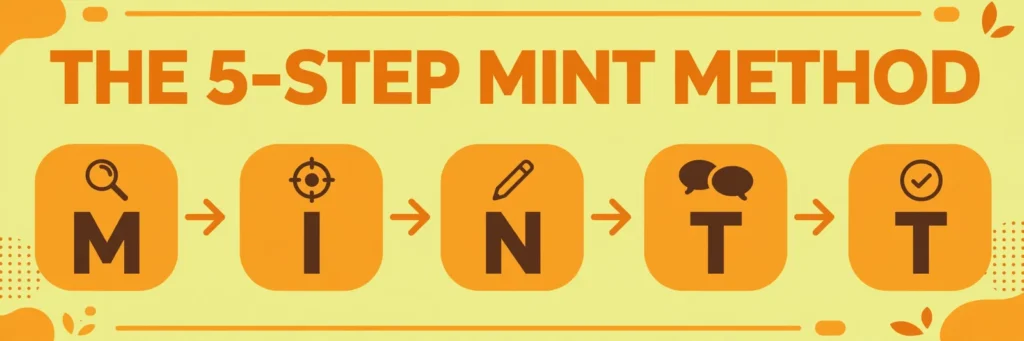
Meet MINT. It is a repeatable framework for translating any Roman Urdu message into natural English. Four letters, five steps. Use it every time and your translations will sound human. Master it, and you will know how to translate Roman Urdu messages into natural English every time.
Step 1 — M: Meaning first. Read the whole message before touching a single word. Ask: what is this person actually saying? Ignore the individual words. Grab the core idea. Example message: “kal mera scene on hai.” Core idea: plans confirmed for tomorrow.
Step 2 — I: Intent. Why did they send this? Are they informing, requesting, joking, or complaining? Intent shapes everything. “Tum time pe aa jana” is a request wrapped in friendly tone. You need that context before choosing English words.
Step 3 — N: Natural draft. Now write the English version — fast and loose. Don’t polish yet. Just get the meaning into English word order (SVO). For our example: “I have plans tomorrow. Come on time.” Ugly but correct. That is fine for a draft.
Step 4 — T: Tone match. Who is the reader? A friend gets casual English. A boss gets polished English. Adjust your draft now. Friend version: “Hey, I’ve got plans tomorrow — be on time!” Boss version: “Just confirming our plans for tomorrow. Please be on time.”
Step 5 — Tidy check. Read your English aloud. Does it sound like something a native speaker would actually say? Fix anything stiff. Cut extra words. “Hey, plans are on for tomorrow — see you on time!” Done. Natural.
Run every message through MINT: Meaning, Intent, Natural draft, Tone, Tidy. Five steps, thirty seconds, natural English. Make it a habit, and you will master how to translate Roman Urdu messages into natural English.
15 Worked Examples: Roman Urdu to Natural English
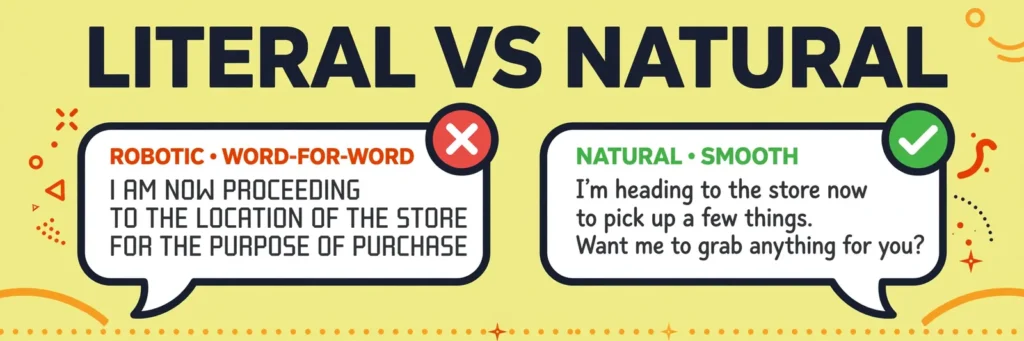
Theory is nice. Examples make it stick. Each row shows the original message, the robotic literal version, and the natural English you should actually use. Study them to see how to translate Roman Urdu messages into natural English in real chats.
| Roman Urdu Message | Literal (Robotic) | Natural English |
|---|---|---|
| yar kal mera scene on hai, tum time pe aa jana | friend tomorrow my scene is on, you time on come | Hey, I’ve got plans tomorrow — be on time! |
| mera dil nahi kar raha bahar janay ko | my heart is not doing to go outside | I don’t feel like going out. |
| us ne mujhe phasa diya | he stuck me | He threw me under the bus. |
| tum ne to had kar di | you did the limit | You’ve gone too far. |
| khana kha liya? | food ate? | Have you eaten? |
| mujhe tum se ek zaroori baat karni hai | to me with you one important talk to do is | I need to discuss something important with you. |
| us ki tabiyat theek nahi hai | his health fine not is | He’s not feeling well. |
| tum fikar na karo, sab set ho jaye ga | you worry not do, all set will become | Don’t worry, everything will work out. |
| mein thora late ho jaun ga, traffic bohat hai | I a little late will become, traffic much is | I’ll be a bit late — there’s heavy traffic. |
| chalo koi baat nahi, next time sahi | come no matter, next time right | No worries, maybe next time. |
| mujhe tumhari bohat yaad aa rahi hai | to me your much memory is coming | I miss you so much. |
| boss ne chutti cancel kar di | boss holiday cancel did | The boss cancelled my leave. |
| mera dimagh kharab ho raha hai | my brain bad is becoming | I’m losing my mind. |
| ghar pohanch kar call karna | home reaching call do | Call me when you get home. |
| tum ne mera din bana diya | you my day made gave | You made my day! |
Notice the pattern. Natural versions reorder words, swap idioms, and add small English words. The last row proves a point: sometimes literal works. When it does, keep it. Spot the pattern, and you already know how to translate Roman Urdu messages into natural English.
Match the Tone: Friend, Family, Boss, Client
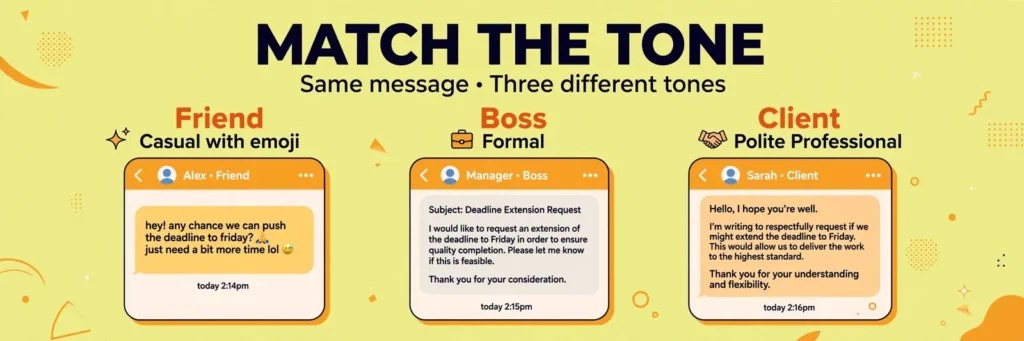
Same message, four audiences, four different English versions. Tone matters as much as meaning. Get it wrong and you sound rude — or weirdly stiff. Tone control is half of learning how to translate Roman Urdu messages into natural English.
Take one intent: telling someone you can’t come tomorrow.
| Audience | Roman Urdu | Natural English |
|---|---|---|
| Friend | sorry yaar, kal nahi aa sakun ga | Sorry man, can’t make it tomorrow. |
| Family elder | maazrat, kal hazir nahi ho sakun ga | I apologize, I won’t be able to come tomorrow. |
| Boss | sir, kal mein available nahi hun ga | Sir, I will be unavailable tomorrow. |
| Client | maazrat, kal meeting possible nahi ho gi | Apologies — a meeting tomorrow won’t be possible. |
Two tactics handle the hard parts. First, compensate for “aap.” English has no formal “you.” Add “sir,” “please,” or “I would appreciate” to carry the respect. soften commandsSecond, . “Tum time pe aa jana” to a friend is “be on time!” To a client it becomes “Please be on time.” Same meaning, different wrapping.
Quick rule: match the relationship first, translate second. When in doubt, go one level more polite. Nobody ever got offended by extra politeness.
Slang and Abbreviations: Decode First, Translate Second
Slang breaks translators because tools read it literally. Humans should do the opposite. Use a two-pass workflow: decode first, translate second.
Pass 1: expand every short form into full Roman Urdu. Pass 2: run the full version through MINT. These two passes teach you how to translate Roman Urdu messages into natural English slang without guessing.
| Message | Pass 1: Decoded | Pass 2: Natural English |
|---|---|---|
| scene on hai, kal miltay hain | plan confirm hai, kal miltay hain | We’re on for tomorrow! |
| jugaar laga li hai, fikar na kar | intezam kar liya hai, fikar na kar | I’ve worked something out, don’t worry. |
| tension na le, sab ho jaye ga | pareshan na ho, sab ho jaye ga | Don’t stress, it’ll all work out. |
| full timepass ho raha hai | bas waqt guzar raha hai | Just killing time. |
| brb, ammi bula rahi hain | abhi aaya, ammi bula rahi hain | BRB — mom’s calling me. |
Common traps: “scene” never means a movie scene in chats. “Jugaar” has no single English word — “workaround” or “fix” comes closest. And “2mro” is just “tomorrow” with SMS-era spelling.
For a full decoder ring, see our Roman Urdu Abbreviations Used in WhatsApp.
When Half the Message Is Missing: Recovering Context
Roman Urdu chats skip words constantly. Subjects vanish. Verbs blur. You must play detective before translating.
Implied subjects. “Kal aa raha hun” — who is coming? The “mein” is missing but implied. Read the thread. If your friend wrote it, the subject is “I”: “I’m coming tomorrow.” Never guess blindly. One wrong pronoun changes everything.
Blurry verbs. “Kar diya” can mean did, has done, or will have done — depending on context. “Us ne kaam kar diya” in a status update means “He has done the work.” In a story about yesterday, it means “He did the work.” The surrounding messages tell you which.
The graceful “matlab?” When context fails, ask. “Matlab?” (meaning?) is not embarrassing. It is smart. Better one clarifying question than a confident mistranslation. Try: “Yeh wala part samajh nahi aaya — thora explain karo?” Then translate the clarified version.
Three examples of context rescue:
- “Wo aa gaya?” (No subject, no context) → Check the thread: they were waiting for Ahmed → “Has Ahmed arrived?”
- “Kar liya, bhej diya” → Previous message asked for the report → “Done — I’ve sent it.”
- “Theek hai, dekhte hain” → Sounds agreeable, but tone says doubtful → “Alright, we’ll see.” (Not “Okay, we watch.”)
Google Translate vs ChatGPT vs Doing It Yourself

Tools help. They also fail in predictable ways. Here is the honest breakdown. No app alone teaches you how to translate Roman Urdu messages into natural English — this table shows why.
| Google Translate | ChatGPT / AI Chatbots | Doing It Yourself (MINT) | |
|---|---|---|---|
| Speed | Instant | ~10 seconds | ~30 seconds |
| Slang handling | Poor — reads literally | Good with the right prompt | Best — you know the context |
| Tone control | None | Good if you instruct it | Full control |
| Privacy | Message goes to Google | Message goes to the AI company | Fully private |
| Needs internet | Yes (mostly) | Yes | No |
Why tools struggle: researchers documented this years ago. A peer-reviewed study on Roman Urdu machine translation found that the lack of standard spelling breaks rule-based systems — the same word appears in five forms, so the tool can’t learn it reliably (Transtech, PMC 2019). No standard spelling means no reliable training data. (We explain the root cause in Why Roman Urdu Has No Standard Spelling.)
Gboard Translate tip: open Gboard, tap the Translate icon, set input to Urdu. If the option doesn’t appear, update Gboard and enable it in Settings → Languages. Many users never find this button — now you know where it hides.
Best ChatGPT prompt: don’t just paste the message. Add: “Translate this Roman Urdu WhatsApp message into natural, polite English. Don’t translate word-for-word.” That one
instruction fixes 80% of robotic output. Always re-read before sending.
7 Mistakes That Make Your English Sound Robotic
Mistake 1: Translating idioms literally. “Us ne mera sir kha liya” → “He ate my head” → “He drove me crazy.” Idioms never survive literal translation. Learn the English equivalent instead.
Mistake 2: Keeping Urdu word order. “Mein ne kitab parhi” → “I book read” → “I read the book.” English needs Subject-Verb-Object. Rearrange every time.
Mistake 3: Dropping articles. “Wo doctor hai” → “He is doctor” → “He is a doctor.” Urdu skips “a” and “the.” English needs them. Add them back.
Mistake 4: Wrong tense from “kar diya.” “Us ne message bhej diya” → “He sent the message” (when it just happened) → He has sent the message.” Match the tense to the moment, not just the verb.
Mistake 5: Translating filler words. “Toh phir mein kya karun?” → “So then what I do?” →”So what should I do?” Fillers like “toh” and “phir” often vanish in natural English. Don’t force them in.
Mistake 6: Losing the “aap” respect. “Aap baithiye” → “You sit” → “Please have a seat.” English “you” carries no formality. Add “please” or “sir” to compensate.
Mistake 7: Guessing the gender. “Wo aa rahi hai” → “He is coming” → “She is coming.” Urdu “wo” hides gender; the verb ending (“rahi”) reveals it. Check verb endings before choosing he/she.
Practice: Translate These 10 Messages Yourself
Try each one with the MINT method. Answers are below — no peeking! Each one trains you in how to translate Roman Urdu messages into natural English.
- kal miltay hain, chai meri taraf se
- sorry yaar, mein bhool gaya tha
- tumhari presentation bohat achi thi
- mujhe kal tak jawab chahiye
- ghar pohanch kar message kar dena
- yeh idea bilkul bekaar hai
- tum ne mujhe bohat hansaya
- please mujhe thora time do
- us se kehna mein naraz nahi hun
- shabash! tum ne kar dikhaya
Answers:
- Let’s meet tomorrow — tea’s on me!
- Sorry man, I forgot.
- Your presentation was really good.
- I need an answer by tomorrow.
- Text me when you get home.
- This idea is completely useless.
- You made me laugh so hard.
- Please give me some time.
- Tell him I’m not upset.
- Well done! You did it!
How many did you get right? Seven or more means MINT is already working. Want more practice material? Try our 100 Common Roman Urdu Phrases and Daily Conversation Sentences.
Words You Don’t Know? Look Them Up Right
Every message has that one mystery word. Here is how to crack it.
Step 1: Guess from context. Read the full sentence. Often the meaning is obvious. “Us ne mujhe ___ diya” with a 🎁 probably means “gift.” Context solves half of unknown words.
Step 2: Search smart. Type the word into Google with “meaning in English.” Roman Urdu words often appear in lyrics sites and forums with translations. Try variant spellings too — remember, spelling isn’t standard.
Step 3: Ask a native speaker. Send the word to a friend: “Yeh lafz ka kya matlab hai?” One message, instant answer. Native speakers decode slang that no dictionary lists.
Step 4: Build your own list. Keep a phone note of new words with their English meanings. Review it weekly. Your personal dictionary grows fast. Start with our Common Roman Urdu Words and Their English Meanings.
When to Ask a Human Instead
MINT handles daily chats. Some messages need a professional.
Legal or medical messages. A mistranslated prescription or contract clause has real consequences. Don’t risk it. Use a certified translator.
Customer support tickets. Your company’s reputation rides on these. If the Roman Urdu is complex or angry, get a bilingual colleague to review your English version.
Poetry and jokes. Wordplay dies in translation. “Wah, kya baat hai” carries warmth no English sentence fully captures. For poetry, commission a human who understands both cultures.
Anything high-stakes. Job applications, visa documents, official complaints. When the cost of error is high, human review is cheap insurance.
For everything else — friends, family, daily chats — MINT is all you need. It is the complete toolkit for how to translate Roman Urdu messages into natural English in daily life.
FAQs: How to Translate Roman Urdu Messages Into Natural English
Can Google Translate convert Roman Urdu messages to English?
Yes, for simple sentences. Paste the message and set the input language to Urdu. It handles basic grammar fine. It struggles with slang, abbreviations, and long chats. For those, the MINT method beats the tool every time.
Why does my Roman Urdu translation sound robotic in English?
You translated word-for-word instead of meaning-for-meaning. Urdu word order and idioms don’t map directly to English. Fix it with the MINT method: grab the meaning first, then rebuild the sentence in natural English order. That shift is the heart of how to translate Roman Urdu messages into natural English.
How do I translate Roman Urdu slang into English?
Decode first, translate second. Expand every short form into full Roman Urdu. Then translate the full version. “Scene on hai” becomes “plan confirm hai” becomes “We’re on!” Never translate slang literally.
Can ChatGPT translate Roman Urdu WhatsApp messages accurately?
Yes, with the right instruction. Paste the message and add: “Translate into natural, polite English — not word-for-word.” This fixes most robotic output. Always re-read the result before sending it anywhere important.
How do I keep the original tone when translating?
Identify the relationship first. Friend, elder, boss, or client? Then pick your English register. Compensate for “aap” with “please” or “sir.” When unsure, go one level more polite than you think you need.
What if I don’t understand a Roman Urdu word in the message?
Guess from context first — it works half the time. Then search the word with “meaning in English.” Then ask a native speaker. Keep a personal word list so you only look things up once.
Is there an app that translates Roman Urdu chats automatically?
Google Translate and Gboard Translate handle basics. AI chatbots do better with slang. New tools built for Roman Urdu keep appearing. All of them still miss tone and context that a human catches instantly.
How long does it take to get good at this?
A few weeks of daily practice with the MINT method. Translate two or three real messages a day. Review your English out loud. Most people feel the shift within a month — messages start converting naturally in their head.
Conclusion: Your Next Message in Natural English
You now have everything: the Meaning-first habit, Intent reading, Natural drafting, Tone matching, and a Tidy check. Five steps. Thirty seconds. Natural English.
Start small. Take the next Roman Urdu message you receive. Run it through MINT. Read your English aloud. Notice how different it feels from the old word-for-word version. Every small win builds your skill in how to translate Roman Urdu messages into natural English.
Translation is a skill, not a talent. Every message you convert makes the next one easier. Your English-speaking friends will thank you — and your Roman Urdu friends will never know the difference. Soon, knowing how to translate Roman Urdu messages into natural English will feel automatic.