
100 English Sentences Translated Into Roman Urdu
Millions of Pakistanis type in Roman Urdu every day. They message parents on WhatsApp. They comment on Instagram reels. They write captions their friends read in seconds. For many, Roman Urdu is the only practical way to write Urdu. Phones had no Urdu keyboards in the SMS era, and the habit never left.
Here is the problem. You want to say something in English, but you need it in Roman Urdu. Maybe you are learning English through Urdu. Maybe you text family abroad who cannot read the Urdu script. Maybe you want natural sentences for daily use. You search online, and every list is Urdu-script-first. If you cannot read that script, those lists block you instead of helping you.
Machine translation does not solve it either. Google Translate handles single Roman Urdu words, but it breaks on full sentences. It has rendered simple market sentences as nonsense. Real users complain about wrong results for full Roman Urdu sentences again and again. You cannot trust it for real conversations.
This guide fills the gap. You get 100 English sentences translated into Roman Urdu first. Roman Urdu is the hero here, not an afterthought. Each sentence also shows the Urdu script as a secondary reference. Nine real-life categories cover your whole day, from morning greetings to late-night WhatsApp chats. Usage notes tell you when to use “aap” and when to use “tum.” Pronunciation notes cover the five sounds English speakers get wrong. A final section warns you about eight phrases you should never translate literally.
For word-level meanings, the Rekhta Dictionary is a reliable reference, and Roman Urdu is the informal Latin-script writing system widely used online.
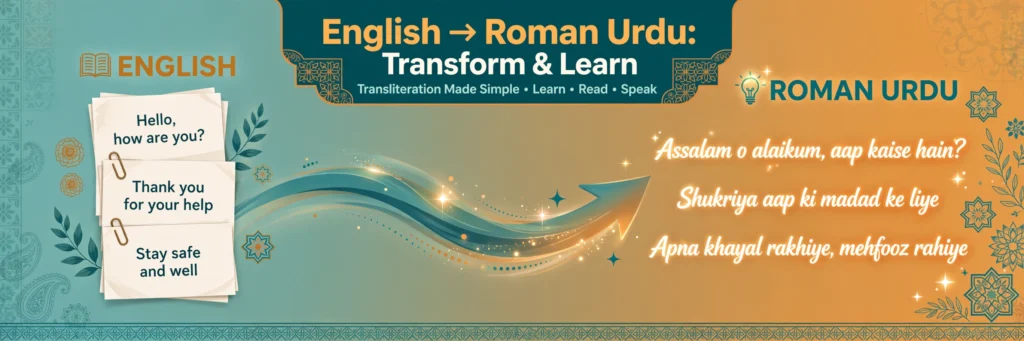
How to Use This List 100 English Sentences Translated Into Roman Urdu
Do not try to memorize all 100 English Sentences Translated Into Roman Urdu in one day. That never works. Cramming gives you a list in your head and nothing in your mouth. Instead, follow a simple daily method that actually sticks.
Pick one category per day. There are nine, so the full cycle takes just over a week. Read five sentences aloud, slowly. Hearing yourself say them trains your mouth, not just your eyes. Then use at least two of them in a real WhatsApp chat the same day. Real use locks a sentence in your memory. A sentence you have typed to a real person stays with you.
Keep a small notebook or phone note. Write down the five sentences you practiced and tick the ones you actually used. Review the ticks every Sunday. The sentences with no ticks need another round. This takes ten minutes a day.
One more technique: shadowing. Play a sentence in your head, then say it immediately after, copying the rhythm. Do it three times per sentence. It feels silly. It works anyway.
Do not jump between categories randomly. Finish greetings before you touch shopping. Each category builds one situation completely. When you can handle a full market trip or a full phone call, you feel the progress. That feeling keeps you going.
Aap or Tum? A Quick Register Guide
English has one word: “you.” Urdu has three levels, and choosing wrong changes how people see you. This matters in almost every sentence below, so learn it in one minute.
Use aap with elders, strangers, shopkeepers, doctors, and everyone at work. It shows respect. Most sentences in this guide use “aap” as the safe default. When you are unsure, “aap” is never wrong.
Use tum with friends, siblings, cousins, and people your own age. It sounds warm and casual. The WhatsApp section of this guide uses “tum” because friends text that way. Texting “aap” to a close friend reads stiff and creates distance.
Avoid tu. It is very informal and intimate. Outside your closest circle, it can sound disrespectful. Learners should simply not use it until a native speaker invites them to.
Now the number-one learner mistake: verb mismatch. The pronoun and the verb must agree. “Aap” always pairs with “hain” — “aap kaise hain.” “Tum” always pairs with “ho” — “tum kaise ho.” Learners constantly mix these and produce “aap kaise ho.” Native speakers notice instantly. Memorize the pairs, not just the pronouns.
Two small respect markers help a lot. Add “ji” after a name with elders — “Ali ji.” In professional settings, use “janab” for sir and “mohtarma” for madam. Skipping these reads as overly casual.
One last note: Urdu verbs change with the speaker’s gender. This guide uses the masculine form as the default, for example “karunga.” If you are female, change the final “a” to “i” — “karungi.” The meaning stays exactly the same.
Roman Urdu Pronunciation — 5 Tricky Sounds
Roman Urdu uses English letters for Urdu sounds. Five sounds have no English equivalent, and English speakers flatten all of them. Getting them right is the fastest way to sound natural.
kh comes from deep in the throat, near the uvula — like a soft clearing of the throat. “Khana” (food) is not “kana.” Practice by whispering a “k” while tightening the back of your throat. Do not confuse it with plain “k.”
gh is a deep, throaty “g,” like a gentle gargle. “Ghar” (home) needs that depth. English speakers say “gar” and lose the word’s weight. Keep the sound low and back.
q is a “k” made even further back in the throat. It sounds heavier and darker. This one changes meanings: “qamar” means moon, but “kamar” means waist. “Qismat” is fate — “kismat” with a plain k is simply wrong. The q-vs-k distinction is not decoration.
Retroflex and aspirated consonants do not exist in English at all. Retroflex sounds curl the tongue back. Aspirated sounds add a breath pulse, like “rh” in “parhna” (to read). Learners flatten these, which blurs word pairs apart. Exaggerate them at first — sounding dramatic beats sounding wrong.
Nasal “n” (noon-ghunna) is hummed through the nose, not pronounced as a hard English “n.” In “mein” (in), let the sound resonate in your nose. Think of it as half a hum.
You do not need perfect pronunciation on day one. People will understand you anyway. But ten minutes of deliberate practice on these five sounds pays off for years.
Greetings and Introductions
Greetings open every door. In Pakistan, the first ten seconds of a conversation set its whole tone. Get the greeting right and people relax. Get it wrong and you spend the next five minutes recovering. These twelve sentences cover hellos, introductions, and polite goodbyes for every situation.
“Assalam-o-Alaikum” is the universal greeting. It works at any hour, in any setting, with any person. Use it freely. “Subah bakhair” is time-specific — morning only, roughly sunrise to noon. It can replace the universal greeting in the morning, but never the other way round. Among friends, the casual shortcut “salam” does the job.
Two mistakes to avoid. First, always answer the greeting properly. “Assalam-o-Alaikum” expects “wa alaikum assalam” in return. Beginners who just say “hello” back miss the cultural script. Second, do not mix up “khush aamdeed.” It means “welcome” to a guest — it is not the reply to “shukriya.” The reply to thanks is “koi baat nahi.”
Formal and casual variants help you flex. “How are you?” is “aap kaise hain?” formally, but friends say “kya haal hai?” Goodbye is usually “Allah Hafiz” or “Khuda Hafiz” — the most common farewell in the country. “Phir milenge” adds a warm “see you again” feeling.
Good morning! → Subah bakhair! (صبح بخیر!). Good evening! → Shaam bakhair! (شام بخیر!). How are you? → Aap kaise hain? (آپ کیسے ہیں؟). I am fine, thank you. → Main theek hoon, shukriya. (میں ٹھیک ہوں، شکریہ۔). What is your name? → Aap ka naam kya hai? (آپ کا نام کیا ہے؟)
My name is Ahmed. → Mera naam Ahmed hai. (میرا نام احمد ہے۔). Nice to meet you. → Aap se mil kar khushi hui. (آپ سے مل کر خوشی ہوئی۔). Where are you from? → Aap kahan se hain? (آپ کہاں سے ہیں؟). I am from Pakistan. → Main Pakistan se hoon. (میں پاکستان سے ہوں۔). How old are you? → Aap ki umar kya hai? (آپ کی عمر کیا ہے؟). See you soon. → Phir milenge. (پھر ملیں گے۔). Take care. → Apna khayal rakhna. (اپنا خیال رکھنا۔)
Daily Conversation and Small Talk
Small talk is the glue of daily life. Neighbors, colleagues, relatives, shopkeepers — every relationship runs on these short exchanges. Learners often skip small talk and jump to “important” sentences. That is backwards. These fourteen sentences get used ten times more than anything fancy.
Code-mixing is normal here, not a flaw. Dropping English words into Urdu sentences — “mujhe email bhej dein” — is exactly how Pakistanis speak. Do not try to purify your sentences. Purity sounds strange in real conversation.
“Koi baat nahi” is the hardest-working phrase in Urdu. It means “no problem,” “you are welcome,” and “never mind,” depending on context. One phrase, three jobs. Learn it as a chunk, not as three separate translations.
Watch two common errors. First, gender agreement: Urdu verbs match the speaker. Female speakers change “karunga” to “karungi.” English has no such rule, so learners forget it constantly. Second, texting register: the respect rules apply in writing too. Do not text elders in slang or “tum” forms on WhatsApp. Formality survives the jump to screens.
A classic opener with acquaintances is “koi nai khabar?” — any news? It is the cultural twin of “what’s new?” And with elders, sprinkle “ji” after names. Small markers, big warmth.
What is going on? → Kya ho raha hai? (کیا ہو رہا ہے؟). How was your day? → Aap ka din kaisa raha? (آپ کا دن کیسا رہا؟). I am busy right now. → Main abhi masroof hoon. (میں ابھی مصروف ہوں۔). Call me later. → Mujhe baad mein call karna. (مجھے بعد میں کال کرنا۔). I will talk to you tomorrow. → Main aap se kal baat karunga. (میں آپ سے کل بات کروں گا۔)
No problem. → Koi baat nahi. (کوئی بات نہیں۔). Thank you very much. → Bahut bahut shukriya. (بہت بہت شکریہ۔). You are welcome. → Koi baat nahi. (کوئی بات نہیں۔). I don’t understand. → Mujhe samajh nahi aaya. (مجھے سمجھ نہیں آیا۔). Please speak slowly. → Aahista bolein, please. (آہستہ بولیں، پلیز۔)
Can you repeat that? → Kya aap dohra sakte hain? (کیا آپ دہرا سکتے ہیں؟). What do you mean? → Aap ka kya matlab hai? (آپ کا کیا مطلب ہے؟). I agree with you. → Main aap se ittefaq karta hoon. (میں آپ سے اتفاق کرتا ہوں۔). I don’t think so. → Mere khayal mein nahi. (میرے خیال میں نہیں۔)
At Home and With Family
Home is where Urdu lives most. Family conversations are warm, fast, and full of unwritten rules. These twelve sentences cover meals, chores, and everyday family talk — plus the cultural notes that keep you from sounding like a textbook.
The biggest learner trap is family titles. Never call elders by their first name — it reads as disrespectful. Use relationship titles: ammi, abbu, chacha, khala. And know the split: “ammi” and “abbu” are what you CALL your parents. “Walida” and “walid” are formal words you use when referring to them — in writing or respectful third-person mention. Saying “walida” to your mother’s face sounds stiff and strange.
Grandparents need four separate words, and learners mix them constantly. “Dadi” is your father’s mother. “Nani” is your mother’s mother. “Dada” is your father’s father. “Nana” is your mother’s father. Maternal and paternal lines never share terms. Get this wrong and the whole family laughs — kindly, but they laugh.
Watch possessive gender too. Family nouns carry gender: “meri ammi” is correct, but “mera abbu” pairs with the masculine noun. “Mera ammi” is wrong and immediately noticeable.
Two warm notes. Kinship terms extend to strangers — an older unknown man is respectfully “chacha,” an older woman “khala.” And requests at home get softened with “-dein”: “battiyan bujha dein” is polite; a blunt command is not how families talk.
Where is my mother? → Meri ammi kahan hain? (میری امی کہاں ہیں؟)
Dinner is ready. → Khana tayyar hai. (کھانا تیار ہے۔)
Please turn off the lights. → Battiyan bujha dein, please. (بتیاں بجھا دیں، پلیز۔)
I am going to sleep. → Main sone ja raha hoon. (میں سونے جا رہا ہوں۔)
Wake me up at seven. → Mujhe saat baje utha dena. (مجھے سات بجے اٹھا دینا۔)
The children are playing outside. → Bachche bahar khel rahe hain. (بچے باہر کھیل رہے ہیں۔)
Help me with the dishes. → Bartan dhone mein meri madad karo. (برتن دھونے میں میری مدد کرو۔)
This is my father’s house. → Yeh mere abbu ka ghar hai. (یہ میرے ابو کا گھر ہے۔)
My sister is a teacher. → Meri behan teacher hai. (میری بہن ٹیچر ہے۔)
We will visit our grandparents. → Hum apne dada-dadi se milne jayenge. (ہم اپنے دادا دادی سے ملنے جائیں گے۔)
The door is locked. → Darwaza band hai. (دروازہ بند ہے۔)
Please open the window. → Khirki khol dein, please. (کھڑکی کھول دیں، پلیز۔)
Food and Dining
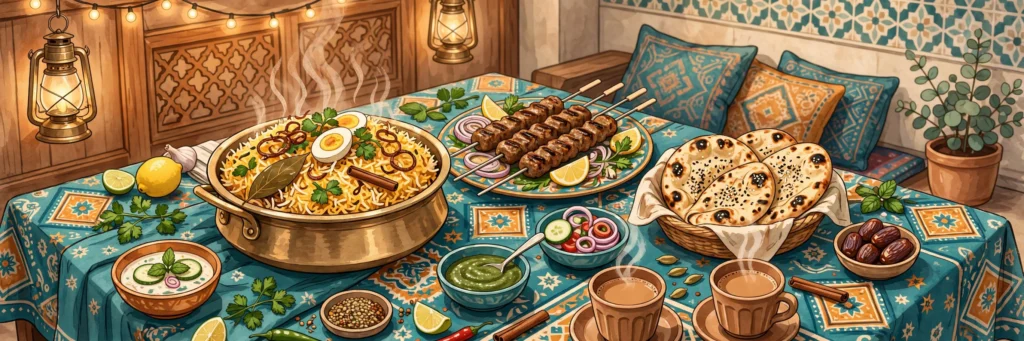
Food talk is daily talk. You discuss meals three times a day at home, and restaurants add their own script. These twelve sentences handle kitchens, restaurants, and daawats — plus the etiquette that matters as much as the words.
Chai is a ritual, not a drink. Guests always get offered chai, and dessert usually arrives before the tea. Refusing tea outright can offend a host. At a daawat, wait for the host’s signal before touching food. Serve others before yourself. Compliment the food out loud — eating generously IS the thank-you. Never arrive empty-handed: bring mithai, fruit, or bakery items. Empty hands get noticed.
Pronunciation matters most at the table. Saying “kana” instead of “khana” turns “food” into a mumble. The “kh” must come from the throat. Same with “q” versus “k” — get the deep sounds right and waiters understand you instantly.
Two classic mistakes: confusing “garam” (hot temperature) with “teekha” (spicy) — say “kam teekha” when the curry burns, not “kam garam.” And using “tum” with restaurant staff. Waiters get “aap.” Always.
Natural alternatives flex your range. “I am hungry” is “mujhe bhook lagi hai,” but friends say “yaar, bhook lag rahi hai.” The bill is “bill le aayen, please” formally, or “bhai, bill dena” casually. And after a great meal, “maza aa gaya” beats any textbook compliment.
I am hungry. → Mujhe bhook lagi hai. (مجھے بھوک لگی ہے۔)
What is for lunch? → Dopahar ke khane mein kya hai? (دوپہر کے کھانے میں کیا ہے؟)
This food is delicious. → Yeh khana mazedar hai. (یہ کھانا مزیدار ہے۔)
Please give me some water. → Mujhe thoda pani de dein. (مجھے تھوڑا پانی دے دیں۔)
I don’t eat spicy food. → Main teekha khana nahi khata. (میں تیکھا کھانا نہیں کھاتا۔)
The tea is too hot. → Chai bahut garam hai. (چائے بہت گرم ہے۔)
Can I have the bill, please? → Bill le aayen, please. (بل لے آئیں، پلیز۔)
I don’t eat meat. → Main gosht nahi khata. (میں گوشت نہیں کھاتا۔)
One more roti, please. → Ek roti aur de dein. (ایک روٹی اور دے دیں۔)
The food has gone cold. → Khana thanda ho gaya hai. (کھانا ٹھنڈا ہو گیا ہے۔)
I really enjoyed the meal. → Khana kha kar maza aa gaya. (کھانا کھا کر مزہ آ گیا۔)
Let’s eat together. → Aao mil kar khate hain. (آؤ مل کر کھاتے ہیں۔)
Shopping and the Market
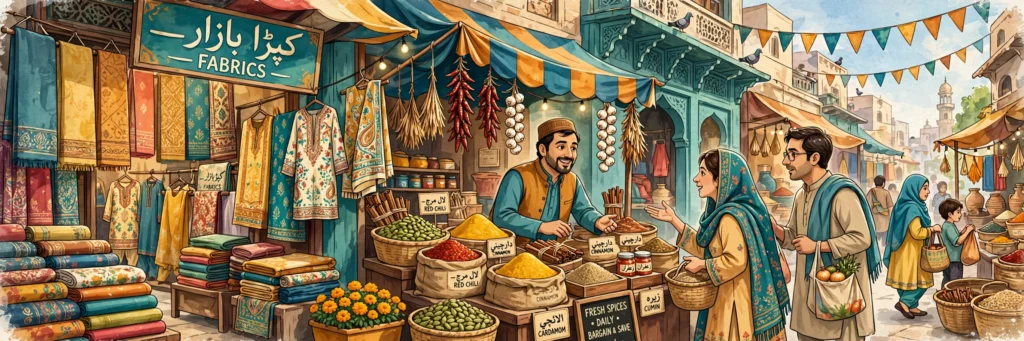
The Pakistani bazaar is a performance, and bargaining is its main act. These twelve sentences give you the script — prices, sizes, polite requests, and the negotiation lines that separate tourists from locals.
First rule: bargaining is expected and social, not confrontational. Sellers inflate the first price. You quote below your real target. Mention the rival shop — “wahan sasta mil raha tha.” Then walk away slowly. Sellers routinely call you back with a better price. The walk-away is the most powerful sentence in the bazaar, and it is silent.
Never show excitement about an item. Sellers read faces and raise prices when they see love. Ask the price flatly, look slightly bored, and point out small flaws to justify your offer. Claiming to be a returning customer — “main to yahan ka purana customer hoon” — softens sellers even when it stretches the truth.
Two hard mistakes to avoid. Do not try bargaining in fixed-price malls — DHA-style malls do not negotiate, and attempting it marks you as clueless. And match your verb to the seller’s gender: “kar sakte hain” for a male seller, “kar sakti hain” for a female seller.
Smaller shops bargain easiest. Street stalls and small dukans negotiate freely, especially before Eid. The ritual is part of the shopping experience. Enjoy it.
How much does this cost? → Yeh kitne ka hai? (یہ کتنے کا ہے؟)
This is too expensive. → Yeh bahut mehnga hai. (یہ بہت مہنگا ہے۔)
Can you lower the price? → Kya aap kimat kam kar sakte hain? (کیا آپ قیمت کم کر سکتے ہیں؟)
I am just looking. → Main bas dekh raha hoon. (میں بس دیکھ رہا ہوں۔)
Do you have a bigger size? → Kya aap ke paas bara size hai? (کیا آپ کے پاس بڑا سائز ہے؟)
I want to buy this shirt. → Main yeh qameez kharidna chahta hoon. (میں یہ قمیض خریدنا چاہتا ہوں۔)
Where is the nearest market? → Qareebi bazaar kahan hai? (قریبی بازار کہاں ہے؟)
The shop opens at nine. → Dukaan subah nau baje khulti hai. (دکان صبح نو بجے کھلتی ہے۔)
Do you accept cards? → Kya aap card lete hain? (کیا آپ کارڈ لیتے ہیں؟)
Please pack it for me. → Ise pack kar dein, please. (اسے پیک کر دیں، پلیز۔)
I will come back tomorrow. → Main kal wapas aaunga. (میں کل واپس آؤں گا۔)
This color suits you. → Yeh rang aap par jachta hai. (یہ رنگ آپ پر جچتا ہے۔)
Travel and Directions
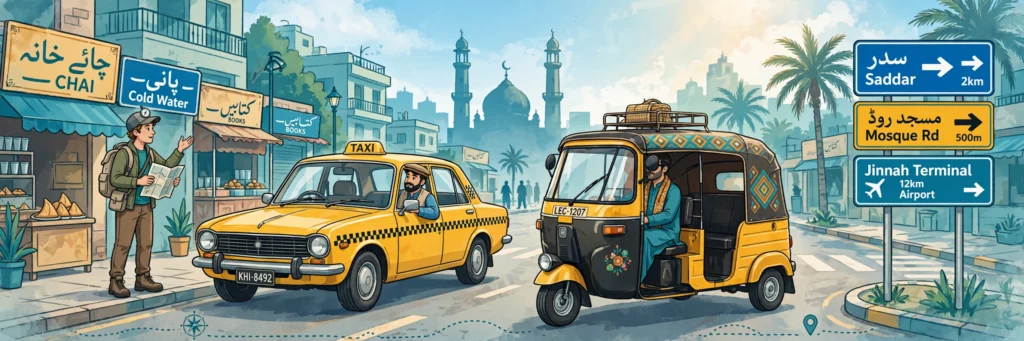
Travel phrases are survival phrases. When you are lost in a new city, these twelve sentences are worth more than a phrasebook. Keep the direction words and the taxi script ready before every trip.
The golden taxi rule: fix the fare BEFORE you sit down. Ask “wahan tak kitna loge?” — how much to go there? Getting in first and asking later invites an inflated fare. Alternatively, use Careem or InDrive for fixed app prices. And carry small change. Drivers rarely have change for thousand-rupee notes, so ask “kya aap ke paas khulla hai?” early.
Navigate by landmarks, not addresses. Street addresses mean little in most Pakistani cities. Ask for the chowk, bazaar, or masjid near your destination. People navigate by what they can see, not by numbers on doors.
Do not fear asking strangers. Hospitality culture runs deep — people will often walk you part of the way themselves rather than just point. A lost traveler is a guest, and guests get helped.
Two language traps: learners mix up “baayein” (left) and “daayein” (right) under pressure — drill them as a pair. And “I am lost” is not “main kho gaya hoon,” which sounds like a lost child. The natural version is “main rasta bhool gaya hoon” — I forgot the way.
Where is the bus stop? → Bus stop kahan hai? (بس اسٹاپ کہاں ہے؟)
How far is the airport? → Airport kitni door hai? (ایئرپورٹ کتنی دور ہے؟)
Turn left at the corner. → Kone se baayein mur jayen. (کونے سے بائیں مڑ جائیں۔)
Go straight ahead. → Seedha chalte jayen. (سیدھا چلتے جائیں۔)
I need a taxi. → Mujhe taxi chahiye. (مجھے ٹیکسی چاہیے۔)
How much is the fare? → Kiraya kitna hai? (کرایہ کتنا ہے؟)
Please stop here. → Yahan rok dein, please. (یہاں روک دیں، پلیز۔)
I have a reservation. → Meri booking hai. (میری بکنگ ہے۔)
What time does the train leave? → Train kitne baje rawana hoti hai? (ٹرین کتنے بجے روانہ ہوتی ہے؟)
I am lost. → Main rasta bhool gaya hoon. (میں راستہ بھول گیا ہوں۔)
Can you show me on the map? → Kya aap mujhe naqshe par dikha sakte hain? (کیا آپ مجھے نقشے پر دکھا سکتے ہیں؟)
The flight is delayed. → Parwaz mein takheer hai. (پرواز میں تاخیر ہے۔)
7. Work and the Office
Office Urdu runs on hierarchy. Pakistani workplaces are seniority-driven — older and senior staff get deference in every interaction. Language carries that hierarchy. These ten sentences keep you polite, professional, and promotion-safe.
The iron rule: “aap” always, upward. Using “tum” with a boss or senior colleague reads as disrespectful, no matter how friendly the office feels. New joiners should default to “aap” with everyone until explicitly invited otherwise. Downward, seniors may use “tum” with juniors — that is their privilege, not yours to mirror.
Politeness markers do heavy lifting. “Barah-e-karam” (kindly), “meherbani,” and the “-dein” verb ending carry the weight English puts into “please” and tone. “Mujhe email bhej dein” is a request. “Mujhe email bhejo” is an order. The three-letter ending is the entire difference. Dropping these markers makes neutral sentences sound rude.
Do not over-translate office vocabulary. “Meeting,” “email,” and “presentation” stay in English in real Pakistani offices — “meri das baje meeting hai” is exactly how people speak. Rendering them into awkward Urdu translations marks you as an outsider. Code-mixing is the professional norm, not sloppy language.
Start professional conversations with “Assalam-o-Alaikum.” It signals cultural awareness even in English-heavy offices. And remember: office WhatsApp groups freely mix English and Roman Urdu in single sentences. Match that register and you fit right in.
I have a meeting at ten. → Meri das baje meeting hai. (میری دس بجے میٹنگ ہے۔)
Please send me the email. → Mujhe email bhej dein. (مجھے ای میل بھیج دیں۔)
The deadline is Friday. → Aakhri tareekh Jumma hai. (آخری تاریخ جمعہ ہے۔)
I will finish it today. → Main ise aaj mukammal karunga. (میں اسے آج مکمل کروں گا۔)
Can we reschedule? → Kya hum dobara waqt tay kar sakte hain? (کیا ہم دوبارہ وقت طے کر سکتے ہیں؟)
My boss is on leave. → Mere boss chhutti par hain. (میرے باس چھٹی پر ہیں۔)
Let’s discuss this tomorrow. → Is par kal baat karte hain. (اس پر کل بات کرتے ہیں۔)
I need your signature. → Mujhe aap ke dastakhat chahiye. (مجھے آپ کے دستخط چاہیے۔)
The presentation went well. → Presentation achhi rahi. (پریزنٹیشن اچھی رہی۔)
I am working from home. → Main ghar se kaam kar raha hoon. (میں گھر سے کام کر رہا ہوں۔)
Health and Emergencies
In an emergency, clear words beat perfect grammar. These eight sentences are the ones to memorize first — before any other category. When pain or panic hits, you will not have time to look things up.
Pakistan’s medical emergency number is 1122 — Rescue 1122, free and toll-free from any phone. Do not confuse it with 15 (police) or 115 (Edhi ambulance). For a medical emergency, 1122 is the number. On the call, dispatchers need three things in order: your exact location, the nature of the emergency, and the number of victims. A ready-made sentence helps: “Yahan [location] par hadsa hua hai, [number] zakhmi hain.”
Describe pain with location plus gesture. “Dard hai” alone gives a doctor nothing. Say “mere sar mein dard hai” and point. Learners often translate “I have pain” without the body part — always add it. And learn symptom phrases whole: “mujhe chakkar aa rahe hain” for dizziness. Word-for-word building fails here.
Two cultural notes. Doctors get “aap” plus “doctor sahab” or “doctor sahiba” — “tum” with a doctor you just met seems rude fast. And asking for a lady doctor — “kya koi lady doctor hain?” — is a routine, expected request for female patients, not an awkward one.
Finally, “medical store” culture: pharmacies dispense many common medicines without prescription. Describing symptoms to the pharmacist — “bukhar aur gala kharab hai, koi dawa de dein” — is everyday practice.
I need a doctor. → Mujhe doctor ki zaroorat hai. (مجھے ڈاکٹر کی ضرورت ہے۔)
I have a headache. → Mere sar mein dard hai. (میرے سر میں درد ہے۔)
Call an ambulance! → Ambulance bulayen! (ایمبولینس بلائیں!)
I feel dizzy. → Mujhe chakkar aa rahe hain. (مجھے چکر آ رہے ہیں۔)
Where is the nearest hospital? → Qareebi hospital kahan hai? (قریبی ہسپتال کہاں ہے؟)
I need medicine. → Mujhe dawa chahiye. (مجھے دوا چاہیے۔)
It hurts here. → Yahan dard ho raha hai. (یہاں درد ہو رہا ہے۔)
Please help me! → Meri madad karen, please! (میری مدد کریں، پلیز!)
9. Phone, WhatsApp, and Social Media
This is where Roman Urdu was born. When phones had no Urdu keyboards, people typed Urdu in English letters — and never stopped. WhatsApp, Instagram, and SMS still run on Roman Urdu today. These eight sentences cover the chat situations you hit daily.
The chat default is “tum,” not “aap.” Typing “aap kaise hain?” to a close friend reads stiff and distant. Friends text “kya haal hai?” or “kya scene hai?” Learners who studied formal Urdu first often text friends too formally, then wonder why replies feel cold. Match the medium: casual chat, casual register.
Code-mixing is the norm, not a flaw. “Mujhe email bhej do, ASAP” — half Urdu, half English — is standard digital communication in Pakistan. Do not purify your chats. Nobody else does.
Abbreviations need care. LOL, OMG, IDK, GM/GN run through every Pakistani chat. But heavy vowel-dropping — “k kr rhy ho” — confuses learners and misfires across generations. And ambiguous short forms cause real mix-ups: people genuinely debate whether “Vc” means voice call or video call. Rule of thumb: spell it out on first use with a new contact.
One more habit: long messages go as voice notes on Pakistani WhatsApp. Typing paragraphs is rare. “Voice note bhej do” is itself a core chat sentence — learn it early.
Did you get my message? → Kya tumhe mera message mila? (کیا تمھیں میرا میسج ملا؟)
I will call you back. → Main tumhe wapas call karunga. (میں تمھیں واپس کال کروں گا۔)
Send me your location. → Mujhe apni location bhejo. (مجھے اپنی لوکیشن بھیجو۔)
My phone battery is dead. → Mere phone ki battery khatam ho gayi. (میرے فون کی بیٹری ختم ہو گئی۔)
Let’s video call tonight. → Aaj raat video call karte hain. (آج رات ویڈیو کال کرتے ہیں۔)
I saw your photo. → Maine tumhari tasveer dekhi. (میں نے تمھاری تصویر دیکھی۔)
Please reply soon. → Jaldi jawab dena. (جلدی جواب دینا۔)
Talk to you later! → Baad mein baat karte hain! (بعد میں بات کرتے ہیں!)
English Phrases You Should Never Translate Literally
Word-for-word translation is the fastest way to sound strange. English idioms carry meanings their individual words never suggest. Learners translate them literally, native speakers laugh, and the real meaning gets lost. Here are eight classic traps with the natural Roman Urdu for each.
“What’s up?” Do not ask what is physically above. It is just a casual greeting. Say “kya haal hai?” or “kya ho raha hai?” Both land exactly like the English original feels.
“Take care.” Do not say “parwah lo” — nobody says that. The natural farewell is “apna khayal rakhna.” It carries the same warmth as the English.
“Break a leg!” Never wish anyone a broken leg, even as a joke. For “good luck,” say “best of luck!” or the warmer “Allah kamyab kare!” — may God grant success.
“It’s raining cats and dogs.” No animals are falling from the sky. Say “bahut tez barish ho rahi hai” — it is raining very heavily. Simple, accurate, natural.
“Piece of cake.” This has nothing to do with cake or dessert. It means something is very easy. Say “bahut aasan hai.” Two words, same meaning.
“I’m broke.” You are not broken into pieces. You have no money. Say “mere paas paise nahi hain.” Direct and honest, like the English.
“Hit the road.” Do not hit anything. It means let’s leave. Say “chalo nikalte hain.” Friends use this one constantly.
“Under the weather.” Weather has nothing to do with it. It means feeling slightly ill. Say “tabiyat theek nahi hai.” Everyone understands instantly.
The pattern is simple. When an English phrase sounds absurd in direct translation, it is almost certainly an idiom. Stop translating words. Learn the natural version as a whole chunk instead.
FAQs
Is Roman Urdu real Urdu?
Yes. Roman Urdu is Urdu written in English letters. The words, grammar, and sentence structure are fully Urdu. Only the script is different. Millions of Pakistanis use it daily on WhatsApp, Instagram, and SMS. It is not slang and not broken language — it is a practical writing system born in the phone era.
Why do Roman Urdu spellings differ from person to person?
Roman Urdu has no standard spelling system and no academy enforcing rules. One person writes “mein,” another writes “main” — both are correct and both get understood. Research confirms a single Urdu word can have many Roman spellings. This guide uses one consistent spelling per word so you learn faster, and notes accepted variants where they matter.
Should I use “aap” or “tum”?
Use “aap” with elders, strangers, shopkeepers, doctors, and everyone at work. Use “tum” with friends, siblings, and people your own age. When in doubt, “aap” is always the safe choice — nobody is ever offended by extra respect. And remember the verb pairs: “aap” goes with “hain,” “tum” goes with “ho.”
Can I use these sentences on WhatsApp?
Absolutely. Roman Urdu was made for phone typing — it exploded in the SMS era when phones had no Urdu keyboards. Copy any sentence from this guide straight into your chats. For friends, prefer the casual “tum” forms from the WhatsApp section.
Do I need to read the Urdu script to use this guide?
No. The Roman Urdu column is the main translation in every table. The Urdu script column is a bonus reference for learners who want to connect the two scripts later. If you only read English letters, this guide still works fully for you.
How do I pronounce “kh” and “gh”?
Say “kh” from deep in your throat, like a soft clearing sound — “khana,” not “kana.” Say “gh” like a gentle gargle — “ghar,” not “gar.” Both come from near the uvula, not the mouth. The pronunciation section near the top of this guide covers all five tricky sounds with practice tips.
Are these translations formal or casual?
Most use the polite “aap” form, which works in every situation from offices to markets. The WhatsApp and social media section uses “tum” because friends text casually. The guide marks the register clearly, so you always know which level you are speaking at.
How can I practice these sentences daily?
Pick five sentences a day from one category. Say them aloud three times. Then use at least two in a real chat the same day. Tick off what you used in a notebook and review weekly. Ten minutes a day beats two hours on Sunday — real use beats memorization every time.
Conclusion
You now hold 100 English sentences translated into Roman Urdu, organized across nine real-life situations. That is the core. But you also hold something more valuable: the judgment to use them well.
You know when to use “aap” and when to use “tum” — and why the verb must match the pronoun. You know the five sounds English speakers flatten, and how to shape them correctly. You know the cultural scripts: greeting elders first, fixing taxi fares before sitting down, bargaining with a smile, softening home requests with “-dein.” You know eight English idioms to never translate literally.
None of this came from a machine translator. It came from how Pakistanis actually speak, text, bargain, and joke. That is the difference between a sentence list and a usable guide.
The next step is small and concrete. Open WhatsApp today. Send five sentences from this guide to a real person. Use two at a shop or with family this week. Language sticks through use, not through reading.
Want the reverse direction? Read our guide on 100 common Roman Urdu phrases with English meanings to go from Roman Urdu back to English. Curious why spellings vary so much? Our article on why Roman Urdu has no standard spelling explains the full story.