
Urdu Gender Rules for English Speakers
Learning Urdu Gender Rules for English Speakers can feel exciting. Yet many English speakers struggle with one topic. That topic is gender. Urdu uses a gender system that affects many parts of a sentence. You must understand this system to speak and write correctly.
Urdu has two grammatical genders. These are masculine (مذکر) and feminine (مؤنث). Every noun belongs to one of these categories. This rule applies to people, animals, places, objects, and even ideas. Gender influences adjectives, verbs, and sentence structure. Because of this, gender plays a major role in Urdu grammar.
English speakers often find Urdu Gender Rules for English Speakers confusing. English uses natural gender in most situations. For example, words like “man” and “woman” show biological gender. Most objects in English have no gender at all. Urdu works differently. A book, chair, room, or door can have a grammatical gender. These objects are not male or female in real life. Urdu grammar simply places them into a gender category.
This difference highlights an important concept. Biological gender relates to living beings. Grammatical gender belongs to language rules. The two do not always match. Understanding this distinction makes Urdu easier to learn.
In this guide, you will learn how Urdu Gender Rules for English Speakers to nouns. You will discover common masculine and feminine patterns. You will see how adjectives and verbs change with gender. You will also learn practical tips, examples, and common mistakes. By the end, you will understand Urdu gender rules with greater confidence and accuracy.
What Is Gender in Urdu Grammar?
Urdu Gender Rules for English Speakers is one of the most important parts of Urdu grammar. It helps speakers build correct sentences. It also affects nouns, adjectives, and verbs. If you understand gender, Urdu becomes much easier to learn.
Definition of Grammatical Gender
Urdu Gender Rules for English Speakers has two grammatical genders. These are masculine (مذکر) and feminine (مؤنث). Every noun belongs to one of these categories.
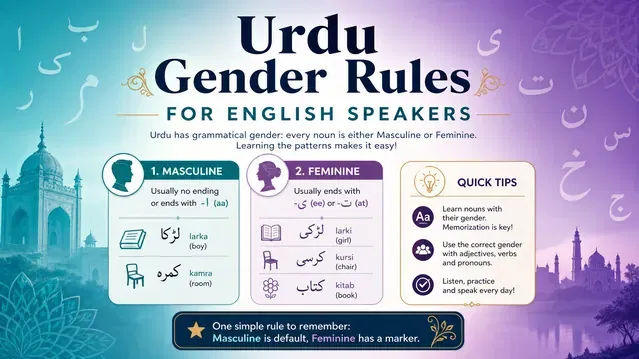
A masculine noun may refer to a male person. For example, لڑکا (boy) is masculine. However, many masculine nouns describe objects. کمرہ (room) and دروازہ (door) are also masculine.
A feminine noun may refer to a female person. For example, لڑکی (girl) is feminine. Many objects are feminine as well. کرسی (chair) and کھڑکی (window) belong to the feminine category.
This system is called grammatical gender. It follows language rules. It does not always match real-world gender.
Why Urdu Uses Gender
Urdu Gender Rules for English Speakers inherited its gender system from older Indo-Aryan languages. Language historians trace many Urdu grammar patterns to Sanskrit and later Prakrit languages. These languages used grammatical gender for centuries.
Urdu also shares a close relationship with Hindi. Both languages developed from the same linguistic roots known as Hindustani. As a result, they use very similar gender rules. A noun that is masculine in Urdu often remains masculine in Hindi.
Gender helps create agreement inside sentences. It connects nouns with the correct adjectives and verb forms. This structure makes Urdu grammar more organized and predictable.
Does English Have Gender?
English uses gender in a limited way. Words like man, woman, father, and mother show natural gender. Most English nouns have no grammatical gender.
For example, a chair remains simply a chair. English speakers never classify it as masculine or feminine.
Urdu works differently. Every noun has a gender. A chair may be feminine. A room may be masculine. Because of this difference, English speakers often struggle at first. Once you learn the patterns, gender becomes easier to recognize and use correctly.
According to linguistic research on Indo-Aryan languages, grammatical gender remains a core feature of Urdu and Hindi grammar. Understanding this feature forms the foundation for mastering Urdu sentence structure.
How Many Genders Are There in Urdu?
Urdu has two grammatical genders. These are masculine (مذکر) and feminine (مؤنث). Every noun belongs to one of these categories. Gender affects how adjectives, verbs, and other words behave in a sentence.
Unlike English, Urdu does not treat most nouns as gender-neutral. You must learn the gender of a noun along with its meaning. This habit helps you avoid common grammar mistakes later.
Masculine Gender in Urdu
Masculine gender includes nouns that Urdu grammar classifies as masculine. Many male people and male animals fall into this category. However, masculine gender is not limited to living things.
Common examples include:
- لڑکا (boy)
- استاد (teacher)
- کمرہ (room)
- دروازہ (door)
Many masculine nouns end in ا or ہ, although exceptions exist. These endings can help beginners make educated guesses. Still, you should not rely on endings alone.
Masculine nouns often require masculine adjective and verb forms. For example:
- بڑا کمرہ (big room)
- لڑکا خوش ہے (the boy is happy)
Feminine Gender in Urdu
Feminine gender includes nouns that Urdu grammar treats as feminine. Female people and female animals usually belong here. Many everyday objects and concepts are feminine as well.
Common examples include:
- لڑکی (girl)
- کرسی (chair)
- کھڑکی (window)
- کتاب (book)
Many feminine nouns end in ی, but many exceptions exist. The best approach is to learn each noun with its gender.
Feminine nouns require feminine agreement in sentences. For example:
- بڑی کرسی (big chair)
- لڑکی خوش ہے (the girl is happy)
Natural Gender vs Grammatical Gender
English speakers often confuse natural gender with grammatical gender. Understanding the difference is essential.
Natural gender relates to biological sex. Words like boy, girl, man, and woman reflect real-world gender.
Grammatical gender follows language rules. It does not always reflect biology.
For human beings, natural and grammatical gender often match. A male teacher is usually masculine. A female teacher is usually feminine.
Animals can follow natural gender when the sex is known. However, some animal names have fixed grammatical genders regardless of context.
Objects and abstract nouns present the biggest challenge. A chair, book, idea, or emotion has no biological gender. Yet Urdu still assigns a masculine or feminine category to each one. This assignment comes from grammar tradition, not logic.
Once you accept gender as a language rule, learning Urdu becomes much easier. The next step is understanding how Urdu assigns gender to different nouns.
Why Urdu Gender Is Difficult for English Speakers
Many English speakers enjoy learning Urdu vocabulary. However, gender often creates confusion. The challenge does not come from difficult rules alone. It comes from a different way of thinking about language.
English and Urdu organize nouns differently. As a result, learners must develop new grammar habits. Understanding these differences helps reduce mistakes and speeds up learning.
English vs Urdu Grammar
English uses mostly gender-neutral nouns. Objects do not have grammatical gender. A chair, table, book, or house remains neutral. Speakers never change adjectives or verbs because of an object’s gender.
Urdu follows a different system. Every noun belongs to either the masculine or feminine category. This rule applies to people, animals, objects, and abstract ideas.
For example:
- کمرہ (room) is masculine.
- کرسی (chair) is feminine.
- کتاب (book) is feminine.
Because English lacks a similar system, learners often expect Urdu nouns to behave like English nouns. This expectation leads to confusion.
Common Challenges
The first challenge involves memorization. Learners must remember both the meaning and the gender of each noun. Learning only the translation is not enough.
The second challenge involves agreement rules. Urdu adjectives often change according to gender. A masculine noun needs a masculine adjective form. A feminine noun needs a feminine form.
The third challenge involves verb changes. Urdu verbs frequently show gender. The same sentence may require different verb forms for masculine and feminine subjects. This pattern feels unfamiliar to many English speakers.
Typical Mistakes English Speakers Make
Many beginners guess a noun’s gender without checking. Sometimes the guess works. Often it does not.
Another common mistake involves adjective agreement. Learners may use a masculine adjective with a feminine noun. This error makes the sentence sound unnatural.
Verb agreement creates problems as well. Some learners use the same verb form for everyone. Urdu does not allow this in many situations.
Many students also assume that every noun ending follows a simple rule. While patterns exist, Urdu contains many exceptions. Words like پانی (water) and دوا (medicine) show why memorization still matters.
Language teachers and Urdu grammar resources often recommend learning nouns together with their gender. This method builds accuracy from the beginning. Once learners recognize common patterns, Urdu gender becomes much easier to manage in everyday communication.
How Urdu Assigns Gender to Nouns
One of the first questions learners ask is simple. How does Urdu decide whether a noun is masculine or feminine? The answer involves patterns, history, and usage. While no rule works every time, several clues can help you identify a noun’s gender more accurately.
General Gender Patterns
Urdu nouns often follow recognizable patterns. These patterns help learners make educated guesses. However, you should always verify a noun’s gender through reliable examples and usage.
Common Masculine Endings
Many masculine nouns end in the following letters:
ا (Alif)
Examples:
- لڑکا (boy)
- کمرہ (room)
- راستہ (road)
Examples:
- دروازہ (door)
- نسخہ (prescription)
Some masculine nouns end with this sound.
Examples:
- چاقو (knife)
- آنسو (tear)
These endings often signal masculine gender. Still, they do not guarantee it.
Common Feminine Endings
Many feminine nouns end in the following letters:
Examples:
- لڑکی (girl)
- کرسی (chair)
- کھڑکی (window)
Examples:
- عادت (habit)
- حقیقت (reality)
Examples:
- کوشش (effort)
- بارش (rain)
These endings frequently appear in feminine nouns across everyday Urdu vocabulary.
Gender Identification Rules
Gender identification becomes easier with practice. Start by observing noun endings. Then pay attention to the adjectives and verbs that accompany those nouns.
For example:
- بڑا کمرہ (big room)
- بڑی کرسی (big chair)
The adjective reveals the noun’s gender. Reading and listening to authentic Urdu also improves recognition skills.
Language experts often recommend learning nouns together with example sentences. This approach helps you remember gender naturally rather than memorizing isolated word lists.
Important Exceptions
Urdu contains many exceptions to common patterns.
For example:
- پانی (water) is masculine.
- ہاتھی (elephant) is masculine.
- دوا (medicine) is feminine.
- ہوا (air) is feminine.
These nouns break the usual ending-based rules. A learner who relies only on endings may choose the wrong gender.
Why Exceptions Exist
Most exceptions come from Urdu’s rich linguistic history. Urdu borrowed vocabulary from Persian, Arabic, Sanskrit, and other languages. These borrowed words often kept their traditional grammatical gender.
Over time, speakers accepted these forms as standard Urdu. As a result, modern Urdu contains both predictable patterns and historical exceptions.
Research in Indo-Aryan linguistics shows that grammatical gender develops through centuries of language evolution. That is why some nouns follow clear rules while others do not. Instead of trying to find a perfect formula, focus on common patterns first. Then learn exceptions through regular exposure and practice.
Understanding these gender patterns gives you a strong foundation. The next step is exploring masculine and feminine nouns in greater detail and seeing how they function in real Urdu communication.
Masculine Nouns in Urdu
Masculine nouns form a major part of the Urdu gender system. You will encounter them in daily conversations, books, news articles, and classroom lessons. Learning common masculine nouns helps you build correct sentences and improve your grammar accuracy.
What Are Masculine Nouns?
A masculine noun is a noun that Urdu grammar classifies as masculine (مذکر). Some masculine nouns refer to male people or male animals. Others describe places, objects, or ideas.
The gender of a noun affects the words around it. Adjectives and many verb forms must agree with the noun’s gender. For example:
- بڑا کمرہ (big room)
- نیا دروازہ (new door)
Both adjectives appear in their masculine form because the nouns are masculine.
Many masculine nouns end in ا or ہ, but this pattern does not apply to every word. Therefore, learners should study nouns with their gender from the beginning.
Common Masculine Urdu Words
People
Many words for male people are masculine.
Examples:
- لڑکا (boy)
- آدمی (man)
- استاد (teacher)
- بھائی (brother)
Places
Several common places take masculine gender.
Examples:
- کمرہ (room)
- بازار (market)
- باغ (garden)
- راستہ (road)
Objects
Many everyday objects are masculine.
Examples:
- دروازہ (door)
- چاقو (knife)
- قلم (pen)
- موبائل (mobile phone)
Animals
Many animal names are masculine unless a specific female form exists.
Examples:
- ہاتھی (elephant)
- گھوڑا (horse)
- شیر (lion)
- اونٹ (camel)
Masculine Noun Examples Table
| Urdu Word | English Meaning | Gender |
| لڑکا | Boy | Masculine |
| آدمی | Man | Masculine |
| بھائی | Brother | Masculine |
| استاد | Teacher | Masculine |
| کمرہ | Room | Masculine |
| بازار | Market | Masculine |
| باغ | Garden | Masculine |
| راستہ | Road | Masculine |
| دروازہ | Door | Masculine |
| قلم | Pen | Masculine |
| چاقو | Knife | Masculine |
| موبائل | Mobile Phone | Masculine |
| ہاتھی | Elephant | Masculine |
| گھوڑا | Horse | Masculine |
| شیر | Lion | Masculine |
| اونٹ | Camel | Masculine |
As you learn new vocabulary, pay attention to gender patterns. Notice how masculine nouns work with masculine adjectives and verbs. This habit strengthens your grammar skills and reduces common learner errors. In the next section, we will explore feminine nouns and compare them with masculine nouns through practical examples.
Feminine Nouns in Urdu
Feminine nouns are just as important as masculine nouns in Urdu. Every Urdu noun belongs to a gender category. To build correct sentences, you must know whether a noun is masculine or feminine.
Many beginners focus only on vocabulary meanings. This approach often leads to grammar mistakes. A better method is to learn each noun together with its gender. This habit improves accuracy and helps you understand gender agreement more naturally.
What Are Feminine Nouns?
A feminine noun is a noun that Urdu grammar classifies as feminine (مؤنث). Some feminine nouns refer to female people or female animals. Others describe objects, places, feelings, or abstract ideas.
Feminine nouns require feminine adjective and verb forms. For example:
- بڑی کرسی (big chair)
- نئی کتاب (new book)
The adjectives بڑی and نئی appear in their feminine forms because the nouns are feminine.
Many feminine nouns end in ی, ت, or ش. These endings can provide useful clues. However, you should always learn the gender of a noun through real usage and examples.
Common Feminine Urdu Words
People
Many words for female people are feminine.
Examples:
- لڑکی (girl)
- عورت (woman)
- بہن (sister)
- استانی (female teacher)
Objects
Many common household and everyday items are feminine.
Examples:
- کرسی (chair)
- کتاب (book)
- میز (table)
- گھڑی (clock)
Concepts
Many abstract ideas and qualities are feminine.
Examples:
- عادت (habit)
- حقیقت (reality)
- خوشی (happiness)
- کوشش (effort)
Feminine Noun Examples Table
| Urdu Word | English Meaning | Gender |
| لڑکی | Girl | Feminine |
| عورت | Woman | Feminine |
| بہن | Sister | Feminine |
| استانی | Female Teacher | Feminine |
| کرسی | Chair | Feminine |
| کتاب | Book | Feminine |
| میز | Table | Feminine |
| گھڑی | Clock | Feminine |
| عادت | Habit | Feminine |
| حقیقت | Reality | Feminine |
| خوشی | Happiness | Feminine |
| کوشش | Effort | Feminine |
| بارش | Rain | Feminine |
| ہوا | Air | Feminine |
| دوا | Medicine | Feminine |
| زبان | Language | Feminine |
Feminine nouns appear frequently in everyday Urdu. You will see them in conversations, stories, newspapers, and educational materials. The more examples you study, the easier gender recognition becomes. In the next section, we will compare masculine and feminine nouns directly through word pairs, making gender differences even clearer for English speakers.
Urdu Masculine and Feminine Word Pairs
One of the easiest ways to understand Urdu gender is through word pairs. These pairs show how masculine and feminine forms relate to each other. They also help learners recognize common gender patterns.
Many Urdu words change form to show gender. This pattern appears in family terms, occupations, and animal names. Learning these pairs improves vocabulary and strengthens grammar skills at the same time.
Family Relationships
Family vocabulary provides some of the clearest gender examples in Urdu. Most learners encounter these words early in their studies.
Examples include:
- بھائی (brother) → بہن (sister)
- بیٹا (son) → بیٹی (daughter)
- شوہر (husband) → بیوی (wife)
- دادا (grandfather) → دادی (grandmother)
These words reflect natural gender because they describe real family relationships.
Occupations
Some occupations have masculine and feminine forms. Modern Urdu sometimes uses one term for both genders. However, traditional forms still appear in many contexts.
Examples include:
- استاد (male teacher) → استانی (female teacher)
- اداکار (actor) → اداکارہ (actress)
- شاعر (poet) → شاعرہ (female poet)
These pairs help learners understand how suffixes can mark gender.
Animal Names
Many animal names also have masculine and feminine versions.
Examples include:
- گھوڑا (stallion) → گھوڑی (mare)
- شیر (lion) → شیرنی (lioness)
- مرغ (rooster) → مرغی (hen)
These forms often follow predictable patterns, making them easier to remember.
Everyday Vocabulary
Not every noun has a masculine and feminine counterpart. However, studying common gendered words helps learners identify patterns faster.
Words related to people and living creatures often appear in paired forms. These pairs provide useful practice for gender agreement in sentences.
Masculine vs Feminine Pairs Table
| Masculine | Feminine | English |
| لڑکا | لڑکی | Boy / Girl |
| آدمی | عورت | Man / Woman |
| بھائی | بہن | Brother / Sister |
| بیٹا | بیٹی | Son / Daughter |
| شوہر | بیوی | Husband / Wife |
| دادا | دادی | Grandfather / Grandmother |
| نانا | نانی | Grandfather / Grandmother (maternal) |
| استاد | استانی | Teacher |
| اداکار | اداکارہ | Actor / Actress |
| شاعر | شاعرہ | Poet |
| گھوڑا | گھوڑی | Horse / Mare |
| شیر | شیرنی | Lion / Lioness |
| مرغ | مرغی | Rooster / Hen |
| بکرا | بکری | Goat (male/female) |
| کتا | کتیا | Dog / Female Dog |
Word pairs make Urdu gender easier to understand because they show clear contrasts. They also prepare you for the next step in learning Urdu grammar. Once you recognize masculine and feminine nouns, you can begin matching them with the correct adjectives. This agreement is essential for creating natural and grammatically correct Urdu sentences.
Urdu Adjectives and Gender Agreement
Understanding noun Urdu Gender Rules for English Speakers is only the first step. The next step involves adjective agreement. Urdu adjectives often change their form to match the gender of the noun they describe. This rule is essential for speaking and writing correct Urdu.
Many English speakers find this concept new because English adjectives usually stay the same. In Urdu, however, adjective forms often change according to gender.
What Is Adjective Agreement?
Adjective agreement means that an adjective matches the gender of its noun. If the noun is masculine, the adjective takes a masculine form. If the noun is feminine, the adjective changes to a feminine form.
For example:
- اچھا لڑکا (good boy)
- اچھی لڑکی (good girl)
The meaning remains similar. Only the adjective changes to match the noun’s gender.
This agreement helps create grammatically correct sentences. It also makes speech sound natural to native Urdu speakers.
Masculine Adjective Forms
Many masculine adjectives end in ا. These forms appear with masculine nouns.
Examples:
- اچھا لڑکا (good boy)
- بڑا گھر (big house)
- نیا موبائل (new mobile phone)
- لمبا درخت (tall tree)
Notice how each adjective matches a masculine noun.
When you learn a new adjective, memorize its masculine form first. This practice makes it easier to recognize later changes.
Feminine Adjective Forms
Feminine adjectives often replace the ending ا with ی. This pattern appears in many common adjectives.
Examples:
- اچھی لڑکی (good girl)
- بڑی کرسی (big chair)
- نئی کتاب (new book)
- لمبی سڑک (long road)
The adjective changes, but the core meaning stays the same.
Adjectives That Change with Gender
Many frequently used Urdu adjectives change according to gender.
Examples:
- اچھا → اچھی (good)
- بڑا → بڑی (big)
- نیا → نئی (new)
- لمبا → لمبی (long/tall)
- سستا → سستی (cheap)
These patterns appear in daily conversations, books, and media. Learning them early improves your sentence accuracy.
Compare these examples:
- بڑا کمرہ (big room)
- بڑی میز (big table)
- نیا دروازہ (new door)
- نئی کتاب (new book)
The adjective changes because the noun’s gender changes.
Adjective Agreement Table
| Masculine Form | Feminine Form | English Meaning |
| اچھا | اچھی | Good |
| بڑا | بڑی | Big |
| نیا | نئی | New |
| لمبا | لمبی | Long / Tall |
| سستا | سستی | Cheap |
| چھوٹا | چھوٹی | Small |
| پرانا | پرانی | Old |
| خوبصورت | خوبصورت | Beautiful |
| اہم | اہم | Important |
| مشہور | مشہور | Famous |
Notice that some adjectives, such as خوبصورت, اہم, and مشہور, do not change form. Linguists often call these invariable adjectives because they remain the same with both masculine and feminine nouns.
According to standard Urdu Gender Rules for English Speakers grammar references, adjective agreement is one of the most important features of the language. Mastering it helps learners build natural sentences and prepares them for the next topic: verb agreement, where gender affects verb forms as well.
Urdu Verbs and Gender Agreement
Urdu Gender Rules for English Speakers verbs do more than show an action. They also reveal important grammar information. In many situations, verbs change according to the Urdu Gender Rules for English Speakers of the subject. This feature makes Urdu different from English and often challenges new learners.
Once you understand verb agreement, your Urdu sentences become more natural and accurate.
Why Verbs Change According to Gender
Urdu Gender Rules for English Speakers uses gender agreement to connect the subject with the verb. When the subject is masculine, the verb usually takes a masculine form. When the subject is feminine, the verb changes to a feminine form.
Consider these examples:
- لڑکا جا رہا ہے۔ (The boy is going.)
- لڑکی جا رہی ہے۔ (The girl is going.)
The action stays the same. Only the verb form changes to match the subject’s gender.
This pattern appears frequently in spoken and written Urdu Gender Rules for English Speakers. Native speakers use it automatically.
Present Tense Examples
Gender often appears clearly in present continuous sentences.
Examples:
- میں پڑھ رہا ہوں۔ (I am reading. – male speaker)
- میں پڑھ رہی ہوں۔ (I am reading. – female speaker)
- وہ کھیل رہا ہے۔ (He is playing.)
- وہ کھیل رہی ہے۔ (She is playing.)
Notice how رہا changes to رہی. This small change signals the speaker’s or subject’s gender.
Past Tense Examples
Gender also affects many past-tense constructions.
Examples:
- علی گھر گیا۔ (Ali went home.)
- سارہ گھر گئی۔ (Sarah went home.)
- لڑکا سو گیا۔ (The boy slept.)
- لڑکی سو گئی۔ (The girl slept.)
The endings گیا and گئی help identify gender immediately.
Future Tense Examples
Future tense forms also show gender in many situations.
Examples:
- میں جاؤں گا۔ (I will go. – male speaker)
- میں جاؤں گی۔ (I will go. – female speaker)
- وہ کام کرے گا۔ (He will work.)
- وہ کام کرے گی۔ (She will work.)
The endings گا and گی indicate masculine and feminine Urdu Gender Rules for English Speakers.
Masculine vs Feminine Verb Forms
The following table highlights common verb agreement patterns. Study these examples carefully. Similar structures appear throughout everyday Urdu.
| Masculine Sentence | Feminine Sentence | English |
| میں پڑھ رہا ہوں۔ | میں پڑھ رہی ہوں۔ | I am reading. |
| میں جا رہا ہوں۔ | میں جا رہی ہوں۔ | I am going. |
| وہ کھیل رہا ہے۔ | وہ کھیل رہی ہے۔ | He/She is playing. |
| علی گھر گیا۔ | سارہ گھر گئی۔ | Ali/Sarah went home. |
| لڑکا سو گیا۔ | لڑکی سو گئی۔ | The boy/girl slept. |
| میں جاؤں گا۔ | میں جاؤں گی۔ | I will go. |
| وہ آئے گا۔ | وہ آئے گی۔ | He/She will come. |
| وہ کام کرے گا۔ | وہ کام کرے گی۔ | He/She will work. |
According to Urdu Gender Rules for English Speakers grammar studies, verb agreement serves as a core feature of the language. It helps listeners identify gender quickly and understand sentence relationships more clearly.
For English speakers, the best strategy is simple. Learn verbs inside complete sentences. This approach helps you recognize gender patterns naturally. After enough practice, choosing the correct verb form becomes much easier and more automatic.
Urdu Pronouns and Gender
Pronouns play an important role in Urdu Gender Rules for English Speakers grammar. They help speakers avoid repeating nouns and make sentences sound natural. Unlike English, Urdu pronouns often work closely with gender agreement. While many Urdu pronouns do not change their form, the adjectives and verbs connected to them often do.
Understanding this relationship helps English speakers build correct and natural sentences.
Personal Pronouns
Personal pronouns replace the names of people or things. Urdu uses several common personal pronouns in daily conversation.
Examples include:
- میں (I)
- ہم (we)
- تم (you)
- آپ (you – respectful)
- وہ (he, she, it, they)
- یہ (this, he, she, it)
One interesting feature of Urdu is that وہ can mean both “he” and “she.” The pronoun itself does not reveal gender. Instead, the verb or adjective provides that information.
For example:
- وہ خوش ہے۔ (He is happy. / She is happy.)
Without context, the sentence does not show gender clearly.
Possessive Pronouns
Possessive pronouns show ownership. In Urdu, these forms often change according to the gender of the noun being possessed.
Examples:
- میرا کمرہ (my room)
- میری کتاب (my book)
- تمہارا موبائل (your mobile phone)
- تمہاری کرسی (your chair)
Notice that میرا changes to میری, and تمہارا changes to تمہاری. The change depends on the noun’s gender, not the owner’s gender.
Pronoun Agreement Rules
Urdu pronouns usually stay the same regardless of gender. However, the words connected to them often change.
Key rules include:
- Verbs must agree with the subject’s gender when required.
- Possessive forms often match the gender of the noun.
- Adjectives must agree with the noun they describe.
For example:
- وہ جا رہا ہے۔ (He is going.)
- وہ جا رہی ہے۔ (She is going.)
The pronoun وہ remains unchanged. The verb reveals the gender.
Examples in Sentences
These examples show how pronouns work with gender agreement in real Urdu sentences.
Personal Pronouns
- میں طالب علم ہوں۔ (I am a student. – male)
- میں طالبہ ہوں۔ (I am a student. – female)
- وہ پڑھ رہا ہے۔ (He is studying.)
- وہ پڑھ رہی ہے۔ (She is studying.)
Possessive Pronouns
- میرا گھر بڑا ہے۔ (My house is big.)
- میری کتاب نئی ہے۔ (My book is new.)
- اس کا موبائل مہنگا ہے۔ (His/Her mobile phone is expensive.)
- اس کی گاڑی نئی ہے۔ (His/Her car is new.)
According to standard Urdu Gender Rules for English Speakers grammar references, pronouns themselves carry less gender information than verbs and adjectives. This difference often surprises English speakers. Once you learn to look at the surrounding words, identifying gender becomes much easier. In the next section, we will see how nouns, pronouns, adjectives, and verbs work together through complete sentence agreement.
Gender Agreement in Complete Urdu Sentences
Learning individual grammar rules is important. However, real communication happens through complete sentences. In Urdu, gender agreement connects different parts of a sentence. Subjects, nouns, adjectives, pronouns, and verbs must work together correctly.
English speakers often learn nouns and verbs separately. Urdu requires a broader approach. You must pay attention to how words interact with each other. Once you understand these relationships, sentence construction becomes much easier.
Subject + Verb Agreement
In many Urdu sentence structures, the verb agrees with the subject’s gender. This agreement helps listeners identify whether the subject is masculine or feminine.
Examples:
- لڑکا جا رہا ہے۔ (The boy is going.)
- لڑکی جا رہی ہے۔ (The girl is going.)
- علی سو گیا۔ (Ali slept.)
- سارہ سو گئی۔ (Sarah slept.)
The verb changes because the subject’s gender changes. This pattern appears frequently in everyday Urdu.
Noun + Adjective Agreement
Adjectives must match the Urdu Gender Rules for English Speakers of the noun they describe. A masculine noun takes a masculine adjective. A feminine noun takes a feminine adjective.
Examples:
- بڑا کمرہ (big room)
- بڑی کرسی (big chair)
- نیا دروازہ (new door)
- نئی کتاب (new book)
When learners ignore this rule, sentences sound unnatural to native speakers.
Pronoun + Verb Agreement
Many Urdu pronouns stay the same for both genders. However, the verb often changes.
Examples:
- وہ پڑھ رہا ہے۔ (He is studying.)
- وہ پڑھ رہی ہے۔ (She is studying.)
- میں جاؤں گا۔ (I will go. – male speaker)
- میں جاؤں گی۔ (I will go. – female speaker)
The pronoun remains unchanged. The verb provides the gender information.
Sentence Transformation Examples
One of the best ways to master Urdu Gender Rules for English Speakers agreement is through sentence transformation. Start with a masculine sentence. Then change it into a feminine sentence.
| Masculine Sentence | Feminine Sentence | English Meaning |
| لڑکا خوش ہے۔ | لڑکی خوش ہے۔ | The boy/girl is happy. |
| علی جا رہا ہے۔ | سارہ جا رہی ہے۔ | Ali/Sarah is going. |
| بڑا کمرہ صاف ہے۔ | بڑی کرسی صاف ہے۔ | The room/chair is clean. |
| وہ پڑھ رہا ہے۔ | وہ پڑھ رہی ہے۔ | He/She is studying. |
| میں جاؤں گا۔ | میں جاؤں گی۔ | I will go. |
| نیا دروازہ کھلا ہے۔ | نئی کھڑکی کھلی ہے۔ | The door/window is open. |
Notice how gender changes different parts of the sentence. Sometimes the verb changes. Sometimes the adjective changes. In many cases, both change together.
Linguists describe agreement as one of the core features of Urdu grammar. It creates clear relationships between words and improves sentence clarity. For English speakers, regular practice with complete sentences is the fastest way to develop accuracy. Once you can spot agreement patterns automatically, Urdu grammar begins to feel much more natural.
Frequently Asked Questions
Is Urdu Gender Rules for English Speakers?
Yes. Urdu Gender Rules for English Speakers. Every noun belongs to either the masculine or feminine category. This system affects adjectives, verbs, and sentence agreement. Unlike English, Urdu assigns gender to many objects and abstract concepts as well.
How many genders are there in Urdu?
Urdu has two grammatical genders:
- Masculine (مذکر)
- Feminine (مؤنث)
Every noun falls into one of these categories. There is no neutral gender category in standard Urdu grammar.
Why does Urdu have masculine and feminine words?
Urdu Gender Rules for English Speakers inherited its gender system from older Indo-Aryan languages. These languages used grammatical gender for centuries. Urdu also shares many grammar features with Hindi because both developed from the Hindustani language tradition. Gender helps create agreement between nouns, adjectives, and verbs.
How do I know if an Urdu noun is masculine or feminine?
You can often identify Urdu Gender Rules for English Speakers through common noun endings and usage patterns.
Some common clues include
- Masculine endings: ا, ہ, و
- Feminine endings: ی, ت, ش
However, many exceptions exist. The most reliable method is learning each noun with example sentences and correct gender usage.
Do Urdu verbs change with gender?
Yes. Urdu verbs often change according to gender.
Examples:
- میں جا رہا ہوں۔ (male speaker)
- میں جا رہی ہوں۔ (female speaker)
- وہ آئے گا۔ (he will come)
- وہ آئے گی۔ (she will come)
Conclusion
Urdu Gender Rules for English Speakers may seem difficult at first, especially for English speakers. English uses very little grammatical gender, while Urdu Gender Rules for English Speakers to nearly every noun. This difference often creates confusion for beginners. However, the system becomes much easier once you understand the basic patterns.
In this guide, you learned the two Urdu Gender Rules for English Speakers, how nouns receive gender, and how adjectives and verbs agree with masculine and feminine forms. You also explored common noun endings, important exceptions, and practical sentence examples. These rules form the foundation of correct Urdu grammar.
Remember that no shortcut can replace regular practice. Learn new nouns with their gender. Read complete sentences instead of isolated words. Pay attention to adjective and verb agreement whenever you study Urdu. Small daily efforts will produce steady progress.
Most importantly, do not worry about making mistakes. Even advanced learners occasionally confuse noun genders. Focus on understanding patterns first and memorizing exceptions over time. With consistent exposure, gender recognition becomes natural.
Keep practicing, stay curious, and use real Urdu examples whenever possible. The more you engage with the language, the more confident and accurate your Urdu communication will become.