
Roman Urdu Spelling Variations: A Simple Online Writing Guide
If you use WhatsApp, Facebook, or Instagram in Pakistan or India, you are already using Roman Urdu Spelling Variations. It is simply the Urdu language written using English letters (the Latin script). While it is the most popular way to chat online, there is one big problem: everyone spells things differently.
In this guide, we will explain why these spelling variations happen, show you common examples, and help you understand how to use them to rank higher on Google.
Why Does Roman Urdu Have So Many Spelling Variations?
The main reason for different spellings is that Roman Urdu Spelling Variations has no official rules. Unlike English or formal Urdu (Nastaliq), there is no “correct” way to spell a word in Roman script. Here are the three main reasons why variations occur:
1. Sound-Based Writing (Phonetics)
Most people write words based on how they sound. Because Urdu has sounds that English letters don’t perfectly match, people improvise.
- Vowels: One person might write “You” as Ap, while another writes Aap.
- Consonants: Some write “Thank you” as Shukriya, while others use Sukriya.
2. Typing Speed and Shortcuts
On social media, speed is everything. This leads to “SMS language” or shorthand.
- Instead of “Nahi,” people just type n.
- Instead of “Bhi,” people type b.
- Instead of “Tomorrow,” you might see 2mro.
3. Regional Accents
The way a person speaks in Lahore might be slightly different from someone in Karachi or London. These small changes in accent show up in their typing.
Common Examples of Roman Urdu Spelling Variations
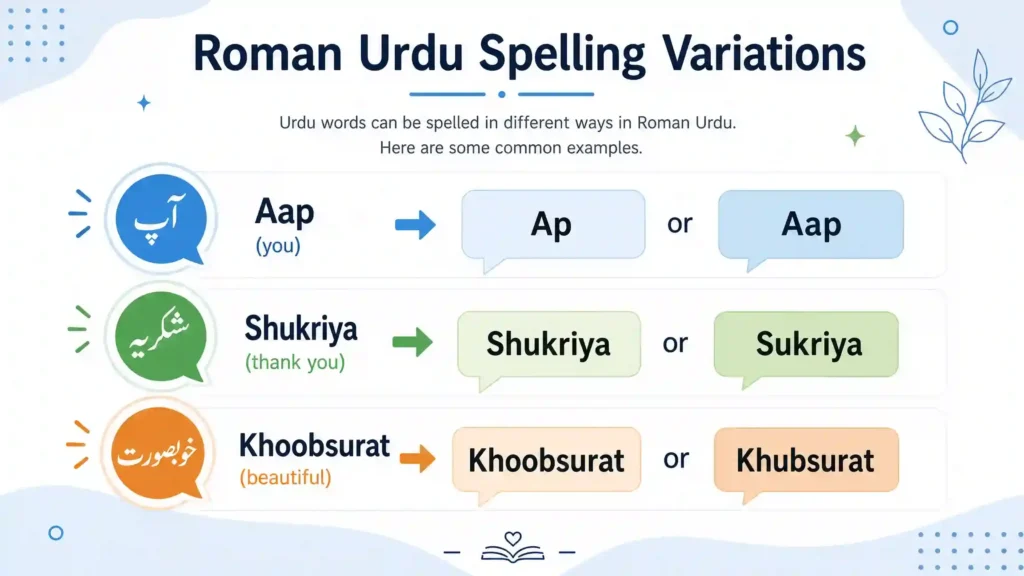
To help you understand, here is a simple table showing how one Urdu word can be written in many ways:
| Urdu Word | Common Spellings | Meaning |
|---|---|---|
| آپ | Aap, Ap | You |
| زندگی | Zindagi, Zindagee | Life |
| خوبصورت | Khoobsurat, Khubsurat | Beautiful |
| شکریہ | Shukriya, Sukriya | Thank you |
| بہت | Bohot, Boht, Bohoooot | Very / Many |
| اچھا | Acha, Achaaaa | Good / Okay |
Urdu vs Roman Urdu vs English: Understanding the Difference
Many people confuse Urdu, Roman Urdu Spelling Variations because all three are commonly used in online communication. While they may express the same meaning, they are written in different forms and used in different situations.
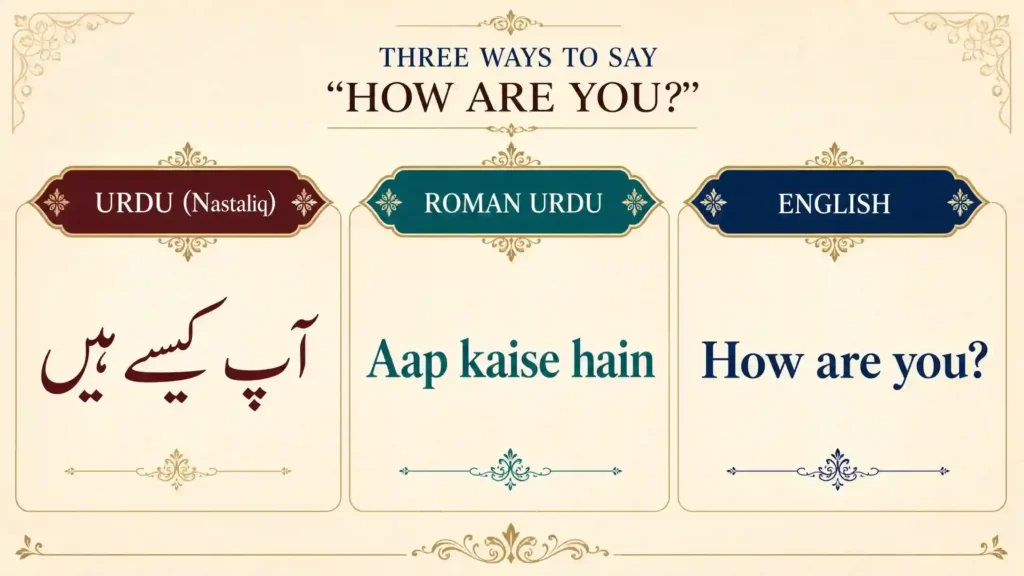
Urdu is traditionally written in the Perso-Arabic Nastaliq script, while Roman Urdu uses English letters to represent Urdu sounds. English, on the other hand, is a completely separate language with its own vocabulary and grammar rules.
Understanding the difference between these three forms can help you communicate better and recognize how people use language in digital conversations.
Urdu vs Roman Urdu vs English Comparison Table
| Language Form | Example | Meaning | Common Usage |
|---|---|---|---|
| Urdu Script | آپ کیسے ہیں؟ | How are you? | Formal writing, books, newspapers, education |
| Roman Urdu | Aap kaise hain? | How are you? | WhatsApp, social media, online chatting |
| English | How are you? | How are you? | International communication, business, education |
1. Urdu Script
Urdu script is the traditional written form of the Urdu language. It uses the Perso-Arabic alphabet and is read from right to left.
Examples:
| Urdu | English Meaning |
|---|---|
| شکریہ | Thank you |
| محبت | Love |
| زندگی | Life |
| دوست | Friend |
Urdu script is commonly used in:
- Books
- Newspapers
- Official documents
- Literature
- Educational materials
2. Roman Urdu
Roman Urdu is Urdu written using English alphabets (Latin script). It became popular because most people can easily type English letters on mobile phones, computers, and social media platforms.
Examples:
| Roman Urdu | Urdu Script | Meaning |
|---|---|---|
| Aap kaise hain? | آپ کیسے ہیں؟ | How are you? |
| Mera naam Ali hai | میرا نام علی ہے | My name is Ali |
| Mujhe Urdu seekhni hai | مجھے اردو سیکھنی ہے | I want to learn Urdu |
Roman Urdu is mostly used in:
- WhatsApp messages
- Facebook comments
- Instagram captions
- Online forums
- Informal conversations
3. English
English is a global language used worldwide for communication, education, business, and technology.
Example:
Roman Urdu:
Mujhe madad chahiye.
English:
I need help.
Common Roman Urdu Spelling Variations
One of the biggest challenges with Roman Urdu is that there is no officially standardized spelling system. Since people write Urdu words according to their pronunciation, the same word can appear in multiple forms.
These variations are common in online communication and usually have the same meaning.
50 Common Roman Urdu Spelling Variations
| Urdu Word | Roman Urdu Variations | English Meaning |
|---|---|---|
| آپ | Aap, Ap | You |
| نہیں | Nahi, Nai, Nh | No |
| کیا | Kya, Kia | What |
| کیوں | Kyun, Kyon | Why |
| اچھا | Acha, Achha, Accha | Good |
| مجھے | Mujhe, Muje | Me / To me |
| زندگی | Zindagi, Zindagee | Life |
| خوبصورت | Khoobsurat, Khubsurat | Beautiful |
| بہت | Bohat, Bohut, Boht | Very / Much |
| شکریہ | Shukriya, Sukriya | Thank you |
| دوست | Dost, Doust | Friend |
| محبت | Mohabbat, Muhabbat | Love |
| پانی | Pani, Paanee | Water |
| کھانا | Khana, Khaana | Food / Eat |
| جانا | Jana, Jaana | Go |
| آنا | Ana, Aana | Come |
| کہنا | Kehna, Kahna | Say |
| کرنا | Karna, Kerna | Do |
| دینا | Dena, Dehna | Give |
| لینا | Lena, Leina | Take |
| ہاں | Haan, Han | Yes |
| کہاں | Kahan, Kahaan | Where |
| یہاں | Yahan, Yahaan | Here |
| وہاں | Wahan, Wahaan | There |
| آج | Aaj, Aj | Today |
| کل | Kal, Kall | Tomorrow / Yesterday |
| رات | Raat, Rat | Night |
| دن | Din, Deen | Day |
| نام | Naam, Nam | Name |
| کام | Kaam, Kam | Work |
| وقت | Waqt, Waqat | Time |
| انسان | Insaan, Insan | Human |
| عورت | Aurat, Orat | Woman |
| مرد | Mard, Mart | Man |
| بچہ | Bacha, Bachha | Child |
| بڑا | Bara, Bada | Big |
| چھوٹا | Chota, Chhota | Small |
| نیا | Naya, Naaya | New |
| پرانا | Purana, Purana | Old |
| آسان | Asaan, Aasan | Easy |
| مشکل | Mushkil, Mushkel | Difficult |
| خوب | Khoob, Khub | Good / Excellent |
| خوش | Khush, Khus | Happy |
| غم | Gham, Gam | Sadness |
| راستہ | Rasta, Raasta | Way / Path |
| شہر | Sheher, Shahar | City |
| گھر | Ghar, Gar | House |
| کتاب | Kitab, Kitaab | Book |
| زبان | Zaban, Zabaan | Language / Tongue |
Common Roman Urdu Typing Rules Guide
Since Roman Urdu does not have fixed spelling rules, people usually write words according to sound. However, understanding common patterns can help you write and read Roman Urdu more easily.
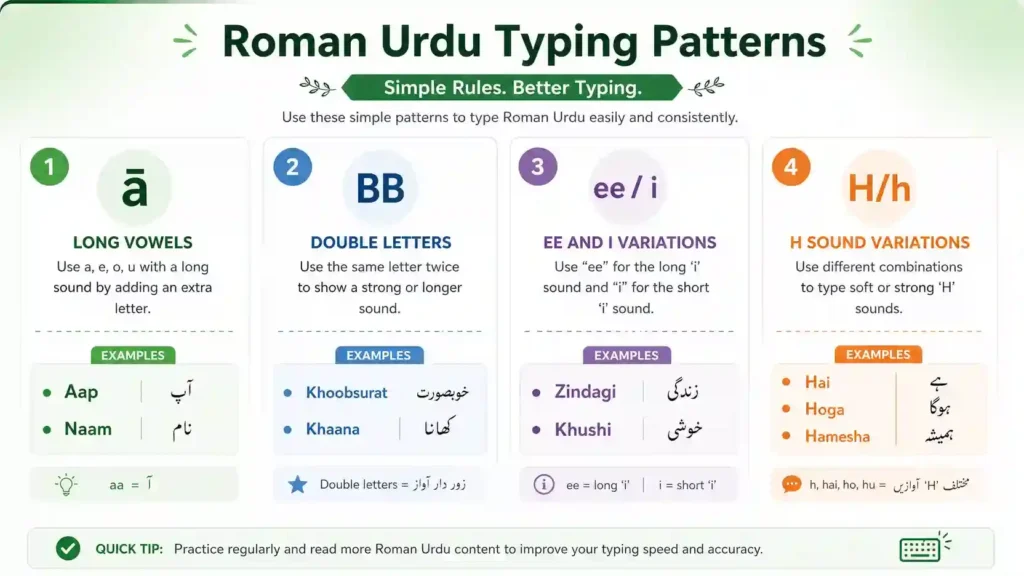
1. Long Vowel Usage in Roman Urdu
Urdu has long vowel sounds that are sometimes represented by extra letters in Roman Urdu.
For example:
| Word | Common Variations | Meaning |
|---|---|---|
| آپ | Aap / Ap | You |
| ہوں | Hoon / Hun | Am |
| نام | Naam / Nam | Name |
| پانی | Pani / Paanee | Water |
2. Double Letter Usage
Some writers use double letters to show stronger or longer sounds.
Examples:
| Word | Variations | Meaning |
|---|---|---|
| خوبصورت | Khoobsurat / Khubsurat | Beautiful |
| اچھا | Acha / Achha / Accha | Good |
| کھانا | Khana / Khaana | Food |
| جانا | Jana / Jaana | Go |
3. “ee” and “i” Confusion
A common variation happens with the long “ee” sound.
Examples:
| Word | Variations | Meaning |
|---|---|---|
| زندگی | Zindagi / Zindagee | Life |
| خوشی | Khushi / Khushee | Happiness |
| پانی | Pani / Paanee | Water |
| روشنی | Roshni / Roshnee | Light |
4. “H” Sound Variations
Some Urdu sounds do not have exact English equivalents, so people represent them differently.
Examples:
| Urdu Sound | Variations |
|---|---|
| خ | Kh / X |
| ق | Q / K |
| ع | A / ignored |
| ح | H |
Frequently Asked Questions (FAQs)
1. Is there an official standard for Roman Urdu spellings? No, there is currently no official governing body that sets rules for Roman Urdu. It is an informal writing system that evolves through social media and digital chat. Because of this, spellings are usually based on personal phonetics (how a word sounds to the writer).
2. Why does Google understand different spellings like “Aap” and “Ap”? Google uses advanced Natural Language Processing (NLP) and AI models that focus on “semantic intent.” This means Google’s algorithm recognizes that different character combinations (variations) refer to the same Urdu word, allowing it to show relevant results regardless of the specific spelling used.
3. What is “Lexical Normalization” in Roman Urdu? Lexical normalization is a technical process used by AI and researchers (like Soomro et al., 2024) to convert various informal spellings into one standard “canonical” form. This helps computers perform tasks like sentiment analysis or language translation more accurately. Understand 500 words variations.