
Roman Urdu to English Translator — Free & Instant Online
Roman Urdu to English translator converts Urdu written in English letters — like “aap kaise hain” or “mujhe samajh nahi aaya” — into clear, natural English. No Urdu keyboard, no Nastaliq script, no typing tools required. Just type Roman Urdu the way you already text it, and get an accurate English translation in seconds.
🌐 Roman Urdu to English Translator
AI-powered translation — works with ANY Roman Urdu text
This is different from a standard Urdu to English translator. Roman Urdu has no fixed spelling — the same word can be typed a dozen ways (“kaisay,” “kaise,” “kesay,” “kese” all mean the same thing), and most translation tools choke on that inconsistency. This tool is built specifically to handle that variation.
100% Free • No Sign-Up • Works on Mobile & Desktop
Roman Urdu to English Translator
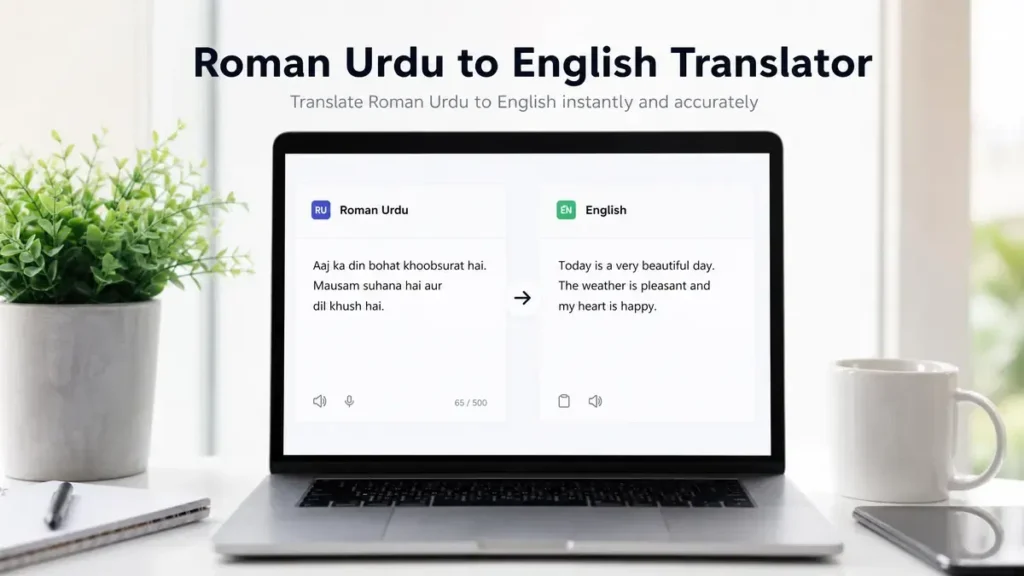
Type or paste Roman Urdu text and get instant English translation
- Roman Urdu Input 0 / 5000
- Translate Now — Clear — Copy — Listen
- English Output 0 characters
What Is Roman Urdu?
Roman Urdu is the Urdu language written using the English (Latin) alphabet instead of the Nastaliq script. It’s how most Pakistanis and Urdu speakers actually type on WhatsApp, Instagram, Facebook, and SMS — because typing Urdu script on a standard keyboard is slow and most phones default to English keys.
So instead of writing شکریہ, someone types “shukriya.” Instead of کیا حال ہے, they type “kya haal hai.” It sounds exactly like spoken Urdu, just spelled with English letters.
Roman Urdu is not a separate language and it’s not “wrong” Urdu — it’s a writing convention. But it creates a real translation problem, which is the whole reason a dedicated Roman Urdu to English translator exists.
Why Roman Urdu Is Harder to Translate Than Urdu Script
Urdu script has fixed spelling. Roman Urdu does not — and that’s the core challenge.
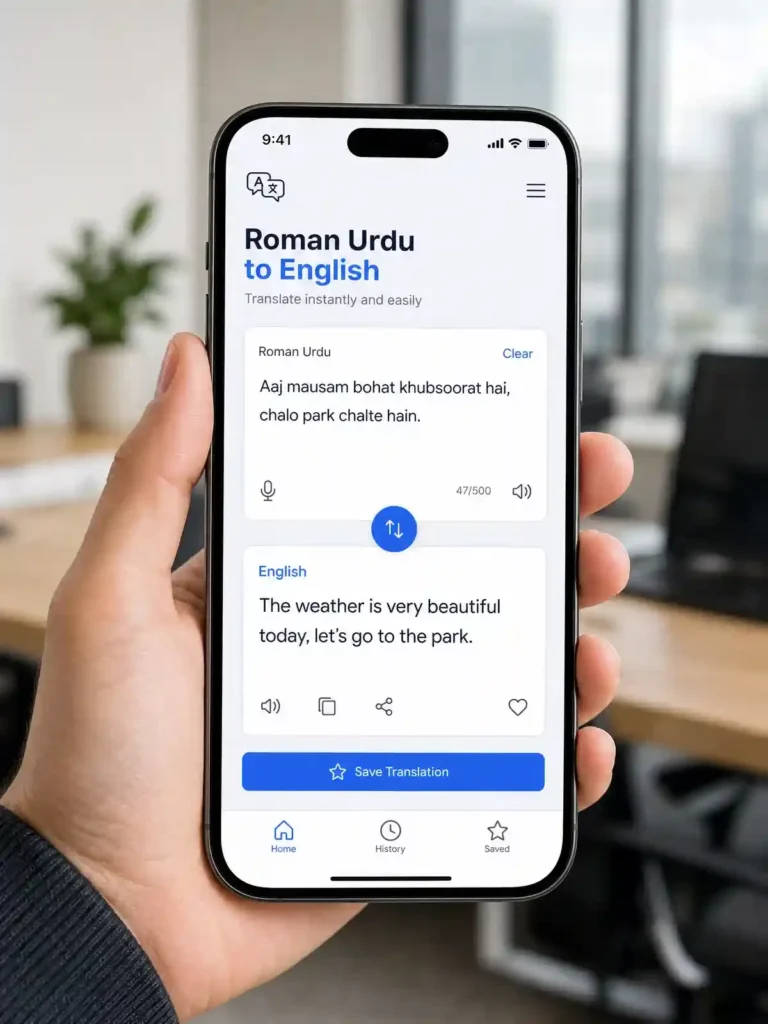
- No standard spelling. “How are you” (Urdu: آپ کیسے ہیں) gets typed as aap kaise hain, aap kaisay hain, ap kese ho, or aap kese hain — four spellings, one meaning.
- One Latin letter, multiple Urdu sounds. The letter “k” in Roman Urdu could represent ک, ق, or خ depending on the word — three completely different Urdu letters collapsed into one English letter.
- Dropped or added vowels. “Samajh” is sometimes typed “smjh,” “samjh,” or “samajh.” A translator that only recognizes exact spellings misses all three.
- Mixed English-Urdu (code-switching). Real messages look like “yaar mujhe ye deadline extend krni hai.” Half English, half Roman Urdu, in one sentence — and both halves need to be understood together.
- Regional and generational variation. Younger users abbreviate more (“kesa” instead of “kaisa hai”), while older users tend to spell Roman Urdu closer to how it sounds phonetically in full.
Because of this, a translator built only for standard Urdu script often fails on Roman Urdu input — it either mistranslates or returns nothing useful. This tool is built to normalize Roman Urdu spelling variations first, then translate the meaning, not just the letters.
How to Use This Roman Urdu to English Translator
- Type naturally. Enter Roman Urdu exactly how you’d text a friend — don’t worry about “correct” spelling. “Kesay ho” and “kaise ho” both work.
- Click Translate. The tool detects Roman Urdu automatically (no need to select a language manually).
- Read the English output. You’ll get a natural English sentence, not a robotic word-for-word swap.
- Copy or listen. Copy the result for messages, reports, or subtitles, or use text-to-speech to hear the English pronunciation.
Roman Urdu to English — Real Examples
| Roman Urdu | English Translation |
|---|---|
| Aap kaise hain? | How are you? |
| Kya haal hai? | What’s up? / How’s it going? |
| Mujhe samajh nahi aaya | I didn’t understand |
| Mera dil nahi lag raha | I don’t feel like doing anything / I’m not in the mood |
| Yaar tum kahan ho? | Dude, where are you? |
| Bohot shukriya aapki madad ke liye | Thank you so much for your help |
| Kal milte hain, inshallah | Let’s meet tomorrow, God willing |
| Mujhe thori der lagegi | I’ll take a little while |
| Tum ne khana khaya? | Have you eaten? |
| Sab theek ho jayega | Everything will be fine |
Notice that “Mera dil nahi lag raha” isn’t translated word-for-word (“my heart isn’t attaching”) — it’s translated for meaning, because that’s how the phrase is actually used in conversation. This is the difference between a literal converter and a real Roman Urdu to English translator.
Common Roman Urdu Words and Their English Meaning
| Roman Urdu | English |
|---|---|
| Shukriya | Thank you |
| Haan | Yes |
| Nahi | No |
| Acha | Okay / Good |
| Theek hai | It’s fine / Alright |
| Kyun | Why |
| Kab | When |
| Kahan | Where |
| Kaisay / Kaise | How |
| Bohot | Very / A lot |
| Zaroor | Definitely / Surely |
| Pata nahi | I don’t know |
| Chalo | Let’s go / Come on |
| Jaldi | Quickly |
Roman Urdu vs. Urdu Script vs. English
| Charaters | Roman Urdu | Urdu Script (Nastaliq) | English |
|---|---|---|---|
| Alphabet used | Latin (A–Z) | Perso-Arabic | Latin (A–Z) |
| Spelling rules | Informal, varies by user | Fixed, standardized | Fixed, standardized |
| Writing direction | Left to right | Right to left | Left to right |
| Where it’s used | Texting, social media, chat | Books, news, formal documents | Global default |
| Translation difficulty | High (spelling variation) | Medium (script conversion needed) | — |
Who Uses a Roman Urdu to English Translator
- Diaspora families — parents or grandparents send Roman Urdu voice notes and texts; younger family members abroad use this to read them in English.
- Customer support teams handling Pakistani or Urdu-speaking customers who write in Roman Urdu on WhatsApp, live chat, or email.
- Content moderators and researchers analyzing Roman Urdu comments, reviews, or social media posts at scale.
- Language learners trying to understand Urdu conversations without learning Nastaliq script first.
- Freelancers and remote teams translating Roman Urdu client messages into professional English for reports or documentation.
- Travelers and friends decoding a Roman Urdu text from someone who doesn’t type in Urdu script.
Tips for More Accurate Roman Urdu Translations
- Type complete phrases, not single words. “Lagta hai” alone is ambiguous; “mujhe lagta hai woh nahi aayega” gives the translator context to work with.
- Keep code-switched sentences intact. Don’t split English and Roman Urdu words apart — translate the full mixed sentence together.
- Punctuate where you can. A question mark on “kya haal hai?” helps the tool recognize it as a question, not a statement.
- Don’t worry about “correct” spelling. This tool is built to handle common variants (kesay/kaise/kese), so type however feels natural.
- Break up very long messages. For paragraph-length Roman Urdu, splitting into 2–3 sentences at a time usually gives cleaner output than one giant block.
Roman Urdu to English Translator vs. Other Tools
| Feature | This Translator | Generic Translation Apps | Basic Roman Urdu Converters |
|---|---|---|---|
| Understands spelling variants (kesay/kaise/kese) | ✅ Yes | ⚠️ Inconsistent | ❌ Rarely |
| Handles mixed English–Roman Urdu sentences | ✅ Yes | ⚠️ Often breaks | ❌ No |
| Translates meaning, not just words | ✅ Yes | ⚠️ Sometimes literal | ❌ Word-by-word only |
| No sign-up required | ✅ Yes | ⚠️ Varies | ⚠️ Varies |
| Free with no character limits | ✅ Yes | ⚠️ Often capped | ⚠️ Often capped |
| Also supports full Urdu script input | ✅ Yes | ✅ Usually | ❌ Rarely |
Frequently Asked Questions
What is Roman Urdu? Roman Urdu is the Urdu language written with English (Latin) letters instead of Urdu Nastaliq script. It’s the writing style most commonly used for texting, WhatsApp, and social media by Urdu speakers.
Can this translator Urdu to English accurately? Yes. It’s built to recognize common Roman Urdu spelling variations (like “kaise,” “kesay,” and “kese” for the same word) and translate based on meaning rather than a strict word-by-word match.
Is Roman Urdu the same as the Urdu language? Yes — Roman Urdu is standard Urdu, just written in English letters instead of Nastaliq script. The vocabulary and grammar are the same; only the writing system changes.
Does this tool work for mixed English and Roman Urdu sentences? Yes. Real-world messages often mix both (“yaar mujhe ye deadline extend krni hai”), and the translator is designed to interpret the full sentence together instead of failing on the English words.
Is there a character limit? No forced daily limit — you can translate single words, full sentences, or short paragraphs. For very long text, breaking it into smaller sections usually gives more accurate results.
Do I need to sign up or download anything? No. It works directly in your browser with no account, no app, and no payment required.
Can it also translate Urdu script, not just Roman Urdu? Yes. This tool supports both Roman Urdu and Urdu Nastaliq script as input, so you don’t need to convert scripts manually before translating.