
Roman Urdu to English Translation Guide: The Complete 2026 Handbook
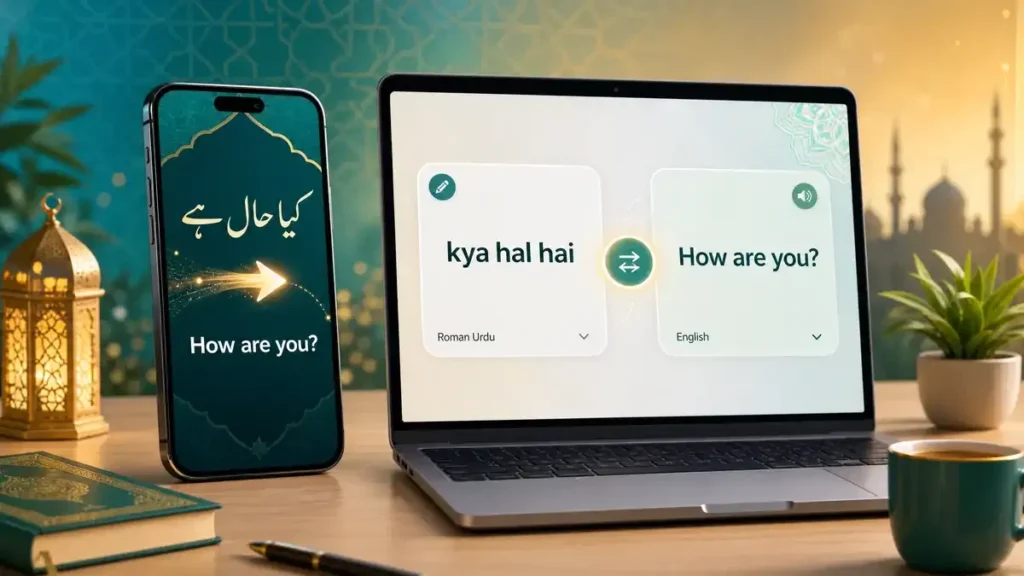
If you’ve ever typed “kya hal hai” or “aap kaisay hain” into a search bar wondering what it means in English, you’re not alone. Millions of people search every month for Roman Urdu to English Translation Guide whether they’re chatting with friends, reading messages, doing business, or learning a new language. This guide covers everything you need to know — from the basics of what Roman Urdu is, to the best Roman Urdu to English converter tools, common word lists, grammar rules, and practical tips to translate accurately every time.
What Is Roman Urdu?
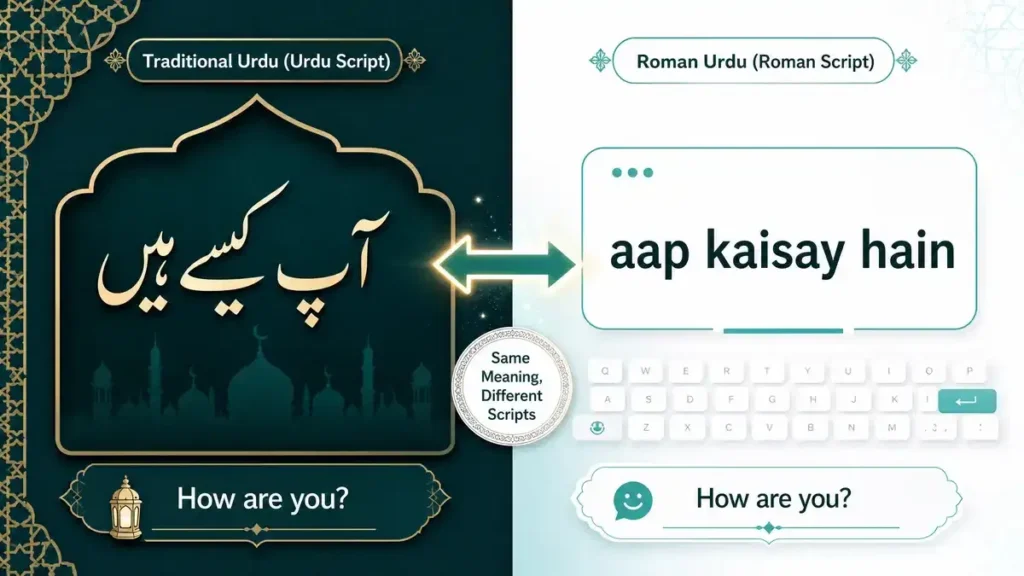
Roman Urdu to English Translation Guide is the practice of writing the Urdu language using the English (Latin) alphabet instead of the traditional Urdu (Nastaliq) script. Instead of writing “آپ کیسے ہیں” people write “aap kaisay hain.” It became extremely popular with the rise of SMS texting, WhatsApp, Facebook, and Instagram, because typing in Urdu script on a regular keyboard is harder for most users than simply typing Urdu words using English letters.
Today, Roman Urdu is used everywhere — in text messages, song lyrics, social media captions, YouTube comments, business chats, and even some casual news content across Pakistan and among the South Asian diaspora.
Why Roman Urdu to English Translation Is So Popular
There are several real reasons people constantly search for Urdu to English translation and Roman Urdu to english translator tools:
- Cross-border communication — Families and friends abroad often can’t read Urdu script but can read Roman Urdu.
- Business and customer support — Companies dealing with Pakistani clients need quick, accurate translation of Roman Urdu messages.
- Content creators — YouTubers, bloggers, and social media managers translate Roman Urdu comments and captions into English for wider audiences.
- Language learners — People learning Urdu often start with Roman Urdu since it’s easier to read.
- AI and chatbot training — Roman Urdu datasets are increasingly used to train translation models and chatbots.
Common Challenges in Roman Urdu Translation
Unlike a standard language pair, Roman Urdu to English Translation Guide doesn’t have fixed spelling rules. This causes several unique challenges:
- No standard spelling: The same word can be spelled multiple ways — “kaisay,” “kaise,” and “kese” all mean “how.”
- Missing diacritics: Urdu script uses short vowel marks (zabar, zair, pesh) that Roman Urdu drops entirely, causing ambiguity.
- Homophones and context dependency: Words like “kal” can mean either “yesterday” or “tomorrow” depending on context.
- Mixed language (code-switching): Many Roman Urdu sentences blend English words in — e.g., “mujhe office jana hai” (I have to go to the office).
- Regional dialects: Punjabi, Sindhi, and Pashto-influenced Urdu phrases often appear mixed in casual chats.
Roman Urdu to English Translation Rules
While Roman Urdu to English Translation Guide has no official grammar, these general rules help translators (human or AI) produce accurate results:
- Identify sentence structure first. Roman Urdu to English Translation Guide typically follows Subject-Object-Verb (SOV) order, while English follows Subject-Verb-Object (SVO). Example: “Main school ja raha hoon” (I school going am) → “I am going to school.”
- Watch for gendered verbs. Urdu verbs change based on gender — “raha” (masculine) vs “rahi” (feminine) — but this doesn’t carry over into English.
- Translate idioms by meaning, not word-for-word. “Dil se” literally means “from the heart” but is often used to mean “sincerely” or “truly.”
- Handle honorifics carefully. Words like “aap,” “tum,” and “tu” all mean “you” but carry different levels of respect — this nuance is often lost in direct translation.
- Recognize borrowed English words. Many Roman Urdu to English Translation Guide sentences already contain English words (office, mobile, table) — keep these as-is.
- Use context for ambiguous words. As mentioned, “kal” needs surrounding context to determine “yesterday” or “tomorrow.”
100+ Common Roman Urdu Words and Phrases
Here’s a practical Roman Urdu to English dictionary of everyday words and phrases:
Greetings & Basics
| Roman Urdu | English Meaning |
|---|---|
| Assalam o Alaikum | Peace be upon you (hello) |
| Kya hal hai? | How are you? |
| Aap kaisay hain? | How are you? (formal) |
| Theek hoon | I am fine |
| Shukriya | Thank you |
| Meharbani | Kindness / Thanks |
| Khuda hafiz | Goodbye |
| Phir milen ge | We will meet again |
Common Everyday Words
| Roman Urdu | English Meaning |
|---|---|
| Haan | Yes |
| Nahi | No |
| Theek hai | Okay / Fine |
| Kya | What |
| Kyun | Why |
| Kahan | Where |
| Kab | When |
| Kaisay | How |
| Kaun | Who |
| Kitna | How much |
| Ghar | Home |
| Kaam | Work |
| Paani | Water |
| Khana | Food |
| Waqt | Time |
| Paisa | Money |
| Dost | Friend |
| Family | Family |
| Zindagi | Life |
| Mohabbat | Love |
| Dil | Heart |
| Khushi | Happiness |
| Gham | Sorrow |
| Umeed | Hope |
Common Phrases
| Roman Urdu | English Meaning |
|---|---|
| Mujhe samajh nahi aya | I didn’t understand |
| Aap kya keh rahay hain? | What are you saying? |
| Mujhe madad chahiye | I need help |
| Kya aap English bol saktay hain? | Can you speak English? |
| Yeh kitne ka hai? | How much does this cost? |
| Mujhe bhookh lagi hai | I am hungry |
| Mujhe neend aa rahi hai | I am feeling sleepy |
| Kal milte hain | See you tomorrow / We met yesterday |
| Chalo chalte hain | Let’s go |
| Bohat acha | Very good |
| Bilkul sahi | Absolutely correct |
| Koi baat nahi | No problem |
| Mujhe maaf kar dein | Forgive me |
| Aap se mil kar khushi hui | Nice to meet you |
Best Tools and Apps for Roman Urdu Translation
Because Roman Urdu to English Translation Guide lacks fixed spelling, not every generic tool handles it well. Here are the most reliable options in 2026:
AI Chat Assistants (Best Accuracy)
Tools like Claude, ChatGPT, and Gemini understand context, idioms, and mixed-language sentences far better than older machine translation engines. They’re currently the most accurate free option for translating full Roman Urdu sentences and paragraphs, especially when context or tone matters.
Google Translate
Google Translate supports Urdu script but struggles more with Roman Urdu to English Translation Guide since it wasn’t originally designed for transliterated text. It works best for short, simple phrases rather than long, casual, code-switched messages.
Dedicated Roman Urdu Translator Apps
Several mobile apps on the Play Store and App Store are built specifically for Roman Urdu to English and English to Roman Urdu conversion. These are handy for quick lookups but usually weaker with full-sentence context compared to AI chat tools.
Manual/Human Translation
For legal, medical, business, or highly sensitive content, a professional human translator is still the gold standard, since machine tools can misinterpret idioms, sarcasm, or cultural nuance.
Step-by-Step Guide: How to Translate Roman Urdu to English Accurately
- Read the full sentence first — don’t translate word by word immediately; understand the overall meaning.
- Identify the subject, verb, and object in the Urdu sentence structure.
- Look up ambiguous words in context (like “kal,” “hal,” or “kar”) rather than relying on a single dictionary meaning.
- Rearrange into English SVO order.
- Adjust idioms and expressions so they sound natural in English rather than literal.
- Proofread for tone — Roman Urdu to English Translation Guide often carries emotional or respectful tone through word choice (aap vs tu) that should be reflected in the English translation style (formal vs casual).
- Double-check with a second tool or native speaker if the content is important (business, legal, or emotional messages).
Roman Urdu vs Urdu Script vs English — Key Differences
| Feature | Urdu Script | Roman Urdu | English |
|---|---|---|---|
| Writing direction | Right to left | Left to right | Left to right |
| Alphabet | Arabic-based (Nastaliq) | Latin alphabet | Latin alphabet |
| Standard spelling | Yes | No | Yes |
| Sentence order | SOV | SOV | SVO |
| Common use | Formal writing, literature | Texting, social media | Global communication |
Tips for Perfect Translation Every Time
- Keep a personal glossary of words you translate often — this saves time long-term.
- When translating for business, always double-check tone (formal “aap” vs casual “tu/tum”).
- Use AI tools for speed, but review important translations manually.
- Watch for regional variations — Roman Urdu to English Translation Guide from Karachi, Lahore, or Islamabad can carry slightly different slang.
- When in doubt about “kal” (yesterday/tomorrow) or similar dual-meaning words, ask for the sentence before and after for context.
Common Mistakes to Avoid
- Translating word-for-word instead of by meaning — this often produces awkward or wrong English.
- Ignoring context for ambiguous words like “kal,” “kar,” or “hal.”
- Missing tone and respect levels (aap/tum/tu) that don’t have a direct English equivalent.
- Over-relying on outdated translation tools that aren’t built for transliterated text.
- Assuming one spelling is correct — Roman Urdu to English Translation Guide has no fixed spelling standard, so multiple versions of the same word are all valid.
FAQs Roman Urdu to English Translation Guide
Q: What is the easiest way to Roman Urdu to English Translation Guide? A: The fastest and most accurate method today is using an AI assistant like Claude or ChatGPT, since they understand sentence context and idioms rather than just translating word by word.
Q: Is Roman Urdu the same as Urdu? A: No. Roman Urdu is the same spoken language as Urdu, but written using the English alphabet instead of the traditional Urdu (Nastaliq) script.
Q: Why does Roman Urdu have so many spelling variations? A: Because there’s no official standardized spelling system for writing Urdu using Latin letters — different people spell the same word differently based on pronunciation and habit.
Q: Can Google Translate handle Roman Urdu accurately? A: It can handle short, simple phrases reasonably well, but it often struggles with longer, casual, or code-switched sentences compared to AI chat tools.
Q: What does “kal” mean in English? A: “Kal” can mean either “yesterday” or “tomorrow” in Urdu — the correct meaning depends entirely on the context of the sentence.
Q: Is Roman Urdu translation used in business? A: Yes, many businesses dealing with Pakistani or South Asian clients Roman Urdu to English Translation Guide customer messages, reviews, and chats into English for support and analysis purposes.
Final Thoughts Roman Urdu to English Translation Guide
Roman Urdu to English Translation Guide isn’t just about swapping words — it’s about understanding context, tone, and culture. Whether you’re a student, a business owner, a content creator, or just chatting with friends and family, the tools and tips in this guide should help you translate accurately and naturally, every single time.