Urdu Pronouns With English Meanings
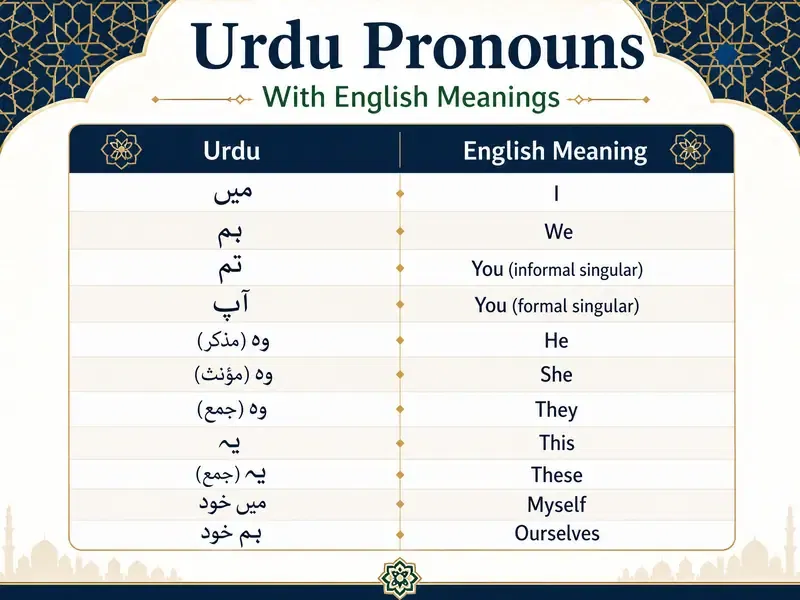
Learning Urdu pronouns with English meanings helps you speak and understand Urdu more naturally. Pronouns replace nouns in a sentence. They make conversations shorter, clearer, and easier to follow. For example, instead of repeating a person’s name, Urdu speakers use words like میں (Main) for “I” or آپ (Aap) for “you.”
Urdu Pronouns With English Meanings play a key role in everyday communication. You will hear them in homes, schools, workplaces, and public conversations. They also show respect, familiarity, and social relationships. Unlike English, Urdu offers different pronouns for formal and informal situations. Choosing the right one helps you speak politely and avoid common mistakes.
English and Urdu Pronouns With English Meanings categories, such as personal, possessive, and demonstrative pronouns. However, Urdu grammar also reflects respect, number, and sentence context in unique ways. Understanding these differences makes translation easier and improves speaking confidence.
This guide suits beginners, students, travelers, teachers, translators, and English speakers learning Urdu. It also helps anyone preparing for language exams or improving daily conversations.
Throughout this guide, you will learn every major type of Urdu Pronouns With English Meanings, clear explanations, pronunciation tips, comparison tables, and real-life examples. You will also discover grammar rules, common mistakes, and practical exercises to strengthen your Urdu communication skills.
Linguistic principles discussed here align with established descriptions of Urdu grammar found in works by linguists such as Ruth Laila Schmidt and standard references including the Comprehensive Grammar of Modern Indo-Aryan Languages, helping ensure accurate and reliable explanations.
What Are Urdu Pronouns?
Urdu Pronouns With English Meanings are words that replace nouns in a sentence. They help speakers avoid repeating the same name or object. In English, words like I, you, he, she, and they are pronouns. Urdu follows the same idea but includes different forms to express respect, formality, and relationships.
Urdu Pronouns With English Meanings uses pronouns to make sentences clear, natural, and easy to understand. They improve the flow of speech and writing. Instead of saying a person’s name several times, speakers use a suitable pronoun. This makes conversations smoother and more engaging.
One unique feature of Urdu is its polite pronoun system. For example, آپ (Aap) shows respect, while تم (Tum) suits informal conversations. تو (Tu) appears only in very close or specific situations. Choosing the correct pronoun shows good manners and accurate language skills.
One Practical Example
Consider these two sentences:
- Ali is my friend. Ali is a teacher. Ali lives in Lahore.
- Ali میرا دوست ہے۔ وہ استاد ہے۔ وہ لاہور میں رہتا ہے۔
- (Ali mera dost hai. Woh ustad hai. Woh Lahore mein rehta hai.)
- English: Ali is my friend. He is a teacher. He lives in Lahore.
In the second version, وہ (Woh) replaces Ali after the first mention. The sentence becomes shorter, smoother, and easier to read.
- Urdu Pronouns List with English Meanings (Quick Reference Table)
- The table below introduces the most common Urdu pronouns with English meanings. These words appear in daily conversations, books, classrooms, and workplaces. Learning them first will help you build simple Urdu sentences with confidence.
| Urdu | Roman Urdu | English Meaning | Type | Example |
| میں | Main | I | First Person Pronoun | میں طالب علم ہوں۔ (Main talib-e-ilm hoon.) → I am a student. |
| ہم | Hum | We | First Person Plural Pronoun | ہم دوست ہیں۔ → We are friends. |
| تو | Tu | You (very informal) | Second Person Pronoun | تو کہاں جا رہا ہے؟ → Where are you going? |
| تم | Tum | You (informal) | Second Person Pronoun | تم کیسے ہو؟ → How are you? |
| آپ | Aap | You (formal/respectful) | Honorific Pronoun | آپ کیسے ہیں؟ → How are you? |
| یہ | Yeh | This / He / She | Demonstrative Pronoun | یہ میری کتاب ہے۔ → This is my book. |
| وہ | Woh | That / He / She / They | Demonstrative & Third Person Pronoun | وہ ڈاکٹر ہے۔ → He/She is a doctor. |
| مجھے | Mujhe | Me | Object Pronoun | مجھے پانی چاہیے۔ → I need water. |
| ہمیں | Hamein | Us | Object Pronoun | ہمیں مدد چاہیے۔ → We need help. |
| اسے | Use | Him / Her | Object Pronoun | میں اسے جانتا ہوں۔ → I know him/her. |
| انہیں | Unhein | Them | Object Pronoun | میں انہیں جانتا ہوں۔ → I know them. |
| اپنا | Apna | Own | Reflexive/Possessive Pronoun | اپنا کام کرو۔ → Do your own work. |
| کون | Kaun | Who | Interrogative Pronoun | وہ کون ہے؟ → Who is that? |
| کیا | Kya | What | Interrogative Pronoun | یہ کیا ہے؟ → What is this? |
| کوئی | Koi | Someone / Anyone | Indefinite Pronoun | کیا کوئی یہاں ہے؟ → Is anyone here? |
| سب | Sab | Everyone / All | Indefinite Pronoun | سب خوش ہیں۔ → Everyone is happy. |
What Is a Pronoun in Urdu Grammar?
A pronoun is a word that replaces a noun in a sentence. In Urdu Pronouns With English Meanings grammar, pronouns help you refer to people, places, animals, or things without repeating their names. They make sentences shorter, clearer, and easier to understand. Common Urdu pronouns include میں (Main), آپ (Aap), وہ (Woh), and یہ (Yeh).
Pronouns play an important role in both spoken and written Urdu Pronouns With English Meanings. They connect ideas smoothly and improve the natural flow of conversation. Every time you replace a noun with a pronoun, your sentence becomes more concise. Urdu also uses pronouns to express respect and social relationships. For example, آپ (Aap) shows politeness, while تم (Tum) suits informal conversations.
A noun names a person, place, or thing. A Urdu Pronouns With English Meanings stands in place of that noun after you introduce it. This simple change prevents unnecessary repetition and makes communication more effective.
Consider this example:
Without a Pronoun
- علی اسکول گیا۔ علی نے کتاب پڑھی۔ علی گھر واپس آیا۔
- (Ali school gaya. Ali ne kitab parhi. Ali ghar wapas aaya.)
- English: Ali went to school. Ali read a book. Ali returned home.
With a Pronoun
- علی اسکول گیا۔ وہ کتاب پڑھنے کے بعد گھر واپس آیا۔
- (Ali school gaya. Woh kitab parhne ke baad ghar wapas aaya.)
- English: Ali went to school. He returned home after reading a book.
The second example sounds smoother because وہ (Woh) replaces Ali after the first mention. This approach matches a basic principle of effective communication found in both Urdu and English grammar.
Types of Urdu Pronouns With English Meanings
Urdu Pronouns With English Meanings grammar includes several types of pronouns, and each serves a specific purpose. Some Urdu Pronouns With English Meanings refer to people, while others show ownership, ask questions, or connect ideas. Learning these categories helps you build accurate sentences and understand everyday conversations more easily.
The table below gives a quick overview before we explore each type in detail.
| Pronoun Type | Purpose | Common Urdu Pronouns | English Meaning |
| Personal Pronouns | Refer to people or things | میں، ہم، تم، آپ، وہ | I, We, You, He, She, They |
| Possessive Pronouns | Show ownership | میرا، میری، ہمارے، آپ کا | My, Mine, Our, Your |
| Demonstrative Pronouns | Point to someone or something | یہ، وہ | This, That, These, Those |
| Interrogative Pronouns | Ask questions | کون، کیا، کس | Who, What, Whom |
| Relative Pronouns | Connect two related ideas | جو، جس، جن | Who, Which, That |
| Reflexive Pronouns | Refer back to the subject | اپنا، خود | Own, Self |
| Reciprocal Pronouns | Show mutual action | ایک دوسرے | Each Other, One Another |
| Indefinite Pronouns | Refer to an unspecified person or thing | کوئی، کچھ، سب | Someone, Something, Everyone |
| Emphatic Pronouns | Add emphasis to the subject | خود | Myself, Yourself, Himself |
Each type follows its own grammar rules and appears in different situations. Personal Urdu Pronouns With English Meanings help you talk about people. Possessive pronouns show ownership. Demonstrative pronouns identify people or objects.
Interrogative pronouns form questions, while relative pronouns connect clauses smoothly. Reflexive and emphatic pronouns add clarity and emphasis, reciprocal pronouns describe shared actions, and indefinite pronouns refer to unknown or general people and things.
Personal Urdu Pronouns With English Meanings
Urdu Pronouns With English Meanings refer to the people speaking, listening, or being discussed. They are the most frequently used pronouns in Urdu. Every conversation uses them to identify the speaker or others without repeating names. Learning these pronouns is the first step toward speaking natural Urdu.
Urdu Pronouns With English Meanings follow the same basic idea as English. However, Urdu also reflects number, respect, and context. The first person pronouns refer to the speaker or a group that includes the speaker.
First Person Pronouns
The two main first person pronouns are میں (Main) and ہم (Hum).
| Urdu | Roman Urdu | English Meaning | Usage |
| میں | Main | I | Refers to one speaker. |
| ہم | Hum | We | Refers to two or more people, including the speaker. |
Use میں (Main) when talking about yourself.
Examples
- میں طالب علم ہوں۔
(Main talib-e-ilm hoon.)
English: I am a student. - میں اردو سیکھ رہا ہوں۔
(Main Urdu seekh raha hoon.)
English: I am learning Urdu.
Use ہم (Hum) when speaking about yourself and others together.
Examples
- ہم دوست ہیں۔
(Hum dost hain.)
English: We are friends. - ہم ہر روز اردو بولتے ہیں۔
(Hum har roz Urdu bolte hain.)
English: We speak Urdu every day.
In formal writing, ہم (Hum) may also represent a single speaker. Writers, scholars, and public speakers sometimes use this style to sound humble or respectful. Everyday conversations, however, usually follow the standard meanings of میں for I and ہم for we.
Second Person Pronouns in Urdu
Second Urdu Pronouns With English Meanings refer to the person you are speaking to. Urdu has three different pronouns for “you”: تو (Tu), تم (Tum), and آپ (Aap). Each one expresses a different level of familiarity and respect. This system makes Urdu different from English, where the single word “you” works in almost every situation.
تو (Tu) is very informal and suits close friends, young children, or poetic expressions. Using it with strangers or elders may sound rude. تم (Tum) fits casual conversations with friends, classmates, cousins, or siblings. It creates a friendly and natural tone. آپ (Aap) is the formal and respectful form.
Use it when speaking to parents, teachers, elders, guests, customers, or someone you have just met. When in doubt, choose آپ because it always sounds polite. Another important difference is that Urdu verbs change according to these pronouns. For example, آپ کیسے ہیں؟ (Aap kaise hain?) means “How are you?” in a respectful way, while تم کیسے ہو؟ (Tum kaise ho?) sounds informal.
Many English speakers mistakenly use تم with everyone because English does not distinguish between formal and informal “you.” Standard Urdu grammar references, including works by Ruth Laila Schmidt and David Matthews, recommend mastering these three pronouns early because they are essential for polite, accurate, and natural communication.
Third Person Pronouns in Urdu
Third Urdu Pronouns With English Meanings refer to a person, place, animal, or thing that is not the speaker or the listener. The two main third person pronouns in Urdu are یہ (Yeh) and وہ (Woh). Unlike English, Urdu does not use separate pronouns for he and she. Instead, the same word represents both genders, and readers understand the meaning from the sentence.
These pronouns can also point to objects or groups, making them one of the most versatile parts of Urdu grammar. Generally, یہ (Yeh) refers to someone or something near the speaker and can mean this, he, she, or these, depending on the context. وہ (Woh) refers to someone or something farther away and can mean that, he, she, or they.
For example, یہ میرا دوست ہے۔ (Yeh mera dost hai.) means “This is my friend.” Another example is وہ استاد ہے۔ (Woh ustad hai.), which means “He is a teacher” or “She is a teacher.” If you say وہ میرے دوست ہیں۔ (Woh mere dost hain.), the meaning becomes “They are my friends.” Likewise, وہ میرا گھر ہے۔ (Woh mera ghar hai.) means “That is my house.” Urdu speakers identify the correct English meaning through context, nearby nouns, and verb forms rather than different pronoun words. Standard Urdu grammar references, including Ruth Laila Schmidt and David Matthews, describe this context-based system as a defining feature of modern Urdu, making it essential for learners to understand both spoken and written communication.
Possessive Pronouns in Urdu
Possessive Urdu Pronouns With English Meanings show ownership or belonging. They answer questions like “Whose is this?” or “Who owns it?” In Urdu, possessive pronouns change according to the gender and number of the noun they describe. This is different from English, where words like my and our usually stay the same. Learning these forms helps you build accurate and natural Urdu sentences.
Some of the most common possessive Urdu Pronouns With English Meanings are میرا (Mera), میری (Meri), میرے (Mere), ہمارا (Hamara), تمہارا (Tumhara), آپ کا (Aap ka), and اس کا (Us ka). Use میرا with masculine singular nouns, میری with feminine singular nouns, and میرے with masculine plural nouns or respectful singular nouns. The same agreement pattern applies to ہمارا, تمہارا, and آپ کا, which change their endings to match the noun.
| Possessive Pronoun | Roman Urdu | English Meaning | Example |
| میرا | Mera | My | میرا قلم ہے۔ (Mera qalam hai.) → This is my pen. |
| میری | Meri | My | میری کتاب نئی ہے۔ (Meri kitab nai hai.) → My book is new. |
| میرے | Mere | My | میرے دوست آئے۔ (Mere dost aaye.) → My friends arrived. |
| ہمارا | Hamara | Our | ہمارا گھر بڑا ہے۔ (Hamara ghar bara hai.) → Our house is big. |
| تمہارا | Tumhara | Your | تمہارا بیگ کہاں ہے؟ (Tumhara bag kahan hai?) → Where is your bag? |
| آپ کا | Aap ka | Your (formal) | آپ کا نام کیا ہے؟ (Aap ka naam kya hai?) → What is your name? |
| اس کا | Us ka | His / Her | اس کا موبائل نیا ہے۔ (Us ka mobile naya hai.) → His/Her mobile is new. |
Demonstrative Pronouns in Urdu
Demonstrative pronouns point to a specific person, place, animal, or thing. They answer questions like “Which one?” or “Who is that?” In Urdu, the two main demonstrative pronouns are یہ (Yeh) and وہ (Woh). These pronouns help identify whether someone or something is near or far from the speaker. They also function as third person pronouns in many sentences, making them essential for everyday communication.
یہ (Yeh) refers to someone or something close to the speaker. Depending on the context, it can mean this, he, she, or these. وہ (Woh) refers to someone or something farther away. It can mean that, he, she, or they. Unlike English, Urdu does not use separate words for he and she. Native speakers understand the correct meaning through context and verb forms.
| Urdu | Roman Urdu | English Meaning | Distance |
| یہ | Yeh | This / He / She / These | Near |
| وہ | Woh | That / He / She / They | Far |
Here are a few everyday examples:
یہ میری کتاب ہے۔
(Yeh meri kitab hai.)
English: This is my book.
وہ میرا گھر ہے۔
(Woh mera ghar hai.)
English: That is my house.
یہ استاد ہیں۔
(Yeh ustad hain.)
English: This is the teacher.
وہ میرے دوست ہیں۔
(Woh mere dost hain.)
English: They are my friends.
Interrogative Pronouns in Urdu
Interrogative pronouns ask questions about people, things, ownership, or objects. They help you gather information during conversations. In Urdu grammar, the most common interrogative pronouns are کون (Kaun), کیا (Kya), کس (Kis), کسے (Kise), and کس کا (Kis ka). These pronouns appear in daily conversations, classrooms, workplaces, and written Urdu. Learning them will help you ask clear and natural questions.
| Urdu | Roman Urdu | English Meaning | Usage |
| کون | Kaun | Who | Asks about a person |
| کیا | Kya | What | Asks about a thing or idea |
| کس | Kis | Whom / Which | Refers to a person or object in context |
| کسے | Kise | To whom / Whom | Refers to the receiver of an action |
| کس کا | Kis ka | Whose | Asks about ownership |
Here are some common examples:
وہ کون ہے؟
(Woh kaun hai?)
English: Who is that?
یہ کیا ہے؟
(Yeh kya hai?)
English: What is this?
تم کس سے بات کر رہے ہو؟
(Tum kis se baat kar rahe ho?)
English: Whom are you talking to?
تم نے کسے بلایا؟
(Tum ne kise bulaya?)
English: Whom did you call?
یہ کس کا بیگ ہے؟
(Yeh kis ka bag hai?)
English: Whose bag is this?
Relative Pronouns in Urdu
Relative pronouns connect two related parts of a sentence. They link a noun with additional information, making the sentence more detailed and natural. In Urdu grammar, the most common relative pronouns are جو (Jo), جس (Jis), and جن (Jin). These words often translate as who, whom, which, or that in English. The exact meaning depends on the context of the sentence.
جو (Jo) introduces a person or thing that the speaker describes. جس (Jis) refers to a singular person or thing after a preposition or within a clause. جن (Jin) serves the same purpose but refers to plural people or things. These pronouns help combine short sentences into one smooth and meaningful sentence.
| Urdu | Roman Urdu | English Meaning | Usage |
| جو | Jo | Who / Which / That | Introduces a relative clause |
| جس | Jis | Whom / Which | Refers to a singular noun |
| جن | Jin | Those whom / Which | Refers to plural nouns |
Here are some everyday examples:
جو لڑکا کھڑا ہے، میرا بھائی ہے۔
(Jo larka khara hai, mera bhai hai.)
English: The boy who is standing is my brother.
جس کتاب کو میں پڑھ رہا ہوں، وہ بہت دلچسپ ہے۔
(Jis kitab ko main parh raha hoon, woh bohat dilchasp hai.)
English: The book that I am reading is very interesting.
جن لوگوں نے مدد کی، میں ان کا شکر گزار ہوں۔
(Jin logon ne madad ki, main un ka shukar guzar hoon.)
English: I am thankful to the people who helped.
Reflexive Pronouns in Urdu
Reflexive Urdu Pronouns With English Meanings With English Meanings refer back to the subject of a sentence. They show that the person performing the action also receives the action or has a personal connection to it. In Urdu, the two most common reflexive pronouns are اپنا (Apna) and خود (Khud). Although both relate to the subject, they have different functions and should not be used interchangeably.
اپنا (Apna) expresses ownership that belongs to the subject. It usually means own and changes its form according to the gender and number of the noun, such as اپنی (Apni) and اپنے (Apne). خود (Khud) means self, myself, yourself, himself, herself, or themselves. It adds emphasis or shows that someone performs an action personally.
| Urdu | Roman Urdu | English Meaning | Usage |
| اپنا | Apna | Own | Shows possession related to the subject |
| خود | Khud | Self / Personally | Emphasizes the subject or action |
The main difference is simple. اپنا focuses on ownership, while خود focuses on the person performing the action.
Consider these examples:
میں اپنا کام کرتا ہوں۔
(Main apna kaam karta hoon.)
English: I do my own work.
اس نے اپنی کتاب کھولی۔
(Us ne apni kitab kholi.)
English: He/She opened his/her own book.
میں خود آیا ہوں۔
(Main khud aaya hoon.)
English: I came myself.
انہوں نے خود مسئلہ حل کیا۔
(Unhon ne khud masla hal kiya.)
English: They solved the problem themselves.
Reciprocal Pronouns in Urdu
Reciprocal Urdu Pronouns With English Meanings describe an action shared between two or more people. They show that each person both performs and receives the same action. In Urdu, the most common reciprocal pronoun is ایک دوسرے (Ek Doosray), which means each other or one another in English. You will hear this expression in daily conversations, stories, and formal writing because it clearly expresses mutual relationships and shared actions.
ایک دوسرے (Ek Doosray) is used when two or more people interact with one another. Instead of repeating the names of the people involved, Urdu uses this reciprocal pronoun to make the sentence shorter and more natural.
| Urdu | Roman Urdu | English Meaning | Usage |
| ایک دوسرے | Ek Doosray | Each Other / One Another | Shows a mutual action between two or more people |
Here are some common examples:
ہم ایک دوسرے کی مدد کرتے ہیں۔
(Hum ek doosray ki madad karte hain.)
English: We help each other.
وہ ایک دوسرے سے بات کر رہے ہیں۔
(Woh ek doosray se baat kar rahe hain.)
English: They are talking to each other.
بچے ایک دوسرے کے ساتھ کھیلتے ہیں۔
(Bachay ek doosray ke sath khelte hain.)
English: The children play with each other.
ہمیں ایک دوسرے کا احترام کرنا چاہیے۔
(Hamein ek doosray ka ehtiram karna chahiye.)
English: We should respect each other.
Indefinite Pronouns in Urdu
Indefinite Urdu Pronouns With English Meanings refer to people or things without naming them specifically. They describe an unknown, unspecified, or general person, object, or group. In Urdu grammar, the most common indefinite pronouns are کوئی (Koi), کچھ (Kuch), and سب (Sab). These words appear frequently in everyday conversations because speakers often talk about someone, something, or everyone without giving exact details.
کوئی (Koi) means someone, anyone, or anybody. کچھ (Kuch) means something, some, or a few, depending on the sentence. سب (Sab) means everyone, everybody, or all. The correct meaning comes from the context of the conversation.
| Urdu | Roman Urdu | English Meaning | Common Usage |
| کوئی | Koi | Someone / Anyone | Refers to an unknown person |
| کچھ | Kuch | Something / Some | Refers to an unknown thing or quantity |
| سب | Sab | Everyone / Everybody / All | Refers to an entire group |
Here are some everyday examples:
کیا کوئی گھر پر ہے؟
(Kya koi ghar par hai?)
English: Is anyone at home?
مجھے کچھ کہنا ہے۔
(Mujhe kuch kehna hai.)
English: I want to say something.
سب خوش ہیں۔
(Sab khush hain.)
English: Everyone is happy.
کچھ لوگ جلدی آ گئے۔
(Kuch log jaldi aa gaye.)
English: Some people arrived early.
سب نے میری مدد کی۔
(Sab ne meri madad ki.)
English: Everyone helped me.
Emphatic Pronouns in Urdu
Emphatic Urdu Pronouns With English Meanings add special emphasis to the subject of a sentence. They show that the person performed the action personally or without anyone’s help. In Urdu, the most common emphatic pronoun is خود (Khud). It usually means myself, yourself, himself, herself, itself, ourselves, or themselves, depending on the context.
Unlike اپنا (Apna), which shows ownership, خود (Khud) highlights the person who performs the action. It stresses that the subject did something independently or deserves special attention. This usage is common in daily conversations, speeches, books, and news reports.
| Urdu | Roman Urdu | English Meaning | Usage |
| خود | Khud | Myself / Yourself / Himself / Herself / Themselves | Adds emphasis to the subject or action |
Here are some common examples:
میں خود بازار گیا۔
(Main khud bazar gaya.)
English: I went to the market myself.
اس نے خود کھانا بنایا۔
(Us ne khud khana banaya.)
English: He/She cooked the food personally.
آپ خود فیصلہ کریں۔
(Aap khud faisla karein.)
English: You decide for yourself.
انہوں نے خود مسئلہ حل کیا۔
(Unhon ne khud masla hal kiya.)
English: They solved the problem themselves.
Subject and Object Urdu Pronouns With English Meanings
Subject and object Urdu Pronouns With English Meanings perform different jobs in a sentence. A subject pronoun tells who performs the action, while an object pronoun tells who receives the action. Understanding this difference helps you build grammatically correct Urdu sentences and improve your translation skills. Like English, Urdu uses different forms for subjects and objects, although the changes often depend on sentence structure and case markers.
The table below compares the most common Urdu subject and object pronouns.
| Subject Pronoun | Object Pronoun | Roman Urdu | English Meaning |
| میں | مجھے | Main / Mujhe | I / Me |
| ہم | ہمیں | Hum / Hamein | We / Us |
| تم | تمہیں | Tum / Tumhein | You / You |
| آپ | آپ کو | Aap / Aap ko | You / You (Formal) |
| وہ | اسے | Woh / Use | He, She / Him, Her |
| وہ | انہیں | Woh / Unhein | They / Them |
A subject Urdu Pronouns With English Meanings appears before the verb because it performs the action. An object pronoun receives the action and usually follows the verb or a postposition such as کو (ko).
Here are some everyday examples:
میں کتاب پڑھتا ہوں۔
(Main kitab parhta hoon.)
English: I read a book.
استاد نے مجھے بلایا۔
(Ustad ne mujhe bulaya.)
English: The teacher called me.
ہم انہیں جانتے ہیں۔
(Hum unhein jante hain.)
English: We know them.
وہ ہمیں دیکھ رہا ہے۔
(Woh hamein dekh raha hai.)
English: He is looking at us.
Frequently Asked Questions
What are Urdu pronouns?
Urdu Pronouns With English Meanings are words that replace nouns in a sentence. They make speech and writing shorter, clearer, and more natural. Common examples include میں (Main), آپ (Aap), وہ (Woh), and یہ (Yeh).
How many pronouns are there in Urdu?
Urdu grammar includes several types of pronouns. The main categories are personal, possessive, demonstrative, interrogative, relative, reflexive, reciprocal, indefinite, and emphatic pronouns. Each category serves a different purpose in communication.
What are personal pronouns?
Urdu Pronouns With English Meanings refer to people or things. Examples include میں (I), ہم (We), تم (You), آپ (You – formal), and وہ (He, She, They). These pronouns appear in almost every Urdu sentence.
What is the difference between تم and آپ?
تم (Tum) is informal and suits friends, classmates, or siblings. آپ (Aap) is formal and respectful. Use آپ for elders, teachers, strangers, and professional conversations. When unsure, choose آپ because it always sounds polite.
Is وہ he or she?
Yes. وہ (Woh) can mean he, she, they, or that. Urdu does not have separate third-person pronouns for males and females. The sentence context and verb form reveal the correct meaning.
How do Urdu pronouns change with respect?
Urdu Pronouns With English Meanings expresses respect through pronouns. تو (Tu) is very informal, تم (Tum) is informal, and آپ (Aap) is respectful. Verbs also change to match the level of respect.
What are possessive pronouns?
Possessive pronouns show ownership. Common examples include میرا (My), میری (My), میرے (My), ہمارا (Our), تمہارا (Your), and آپ کا (Your – formal). These pronouns change according to the gender and number of the noun.
What are reflexive pronouns?
Reflexive pronouns refer back to the subject of a sentence. In Urdu, اپنا (Apna) shows ownership related to the subject, while خود (Khud) refers to the subject personally or adds emphasis.
Are Urdu Pronouns With English Meanings gender-specific?
Most Urdu Pronouns With English Meanings are not gender-specific. For example, وہ (Woh) refers to both he and she. However, verbs and adjectives often change according to gender.
Conclusion
Learning Urdu pronouns with English meanings is one of the best ways to build a strong foundation in Urdu grammar. In this guide, you learned the major types of Urdu pronouns, including personal, possessive, demonstrative, interrogative, relative, reflexive, reciprocal, indefinite, and emphatic pronouns. You also discovered how to use them in everyday sentences, understand formal and informal speech, and avoid common mistakes that many beginners make.
The best way to master Urdu pronouns is through daily practice. Read simple Urdu sentences, listen to native speakers, and create your own examples using pronouns like میں (Main), آپ (Aap), وہ (Woh), and یہ (Yeh). Even ten minutes of regular practice will improve your confidence, vocabulary, and sentence-building skills. Try replacing nouns with pronouns in your daily conversations to make your Urdu sound more natural.
To continue your learning journey, explore other Urdu Pronouns With English Meanings grammar topics such as Urdu Sentence Structure Compared With English, Urdu Grammar Rules, 100 Daily Use Urdu Sentences in English, Urdu Questions and Answers in English, and 500 Common Roman Urdu Words With English Meanings. These lessons will strengthen your grammar, improve your speaking skills, and expand your vocabulary. Keep practicing consistently, and you will soon understand, speak, and write Urdu with greater accuracy and confidence.