
Urdu Script vs Roman Urdu
Urdu Script vs Roman Urdu represent the same language in two different writing systems. Urdu Script uses the Nastaliq style of the Perso-Arabic script. People use it in books, newspapers, schools, official documents, and literature. Roman Urdu writes Urdu words with the English alphabet. People mostly use it in text messages, social media, emails, and online chats.
Many learners confuse these writing systems. They often wonder which one is easier, more accurate, or better for daily use. This guide answers those questions with clear facts and practical examples. It also explains how each writing system supports communication, learning, and digital technology.
This comparison helps students, teachers, language learners, writers, researchers, and content creators. It also benefits anyone who wants to improve Urdu reading or writing skills.
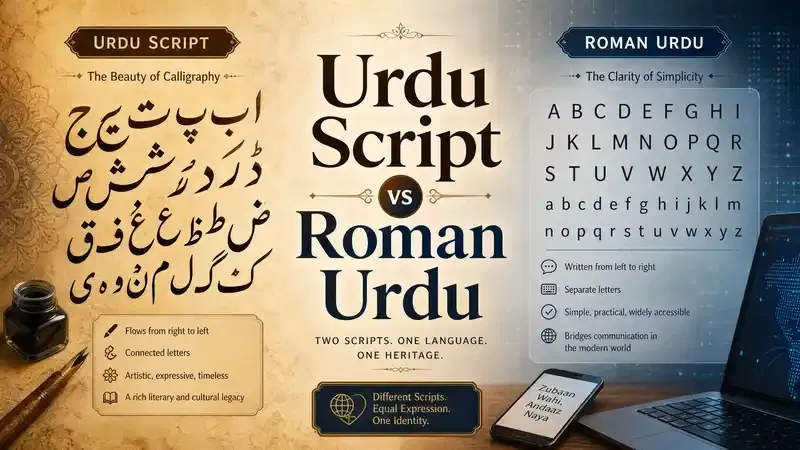
Quick answer: Urdu Script is the official and standardized writing system for Urdu. It offers better reading accuracy, consistent spelling, and stronger cultural value. Roman Urdu provides faster typing and easier communication on English keyboards. Both serve different purposes, but learning Urdu Script builds stronger language skills over time.
Throughout this guide, you will compare their features, strengths, limitations, real-world examples, and best use cases. You will also discover which option matches your learning goals and everyday needs.
What Is Urdu Script vs Roman Urdu?
Definition of Urdu Script
Urdu Script vs Roman Urdu is the official writing system of the Urdu language. It uses the Perso-Arabic script and follows the elegant Nastaliq writing style. Unlike the English alphabet, Urdu reads from right to left. Each letter joins with others to form smooth and connected words. This unique style gives Urdu its distinct visual identity.
Urdu Script does more than display words. It preserves the language’s pronunciation, grammar, and literary heritage. Standard spelling helps readers understand the same word without confusion. This consistency makes Urdu Script suitable for education, publishing, government records, and formal communication.
Many people confuse Urdu Script with Roman Urdu. However, they serve different purposes. Urdu Script follows recognized spelling rules, while Roman Urdu has no official standard. As a result, one Roman Urdu word may appear in several spellings. Urdu Script removes this uncertainty by using a single accepted form.
Today, millions of people in Pakistan, India, and other parts of the world read and write Urdu Script every day. Schools teach it as the standard form of written Urdu. Newspapers, books, poetry, legal documents, and digital publications also rely on it. Understanding Urdu Script creates a strong foundation for reading accurately, writing confidently, and appreciating the language’s rich cultural and literary traditions.
Urdu Script vs Roman Urdu
Urdu Script vs Roman Urdu represent the same language, but they serve different purposes. Urdu Script follows an official writing system with standardized spelling and grammar. Roman Urdu focuses on convenience and fast digital communication. Understanding their differences helps you choose the right option for learning, writing, and everyday use.
The table below compares both writing systems across the most important features.
| Feature | Urdu Script | Roman Urdu |
| Writing System | Official Urdu writing system | Informal way of writing Urdu |
| Alphabet | Urdu alphabet based on the Perso-Arabic script | English (Roman) alphabet |
| Script | Nastaliq writing style | Roman alphabet without a fixed script style |
| Pronunciation | Preserves accurate pronunciation | Pronunciation depends on the writer’s spelling |
| Grammar | Follows standard Urdu grammar and spelling | Grammar often remains correct, but spelling varies |
| Standardization | Officially standardized | No official spelling standard |
| Readability | Best for fluent Urdu readers | Easy for users familiar with English letters |
| Typing | Requires an Urdu keyboard or input tool | Easy to type on any English keyboard |
| Learning Curve | Takes more time to master | Easy for beginners to start |
| Official Status | Used in education, government, and publishing | Not officially recognized as a writing system |
| Digital Use | Common in websites, eBooks, news, and official platforms | Popular in messaging apps and social media |
| Search Behavior | Supports native Urdu searches and Unicode indexing | Matches many conversational searches with spelling variations |
| AI Compatibility | Easier for language models to process accurately | Transliteration and spelling differences increase ambiguity |
| Education | Standard for schools, universities, and examinations | Rarely accepted in formal education |
| Literature | Essential for poetry, novels, newspapers, and academic works | Mostly limited to casual communication |
Both writing systems have practical value. Urdu Script builds strong reading and writing skills while preserving the language’s cultural identity. Roman Urdu improves typing speed and makes digital conversations easier. The following sections explore each difference in greater detail and explain when one option works better than the other.
Difference Between Urdu Script vs Roman Urdu
Urdu Script vs Roman Urdu represent the same language, but they work in different ways. Urdu Script is the official writing system and follows standard spelling rules. Roman Urdu uses English letters to write Urdu words without a fixed standard. This difference affects reading, writing, pronunciation, education, and digital communication. Many beginners choose Roman Urdu because it is easy to type. However, Urdu Script offers greater accuracy and preserves the language’s original form. Knowing these differences helps you select the right writing system for your goals. Whether you want to learn Urdu, create content, improve SEO, or communicate online, understanding both systems is valuable. The following sections compare their script, alphabet, pronunciation, spelling, readability, writing experience, Unicode support, standardization, cultural importance, and educational value. This detailed comparison explains where each writing system performs best and why both remain important in today’s digital world.
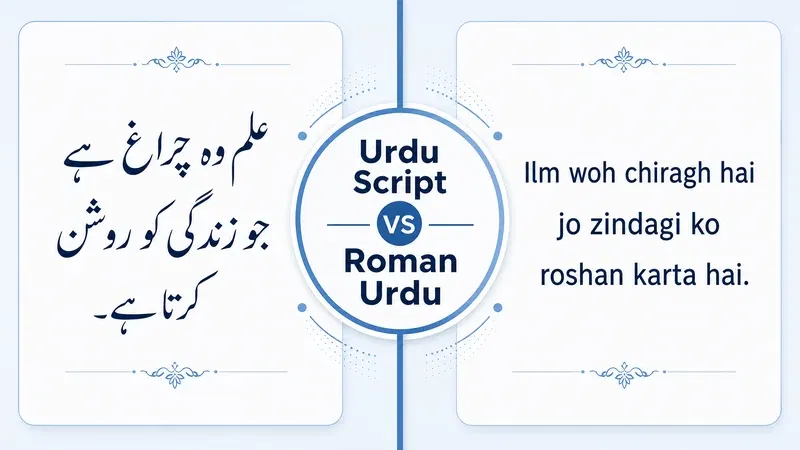
Urdu Script vs Roman Urdu Examples
Examples make it easier to understand the difference between Urdu Script vs Roman Urdu. Both express the same language, but they look very different in writing. Urdu Script follows standard spelling and uses the Nastaliq style. Roman Urdu writes the same words with the English alphabet. Many people use Roman Urdu for quick messages, while Urdu Script remains the preferred choice for education, books, and official communication. The examples below show how both writing systems represent common words and sentences in everyday life.
| Meaning | Urdu Script | Roman Urdu |
| Hello | سلام | Salam |
| How are you? | آپ کیسے ہیں؟ | Aap kaise hain? |
| I am fine. | میں ٹھیک ہوں۔ | Main theek hoon. |
| What is your name? | آپ کا نام کیا ہے؟ | Aap ka naam kya hai? |
| My name is Ali. | میرا نام علی ہے۔ | Mera naam Ali hai. |
| Good morning | صبح بخیر | Subah bakhair |
| Thank you | شکریہ | Shukriya |
| Please | براہِ کرم | Barah-e-karam |
| Yes | جی ہاں | Jee haan |
| No | نہیں | Nahin |
| Mother | ماں | Maa |
| Father | والد | Walid |
| Brother | بھائی | Bhai |
| Sister | بہن | Behen |
| Eat | کھانا | Khana |
| Go | جانا | Jana |
| Come | آنا | Aana |
| Read | پڑھنا | Parhna |
| Write | لکھنا | Likhna |
| Please submit your assignment tomorrow. | براہِ کرم اپنا اسائنمنٹ کل جمع کروائیں۔ | Barah-e-karam apna assignment kal jama karwain. |
| I will reach in ten minutes. | میں دس منٹ میں پہنچ جاؤں گا۔ | Main 10 minute mein pohanch jaunga. |
| See you later. | پھر ملتے ہیں۔ | Phir milte hain. |
| The research paper explains Urdu grammar clearly. | تحقیقی مقالہ اردو قواعد کو واضح انداز میں بیان کرتا ہے۔ | Tehqeeqi maqala Urdu qawaid ko wazeh andaz mein bayan karta hai. |
These examples highlight the strengths of both writing systems. Urdu Script delivers consistent spelling and clear pronunciation. Roman Urdu offers speed and convenience for digital conversations. Choosing the right format depends on your purpose, audience, and communication style.
Pros and Cons of Urdu Script vs Roman Urdu
Urdu Script vs Roman Urdu remains the official writing system of the Urdu language. It offers accuracy, consistency, and cultural value. Schools, universities, publishers, and government offices rely on it every day. Learning Urdu Script takes time, but the long-term benefits outweigh the challenges. Understanding its strengths and limitations helps you decide when to use it.
Advantages of Urdu Script
- Standard writing: Urdu Script follows official spelling and grammar rules. This consistency reduces confusion and improves communication.
- Better pronunciation: Each written word closely reflects its correct pronunciation. Readers can speak words more accurately than with Roman Urdu.
- Rich literature: Urdu poetry, novels, newspapers, and classical works use Urdu Script. Learning it opens the door to centuries of literary heritage.
- Official documents: Government records, legal papers, educational certificates, and public notices use Urdu Script as the standard format.
- Education: Schools and universities teach reading and writing through Urdu Script. Students need it for examinations and academic success.
- Language preservation: Urdu Script protects the language’s history, identity, and cultural traditions for future generations.
Disadvantages of Urdu Script
- Harder typing: New users often type more slowly until they become familiar with Urdu keyboards.
- Learning curve: Reading connected letters and mastering Nastaliq requires regular practice.
- Keyboard familiarity: Many beginners only know English keyboards. They must learn Urdu keyboard layouts or input tools before typing comfortably.
Pros and Cons of Urdu Script vs Roman Urdu
Urdu Script vs Roman Urdu has become a popular way to write Urdu in the digital age. It uses the English alphabet instead of the traditional Urdu Script. Millions of people use it every day for texting, social media, and online communication. Its simplicity makes it attractive, especially for beginners. However, it also has important limitations that affect learning, accuracy, and formal writing.
Advantages of Roman Urdu
- Easy typing: You can write Roman Urdu on any English keyboard. There is no need to install special fonts or keyboard layouts.
- Fast messaging: Roman Urdu speeds up conversations on phones and computers. People can send messages quickly without switching keyboards.
- Social media friendly: Platforms like WhatsApp, Facebook, Instagram, and YouTube contain millions of Roman Urdu posts and comments. It supports quick and informal communication.
- Beginner friendly: New learners often find Roman Urdu easier because they already know the English alphabet. They can start communicating before learning Urdu Script.
Disadvantages of Roman Urdu
- No spelling standard: The same word often appears in several forms, such as “kaise,” “kesay,” or “kaisay.” This inconsistency creates confusion.
- Pronunciation confusion: Different spellings can make pronunciation unclear, especially for new learners.
- AI ambiguity: Multiple spellings make transliteration, translation, and language processing more difficult for search engines and AI systems.
- Poor academic use: Schools, universities, official documents, and published literature rarely accept Roman Urdu for formal writing.
Which Is Better: Urdu Script or Roman Urdu?
There is no single answer to this question. The better choice depends on your goals, daily needs, and audience. Urdu Script offers accuracy, standardization, and cultural value. Roman Urdu provides speed and convenience for digital communication. Choosing the right option becomes easier when you match it to your purpose.
- Students: Urdu Script is the better choice. Schools, colleges, and universities use it for textbooks, assignments, and examinations.
- Beginners: Roman Urdu helps beginners start speaking and typing quickly. Learning Urdu Script later builds stronger reading and writing skills.
- Native Urdu speakers: Urdu Script preserves correct spelling and pronunciation. It also improves reading fluency and writing accuracy.
- Overseas Pakistanis: Roman Urdu makes daily communication simple. Learning Urdu Script strengthens cultural and family connections.
- Researchers: Urdu Script provides reliable access to historical documents, academic studies, and authentic literary sources.
- Content creators: Use both formats when appropriate. Urdu Script reaches native readers, while Roman Urdu supports users who search with English letters.
- Businesses: Urdu Script builds trust in formal communication. Roman Urdu works well for casual marketing and social media engagement.
- Developers: Support both writing systems to improve accessibility and user experience across different platforms.
- AI users: Urdu Script produces more consistent results because it follows standardized spelling. Roman Urdu often creates ambiguity due to multiple spellings.
Urdu Script vs Roman Urdu for Learning Urdu
Choosing the right writing system can make learning Urdu easier and more enjoyable. Both Urdu Script vs Roman Urdu have advantages, but they support different learning goals. Roman Urdu helps beginners start quickly because it uses the English alphabet. Urdu Script takes more effort to learn, yet it provides a stronger foundation for reading, writing, and understanding the language. Knowing how each system supports different skills helps you make the best choice.
- Reading: Urdu Script improves reading fluency because it follows standard spelling. Roman Urdu helps beginners read simple messages but cannot replace native reading skills.
- Writing: Urdu Script teaches correct spelling and grammar. Roman Urdu makes casual writing easier but encourages inconsistent spelling habits.
- Speaking: Both systems support spoken Urdu. However, Urdu Script connects spoken words with their correct written form.
- Pronunciation: Urdu Script represents sounds more accurately. Roman Urdu spellings often vary, which can confuse new learners.
- Vocabulary: Reading books, newspapers, and articles in Urdu Script exposes learners to a richer vocabulary. Roman Urdu mainly appears in informal communication.
- Long-term learning: Urdu Script offers lasting benefits for education, literature, professional communication, and cultural understanding. Roman Urdu works well as a temporary learning aid or a convenient typing method.
If your goal is to speak casually, Urdu Script vs Roman Urdu provides a good starting point. If you want complete language proficiency, Urdu Script is the better long-term investment. Many successful learners begin with Roman Urdu and gradually transition to Urdu Script for lasting confidence and accuracy.
Why Roman Urdu Became So Popular
Urdu Script vs Roman Urdu became popular because it matched the way people started communicating in the digital age. When mobile phones and internet services expanded, many users needed a quick way to write Urdu. Roman Urdu provided a simple solution because most devices already supported the English alphabet.
The SMS era played an important role in its growth. Early mobile phones had limited language support and expensive message limits. Typing Urdu Script was difficult on many devices. Users started writing Urdu words with English letters to save time and effort.
The rise of mobile phones made Roman Urdu even more common. Most users already knew English keyboards, so they could type messages without learning a new layout. This convenience encouraged millions of people to adopt Roman Urdu.
Social media platforms also increased its popularity. Users began writing Roman Urdu on WhatsApp, Facebook, YouTube comments, and online forums. It became a natural choice for casual conversations, especially among younger users.
Urdu Script vs Roman Urdu offers digital convenience. People can type quickly, communicate across different devices, and avoid font or keyboard issues. It also helps overseas Urdu speakers stay connected with family and friends.
However, popularity does not mean replacement. Roman Urdu supports fast communication, while Urdu Script remains essential for formal writing, education, literature, and preserving the Urdu language.
Why Urdu Script Still Matters
Urdu Script vs Roman Urdu remains an important part of the Urdu language because it carries history, identity, and knowledge. Although Roman Urdu has grown through digital communication, Urdu Script continues to represent the authentic written form of Urdu. It connects modern readers with centuries of language development and cultural expression.
National identity plays a major role in the importance of Urdu Script. In Pakistan, Urdu Script represents a shared cultural connection among diverse communities. It helps preserve traditions, stories, and historical records.
Newspapers and literature continue to depend on Urdu Script. Readers access news, novels, essays, and research materials through the native writing system. Many famous Urdu writers created their work in this script.
Poetry holds a special place in Urdu culture. Classical poets and modern writers use Urdu Script to express emotions, rhythm, and meanings that can become unclear through Roman Urdu.
Education relies on Urdu Script for teaching reading, writing, and language skills. Students learn proper spelling, grammar, and comprehension through the standard writing system.
Government documents and official communication often use Urdu Script for clarity and formal recognition. It provides a consistent format for important records.
Religious texts and traditional writings also use Urdu Script because many readers understand and connect with this format.
Today, digital publishing has expanded Urdu Script’s reach. Websites, eBooks, mobile apps, and online platforms now support Urdu Unicode text. This growth proves that Urdu Script remains valuable in both traditional and modern environments.
Can Urdu Script vs Roman Urdu?
Urdu Script vs Roman Urdu has become a common way to write Urdu online, but replacing Urdu Script completely remains unlikely. Both systems serve different purposes. Roman Urdu supports fast communication, while Urdu Script preserves accuracy, history, and cultural value.
Linguistic limitations create the biggest challenge for Roman Urdu. Urdu contains sounds that do not have exact matches in the English alphabet. Different people write the same word in different ways. For example, “kya,” “kia,” and “kiya” may represent the same Urdu word. This variation affects reading accuracy and language understanding.
The cultural impact of replacing Urdu Script would also be significant. Urdu literature, poetry, calligraphy, and historical documents depend on the native script. Changing the writing system could create distance from centuries of literary and cultural heritage.
Technology has helped both systems grow. Digital keyboards, Unicode, and AI tools now support Urdu Script worldwide. Roman Urdu remains useful because it works easily across devices and platforms.
Standardization challenges make Roman Urdu difficult to adopt as an official writing system. A fixed spelling system would require agreement among millions of users.
Language experts generally view Roman Urdu as a practical digital tool rather than a replacement for Urdu Script. A balanced approach works best. People can use Roman Urdu for quick communication while learning Urdu Script for complete language skills, education, and cultural connection.
How AI Handles Urdu Script and Roman Urdu
Artificial intelligence has changed the way computers understand and process Urdu. Modern AI systems can work with both Urdu Script and Roman Urdu, but each writing system creates different challenges. Urdu Script follows standard spelling, while Roman Urdu often contains multiple spellings for the same word.
Transliteration helps AI convert Roman Urdu into Urdu Script. For example, AI tools can transform “Aap kaise hain?” into “آپ کیسے ہیں؟” However, spelling variations in Roman Urdu can affect accuracy.
Translation systems use AI models to convert Urdu into other languages. Better results usually come from correctly written Urdu Script because it provides clearer language patterns.
Natural Language Processing (NLP) allows computers to analyze Urdu text, understand meaning, and generate responses. Researchers train NLP models using large Urdu datasets that include vocabulary, grammar, and sentence structures.
Optical Character Recognition (OCR) helps AI read Urdu Script from images, scanned books, and documents. Advanced OCR systems now recognize Nastaliq text more effectively.
Speech recognition allows AI to convert spoken Urdu into written text. These systems must understand different accents, speaking styles, and regional variations.
Large language models such as modern AI assistants process Urdu Script and Roman Urdu through language patterns. Clear spelling improves understanding and response quality.
Unicode gives Urdu Script a digital identity by assigning unique codes to characters. This supports websites, apps, and digital publishing.
Search indexing improves when content uses clear Urdu Script and natural Roman Urdu variations.
Urdu Script vs Roman Urdu for SEO
Search engines now understand more languages and writing systems than ever before. For Urdu content, both Urdu Script and Roman Urdu can support SEO when used correctly. The best strategy depends on user behavior, search intent, and content goals.
Search intent helps you understand what users want. Some people search in Urdu Script because they read native Urdu. Others use Roman Urdu because they type with English keyboards. Content that covers both formats can reach a wider audience.
Keyword variations are important for Roman Urdu because users write the same phrase in many ways. For example, “Urdu seekhna,” “Urdu sikhna,” and “Urdu seekhne ka tareeqa” may target similar searches. Understanding these variations helps create better content.
Roman Urdu spellings create SEO challenges because there is no universal standard. Writers should include natural variations without forcing keywords. This approach improves visibility while keeping content readable.
Urdu Unicode indexing allows search engines to understand and display Urdu Script content correctly. Using proper Unicode characters improves accessibility across websites and devices.
AI search systems analyze meaning instead of only matching exact words. Helpful content with clear explanations, related entities, and natural language performs better.
Voice search also increases the need for conversational content. People often speak queries differently from how they type them.
Featured snippets and AI Overviews favor direct answers, clear formatting, and trustworthy information.
Multilingual SEO works best when websites support both Urdu Script and Roman Urdu audiences. Combining both writing systems creates stronger coverage, improves accessibility, and builds broader topical authority.
Common Mistakes People Make
Learning or usingUrdu Script vs Roman Urdu becomes easier when you understand common mistakes. Many users face problems because they mix writing systems, ignore spelling differences, or rely on incorrect assumptions. Avoiding these mistakes improves communication, learning, and digital accuracy.
Mixing scripts is a common issue. Some writers combine Urdu Script and Roman Urdu in the same sentence. This can reduce readability and create confusion for readers. Using one writing system clearly improves understanding.
Incorrect transliteration creates another challenge. Roman Urdu does not have fixed spelling rules, so users often convert words incorrectly. For example, different spellings may represent the same Urdu word. Accurate transliteration requires understanding Urdu sounds and letter patterns.
Many people make the mistake of assuming Roman Urdu is standardized. Unlike Urdu Script, Roman Urdu has no official spelling system. Users should expect variations and focus on meaning rather than exact spelling.
Poor pronunciation can happen when learners depend only on Roman Urdu. English letters cannot always represent every Urdu sound accurately. Learning Urdu Script helps users recognize correct pronunciation.
Unicode issues also affect digital Urdu. Some websites display broken characters when they do not support proper Unicode encoding. Using standard Unicode Urdu text improves compatibility across platforms.
Avoiding these mistakes helps learners, writers, and developers create clearer Urdu content. A balanced approach using both systems can improve communication while protecting language accuracy.
Frequently Asked Questions
Is Roman Urdu the same as Urdu Script?
No. Urdu Script vs Roman Urdu represent the same language but use different writing systems. Urdu Script uses the Nastaliq style of the Perso-Arabic script. Roman Urdu uses English letters to write Urdu words.
Which is easier to learn?
Urdu Script vs Roman Urdu is easier for beginners because it uses the familiar English alphabet. Urdu Script requires learning new letters and reading patterns. However, Urdu Script provides stronger long-term language skills.
Can Roman Urdu replace Urdu Script?
Urdu Script vs Roman Urdu can support digital communication, but it cannot fully replace Urdu Script. Urdu Script preserves pronunciation, literature, education, and cultural heritage.
Is Roman Urdu officially recognized?
No. Roman Urdu does not have official status as a writing system. Urdu Script remains the standardized form used in education, government, and publishing.
Why is Urdu written in Nastaliq?
Urdu uses Nastaliq because it developed from the Perso-Arabic writing tradition. Nastaliq gives Urdu its unique appearance and supports connected letter forms.
Can Google Translate convert Roman Urdu?
Google Translate may understand some Roman Urdu phrases, but accuracy varies. Different spellings can create challenges for translation systems.
Which script is better for beginners?
Roman Urdu helps beginners start quickly. Learning Urdu Script later improves reading, writing, and pronunciation accuracy.
Which script is better for SEO?
Both can support SEO. Urdu Script targets native readers, while Roman Urdu captures conversational searches. Using both creates broader search coverage.
Does AI understand Roman Urdu?
Yes, many AI systems can process Urdu Script vs Roman Urdu. However, spelling variations can make understanding more difficult compared to standardized Urdu Script.
Why are there many Roman Urdu spellings?
Urdu Script vs Roman Urdu has no official spelling rules. Users write words based on personal pronunciation, regional habits, and typing preferences. This creates multiple spellings for the same Urdu word.
Conclusion
Urdu Script vs Roman Urdu both have an important place in modern communication, but they serve different purposes. Urdu Script remains the stronger choice for anyone who wants to master the Urdu language completely. Students, researchers, writers, and professionals benefit from Urdu Script because it provides accurate spelling, better pronunciation, and direct access to Urdu literature, education, and official content. It preserves the cultural identity and historical value of the language.
Urdu Script vs Roman Urdu benefits people who need quick and simple communication. Beginners, overseas Urdu speakers, and social media users often prefer it because they can type Urdu words using familiar English keyboards. It makes digital conversations faster and more accessible. However, Roman Urdu lacks standard spelling rules, which can create confusion in pronunciation, learning, and AI processing.
For students and long-term learners, Urdu Script is the better investment because it develops complete reading and writing skills. For casual online communication, Roman Urdu remains a practical option. The best approach is not to choose one and ignore the other. Learning Urdu Script while understanding Roman Urdu creates a balanced skill set. It allows people to enjoy Urdu’s rich heritage while communicating easily in today’s digital world.