
What Is Roman Urdu?
What Is Roman Urdu? written with the Latin alphabet instead of the Urdu script. People often use it for texting, social media, and online communication. The language remains Urdu, but the writing system changes.
For example:
| Roman Urdu | Urdu Script | English Meaning |
| Aap kaise hain? | آپ کیسے ہیں؟ | How are you? |
| Mujhe Urdu pasand hai. | مجھے اردو پسند ہے۔ | I like Urdu. |
| Aaj mausam acha hai. | آج موسم اچھا ہے۔ | The weather is nice today. |
Roman Urdu does not create a new language. It changes how people write Urdu. Standard Urdu uses the Urdu alphabet, which usually appears in the Nastaliq style. Roman Urdu uses familiar Latin letters such as a, b, d, k, m, n, and r.
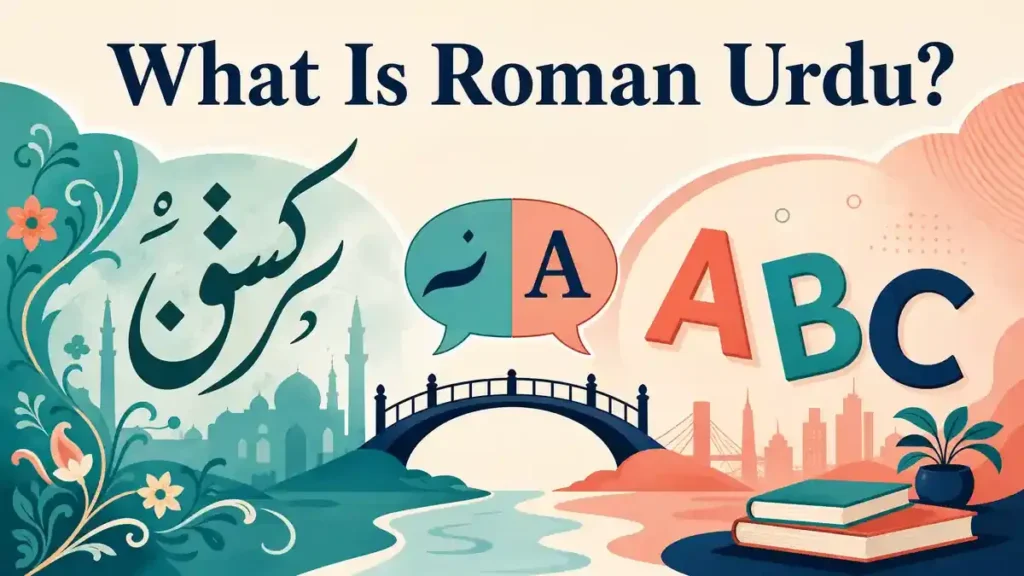
The term Roman Urdu can also describe informal Urdu romanization. Users often spell words by sound rather than following one fixed system. Research shows that Roman Urdu has no universal spelling standard.
That explains why you may see different spellings for the same Urdu word. This flexibility makes Roman Urdu easy to type but harder to process for computers.
In simple terms, Roman Urdu is Urdu written with English-style letters. The words and language stay Urdu, while the script changes.
Roman Urdu Examples
The easiest way to understand Roman Urdu is to see it in everyday use. Roman Urdu uses the Latin alphabet to write Urdu words and sentences. The underlying language stays Urdu. Only the script changes.
Common Roman Urdu Words
| Roman Urdu | Urdu Script | English Meaning |
| Salam | سلام | Hello |
| Shukriya | شکریہ | Thank you |
| Dost | دوست | Friend |
| Ghar | گھر | Home |
| Pani | پانی | Water |
| Kitab | کتاب | Book |
| Khana | کھانا | Food |
| Acha | اچھا | Good |
| Kal | کل | Tomorrow / Yesterday |
| Mohabbat | محبت | Love |
These examples show a key feature of Roman Urdu. The Latin alphabet represents Urdu words without changing their basic meaning.
Everyday Roman Urdu Sentences
| Roman Urdu | Urdu Script | English Meaning |
| Aap kaise hain? | آپ کیسے ہیں؟ | How are you? |
| Main theek hoon. | میں ٹھیک ہوں۔ | I am fine. |
| Aap kahan ja rahe hain? | آپ کہاں جا رہے ہیں؟ | Where are you going? |
| Mujhe bhook lagi hai. | مجھے بھوک لگی ہے۔ | I am hungry. |
| Mujhe samajh nahi aaya. | مجھے سمجھ نہیں آیا۔ | I did not understand. |
| Aaj mausam acha hai. | آج موسم اچھا ہے۔ | The weather is nice today. |
Roman Urdu appears often in informal digital communication. Research describes it as Urdu written in the Latin script. Users commonly write it online and in text messages.
Real Conversational Examples
Ali: Tum kahan ho?
Sara: Main ghar par hoon. Tum kahan ho?
Ali: Main bazaar mein hoon. Kya tum aa rahi ho?
Sara: Haan, main thori dair mein aa jaungi.
In Urdu script, the same conversation looks like this:
علی: تم کہاں ہو؟
سارہ: میں گھر پر ہوں۔ تم کہاں ہو؟
علی: میں بازار میں ہوں۔ کیا تم آ رہی ہو؟
سارہ: ہاں، میں تھوڑی دیر میں آ جاؤں گی۔
The meaning stays the same. Roman Urdu simply replaces the Urdu script with Latin letters.
Why Roman Urdu Examples Look Different
You may see the same word written in several ways. For example:
- kaise
- kaisay
- kese
All three can represent کیسے in informal Roman Urdu.
This variation happens because Roman Urdu has no single widely accepted spelling standard. Writers often spell words according to sound and personal habit.
Urdu normally uses the Nastaliq writing style. Roman Urdu instead uses the Latin alphabet, which makes typing easier for people who use standard English keyboards.
How Is Roman Urdu Different From Urdu?
The main difference between Roman Urdu vs Urdu is the writing system. Both can represent the same Urdu language. Roman Urdu uses the Latin alphabet, while standard Urdu uses the Urdu script, commonly written in Nastaliq.
| Feature | Roman Urdu | Urdu |
| Language | Urdu | Urdu |
| Writing system | Latin/Roman alphabet | Urdu script |
| Common style | Informal and phonetic | Standard written Urdu |
| Example | Aap kaise hain? | آپ کیسے ہیں؟ |
| Typical use | Chats, texts, social media | Books, newspapers, formal writing |
Roman Alphabet vs Nastaliq
Roman Urdu uses familiar Latin letters such as a, b, d, k, m, and r.
What Is Roman Urdu? uses its own script. Nastaliq is a major calligraphic style used for Urdu writing.
For example:
Roman Urdu: Mujhe Urdu parhna pasand hai.
Urdu script: مجھے اردو پڑھنا پسند ہے۔
English: I like reading Urdu.
The words do not become English when you write them with Latin letters. Only the script changes.
Language vs Writing System
This distinction causes much of the confusion around Roman Urdu.
Urdu is the language.
Roman Urdu is a way of writing that language.
Think of it this way:
Same language + different script = Roman Urdu
Researchers also describe Roman Urdu as Urdu written in the Latin script. They note that users often spell it differently because no universal spelling rules exist.
When Do People Use Each One?
People often choose Roman Urdu for quick digital communication. It works well with Latin-based keyboards on phones and computers. Researchers have documented its use in internet communication, social media, and text messaging.
Urdu script remains important for formal and published writing. You will commonly see it in books, newspapers, literature, education, and other traditional Urdu content.
Roman Urdu also helps people who speak Urdu but read Urdu script less comfortably. It gives them another way to communicate in the language.
So, Roman Urdu does not replace the Urdu language. It offers another way to write it.
This difference also explains why Roman Urdu can have many spellings for the same word. The next section looks at how people actually write Roman Urdu and why spelling varies.
How to Write Roman Urdu
Writing What Is Roman Urdu? is simple once you understand one basic idea: write Urdu sounds with Latin letters. There is no single spelling system that everyone follows.
Basic Roman Urdu Writing Rules
When you write Roman Urdu, focus on the sound of the Urdu word.
For example:
- کیا → kya
- گھر → ghar
- خواب → khwab
- شکریہ → shukriya
- چلو → chalo
You do not need special Urdu keyboard characters. The Latin alphabet lets you type Urdu words with familiar keys.
Use Phonetic Spelling
Roman Urdu often follows phonetic spelling. This means you choose letters that represent the sounds you hear.
For example:
- خ → kh
- غ → gh
- ش → sh
- چ → ch
So you might write:
| Urdu Letter | Common Roman Form | Example |
| خ | kh | khana → کھانا |
| غ | gh | ghalat → غلط |
| ش | sh | sham → شام |
| چ | ch | chalo → چلو |
These combinations help represent Urdu sounds that do not have simple one-letter equivalents in English.
Why Does Roman Urdu Spelling Vary?
You may see several spellings for the same Urdu word.
For example:
- kya
- kia
- keeya
They can represent کیا in informal Roman Urdu.
You may also see:
- nahi
- nahin
- nhi
This variation does not always mean someone wrote the word incorrectly. Roman Urdu has no universal spelling standard, so people often use personal, regional, or pronunciation-based spellings.
Research on South Asian Latin-script writing also finds that spelling can vary because of pronunciation, dialect, regional accents, and individual writing habits.
Is There a Correct Way to Write Roman Urdu?
For everyday Roman Urdu, there is no single correct spelling system.
The best approach depends on your purpose. Casual messages can use familiar spellings. Formal transliteration may follow a defined system.
For example, someone might type:
Aap kya kar rahe ho?
Another person might write:
Ap kia kr rhy ho?
Both can communicate the same idea.
However, clear writing still matters. Avoid spellings that make the intended word difficult to understand.
In short, how to write Roman Urdu comes down to clarity, sound, and context.
This spelling flexibility makes Roman Urdu convenient for people. It also creates challenges for search systems, keyboards, and NLP tools.
Does Roman Urdu Have Standard Spelling?
What Is Roman Urdu? does not have one universal spelling system for everyday writing. People often spell Urdu words according to sound, habit, and personal preference. Research confirms this spelling variation as a real linguistic and NLP challenge.
Why Does Roman Urdu Spelling Vary?
Urdu has an established writing system. Roman Urdu does not have one widely accepted informal standard.
This creates orthographic variation. The same Urdu word can appear in several Roman Urdu forms.
For example:
| Urdu | Common Roman Urdu Variants |
| کیا | kya / kia |
| نہیں | nahi / nahin / nhi |
| زندگی | zindagi / zindagee / zindagy |
| کیسے | kaise / kaisay / kese |
| دیکھنا | dekhna / dikhna |
These forms can still carry the same meaning.
A 2015 EMNLP study documented several spellings for the same Roman Urdu words. It specifically found variations such as zindagi, zindagee, zindagy, and zndagi.
Formal Romanization vs Everyday Texting
Not all Roman Urdu follows the same approach.
Formal romanization can follow a defined transliteration system. Such systems aim for consistency and closer mapping between Urdu characters and Latin letters.
Everyday Roman Urdu works differently. People usually type quickly and choose spellings that feel natural.
For example:
Aap kahan ja rahe hain?
Someone texting casually might write:
Ap kahan ja rhy hain?
The second version uses shorter forms. The writer cares more about speed and understanding than strict spelling.
What Is Orthographic Variation?
Orthographic variation means different written forms can represent the same word.
Roman Urdu shows this clearly because writers lack one universal spelling standard.
This creates problems beyond simple spelling differences. Computers must recognize that different spellings can represent the same Urdu word.
Researchers call this process lexical normalization. It aims to connect different spellings with a common form.
Recent NLP research also describes Roman Urdu as highly variable and user-dependent. The researchers identify inconsistent spelling as a challenge for information retrieval systems.
So, Is One Spelling More Correct?
For casual Roman Urdu, there is usually no single spelling that everyone must follow.
Clarity matters more than strict rules.
For formal work, you can follow a specific romanization or transliteration system. That approach gives writers consistent rules.
For everyday chats, several spellings may remain understandable.
That spelling flexibility makes Roman Urdu easy to use. It also makes Roman Urdu harder for computers to process.
Roman Urdu vs Transliteration vs Translation
These three terms often overlap, but they describe different processes. Understanding the difference makes Roman Urdu easier to explain.
Romanization
Romanization means representing a language with the Latin or Roman alphabet.
For Urdu, this means changing the writing system without changing the language.
Urdu: مجھے اردو آتی ہے۔
Roman Urdu: Mujhe Urdu aati hai.
Meaning: I know Urdu.
The language remains Urdu. Only the script changes. Research specifically describes Roman Urdu as a Romanized form of Urdu used in digital communication.
Transliteration
Transliteration represents words from one writing system in another.
It focuses on representing the original written form. It does not aim to change the meaning into another language.
For example:
Urdu script: کتاب
Roman form: kitaab
Both forms represent the same Urdu word.
The Library of Congress describes transliteration as representing non-Roman scripts through the Roman alphabet. Researchers have also studied direct Urdu-to-Roman Urdu transliteration.
Translation
Translation changes the language, not just the script.
For example:
Urdu: مجھے کتاب پسند ہے۔
English: I like the book.
Here, Urdu becomes English. The writing system may change too, but the key change is the language and meaning representation.
Romanization vs Transliteration vs Translation
| Process | What changes? | Example |
| Romanization | Script | Urdu → Roman alphabet |
| Transliteration | Script representation | کتاب → kitaab |
| Translation | Language and meaning | کتاب → book |
Why Do People Use Roman Urdu?
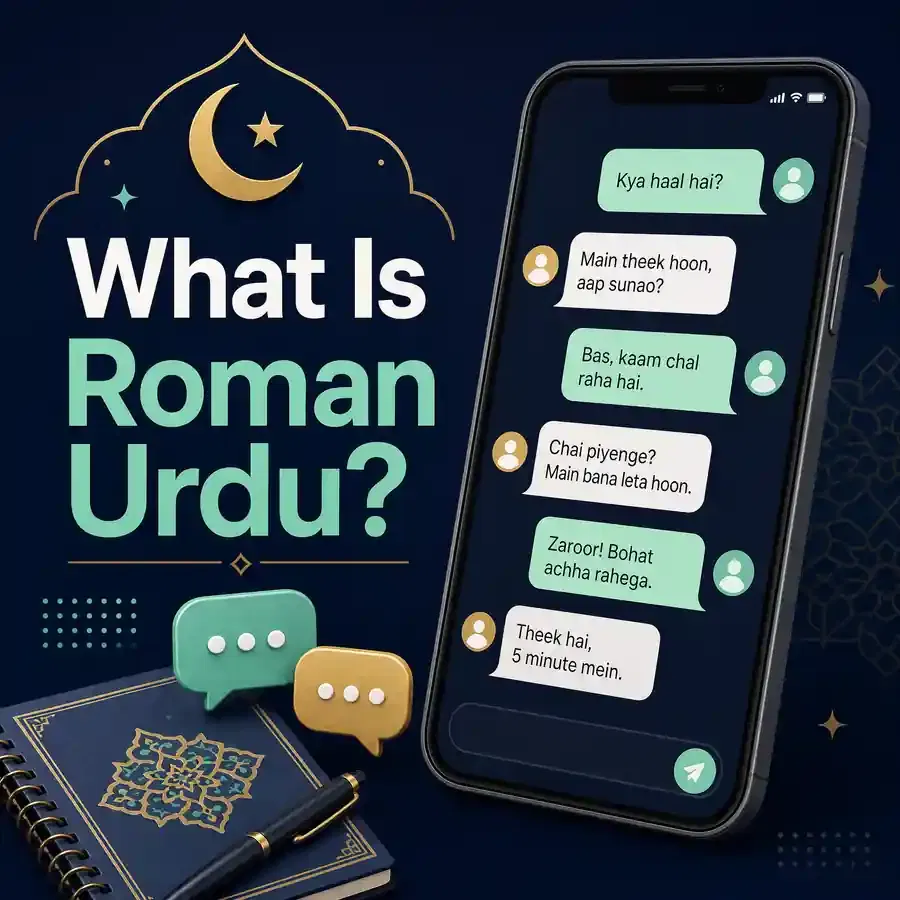
People use Roman Urdu because it makes Urdu easier to type in many digital settings. It fits naturally into texting, social media, and other informal online communication.
Researchers have documented Roman Urdu in Pakistani text messages and social media. More recent research describes it as widely used in digital communication.
Mobile Texting Is Fast and Convenient
Roman Urdu is common in informal text messages.
Users can type Urdu words with the Latin alphabet. They do not need to switch to an Urdu-script keyboard.
For example:
Roman Urdu: Kal miltay hain.
Urdu: کل ملتے ہیں۔
English: Let’s meet tomorrow.
Early research on Pakistani text messages specifically examined informal, Romanized Urdu in SMS communication. The study noted that Roman letters were commonly used in text messaging and other informal platforms.
Social Media Favors Informal Writing
Roman Urdu also appears across social media and online communication.
Users often write quickly while chatting, commenting, or posting. Roman Urdu fits this informal style.
Research describes Roman Urdu as widely used across digital communication. Recent work also identifies its presence in social media, online news, e-commerce, and informal messaging.
This explains why you may see sentences such as:
Aaj kya plan hai?
Tum kahan ho?
Mujhe bhi batao.
The writing feels closer to everyday conversation than formal Urdu prose.
Latin Keyboards Can Be More Convenient
Many phones and computers make Latin-alphabet typing familiar and accessible.
A user can type:
Mujhe ghar jana hai.
Instead of switching to an Urdu keyboard:
مجھے گھر جانا ہے۔
This does not mean Roman Urdu is inherently easier for everyone. It depends on the user’s typing habits, keyboard settings, and familiarity with Urdu script.
The key advantage is convenience for users who already type comfortably with Latin letters.
Urdu-Script Literacy Can Differ From Spoken Fluency
Speaking Urdu and reading Urdu script are different skills.
Someone may understand spoken Urdu well but have limited confidence reading or typing Urdu script. Roman Urdu can provide an alternative for informal written communication.
This distinction matters for learners and multilingual users. Roman Urdu lets them represent familiar Urdu words without first mastering the Urdu writing system.
However, Roman Urdu does not replace Urdu-script literacy. Formal reading and writing still require familiarity with the Urdu script.
Diaspora Users May Find It Practical
Roman Urdu can also help Urdu speakers living outside Urdu-speaking environments.
A person may speak Urdu at home but use Latin-script keyboards for much of their digital communication.
Roman Urdu can therefore provide a bridge between spoken Urdu and everyday digital writing.
This should not be treated as a universal diaspora pattern. User preferences differ by age, education, country, keyboard access, and Urdu-script literacy.
Informal Communication Encourages Roman Urdu
Roman Urdu works especially well for quick, conversational messages.
People can write short phrases without following formal writing conventions.
For example:
Kya kar rahay ho?
Main ghar par hoon.
Thori dair mein aata hoon.
Such writing resembles spoken conversation.
Research also describes Roman Urdu a
Advantages and Disadvantages of Roman Urdu
Roman Urdu has clear practical benefits, especially in digital communication. It also creates challenges that become more important in formal writing, search, and language technology.
Understanding both sides gives a more accurate picture of Roman Urdu.
Advantages of Roman Urdu
Easy Keyboard Access
Roman Urdu can be typed with a standard Latin keyboard.
Users do not need an Urdu-script keyboard to write Urdu words. This can make typing more convenient on phones, computers, and other devices.
For example:
Roman Urdu: Mujhe ghar jana hai.
Urdu: مجھے گھر جانا ہے۔
This convenience has helped Roman Urdu become common in digital communication. Research links its use to familiarity with Latin characters and practical keyboard limitations.
Fast Informal Communication
Roman Urdu works well for quick conversations.
People can type messages without switching between keyboard layouts. This suits texting, comments, chats, and other informal communication.
A short message such as “Kahan ho?” takes little effort to type.
Roman Urdu therefore fits the speed and informality of online conversations.
Useful for Some Urdu Learners
Roman Urdu can help learners recognize Urdu words through familiar Latin letters.
A beginner who cannot yet read Nastaliq may understand:
Aap kaise hain?
before becoming comfortable with:
آپ کیسے ہیں؟
This makes Roman Urdu useful as a learning aid in some situations.
However, it should not replace learning the Urdu script when the goal includes reading standard Urdu texts.
Accessible to People Unfamiliar With Nastaliq
Roman Urdu can lower the initial barrier for people who speak or understand Urdu but cannot easily read Nastaliq.
This can include some multilingual users, language learners, and people who mainly communicate through Latin-script keyboards.
The benefit depends on the individual. Roman Urdu improves access to written Urdu for some users, while others find Urdu script more natural.
Limitations of Roman Urdu
Spelling Can Be Inconsistent
Roman Urdu does not have one universally followed informal spelling system.
The same Urdu word can appear in several forms.
For example, research has documented variants such as:
- zindagi
- zindagee
- zindagy
- zndagi
These variations can make Roman Urdu harder to normalize and process automatically.
More recent research also identifies the lack of standardized spelling conventions as a central challenge for Roman Urdu.
Spelling Does Not Always Show Pronunciation Clearly
Roman Urdu is often phonetic, but users do not always represent sounds in the same way.
One person may write:
nahi
Another may write:
nahin
Someone else may shorten it to:
nhi
Readers usually understand these forms from context. Yet unfamiliar words can become harder to interpret.
Spelling variation can also create ambiguity between Urdu words and English words that share similar Roman spellings. Research on Roman Urdu has documented this type of lexical ambiguity.
Long-Form Reading Can Be Less Consistent
Short Roman Urdu messages are often easy to scan.
Long paragraphs can become harder to read when spelling varies throughout the text.
The problem becomes more noticeable when several conventions appear together. Readers must rely more heavily on context and familiarity with Urdu pronunciation.
This does not mean Roman Urdu cannot support long-form writing. Books, articles, and other extended texts can use it. The main issue is consistency.
NLP and Search Systems Face Extra Challenges
Roman Urdu creates specific problems for natural language processing (NLP).
Different spellings can represent the same word. English words can appear alongside Urdu. Some Roman Urdu spellings can also resemble English words.
This creates problems for tasks such as:
- Search and information retrieval
- Text normalization
- Transliteration
- Language identification
- Sentiment analysis
- Machine learning
- Chatbots and language models
A 2025 ACL study describes Roman Urdu as widely used but underrepresented in language technology. It identifies spelling variation and Eng
Roman Urdu in Social Media, AI and NLP
Roman Urdu is not limited to casual texting. It has also become an important subject in natural language processing (NLP).
People use Roman Urdu across digital communication. Researchers now study how computers can search, normalize, identify, and understand this informal form of Urdu.
The main challenge is simple: people can understand spelling variation more easily than machines can.
Roman Urdu on WhatsApp and Social Media
Roman Urdu fits naturally into informal digital communication.
People use it in messaging, comments, posts, and online conversations. Research describes Roman Urdu as widely used in social media, text messaging, and other digital settings.
A typical message might look like:
Kal WhatsApp par baat karte hain.
Aaj ka plan kya hai?
Mujhe bhi group mein add kar do.
These messages can mix Roman Urdu with English, abbreviations, and informal spelling.
That flexibility makes Roman Urdu useful for people. It also creates extra complexity for language technology.
English Code-Switching Is Common
Roman Urdu does not always appear as pure Urdu.
Users often switch between Urdu and English within the same message. Linguists call this code-switching or code-mixing, depending on the context and analytical framework.
For example:
Kal meeting kis time hai?
Mujhe file send kar dena.
Yeh idea kaafi interesting hai.
Words such as meeting, file, send, and interesting appear naturally alongside Urdu.
A 2025 ACL study identifies frequent English code-switching as one of the challenges of processing Roman Urdu.
For humans, the meaning can remain obvious from context.
For an NLP system, the input becomes more complex.
What Is Roman Urdu NLP?
Roman Urdu NLP means using computational methods to process Roman Urdu text.
NLP systems can perform tasks such as:
- Language identification
- Text classification
- Sentiment analysis
- Search and information retrieval
- Transliteration
- Text normalization
- Machine translation
- Chatbot understanding
Roman Urdu has received less research and tooling than many higher-resource languages. A 2025 ACL paper describes it as widely used in digital communication but still underrepresented in language technology.
This makes Roman Urdu an important low-resource NLP research area.
Why Does Spelling Variation Matter?
The biggest problem is spelling inconsistency.
Consider a word such as:
zindagi
A user might write:
- zindagi
- zindagee
- zindagy
- zndagi
People familiar with Urdu can often recognize the intended word.
A computer system cannot always treat these forms as identical without additional processing.
Research has documented this problem directly. An IEEE study on Roman Urdu describes inconsistent writing as a major obstacle for NLP and proposes lexical normalization methods to address it.
What Is Roman Urdu Spelling Normalization?
Spelling normalization converts different informal forms into a more consistent representation.
For example, a normalization system might learn that several spellings refer to the same underlying Urdu word.
The goal is not to force users to change how they write.
Instead, normalization helps computers connect different forms during processing.
This can improve tasks such as:
Search → matching → classification → analysis
Without normalization, a system may treat related spellings as unrelated tokens.
Roman Urdu and Search
Search engines and information retrieval systems need to connect a user’s query with relevant documents.
Roman Urdu makes this harder when users spell the same word differently.
Imagine users searching for related content with different forms:
zindagi
zindagee
zindagy
A search system that relies heavily on exact word matching may struggle to connect every variation.
This problem has now received dedicated research attention. In 2025, researchers introduced what they described as the first large-scale information-retrieval dataset specifically for Roman Urdu. They also evaluated multilingual retrieval models on Roman Urdu queries.
That development shows why Roman Urdu matters beyond social media.
It is becoming a real information retrieval research problem.
Roman Urdu and AI Chatbots
AI systems can process Roman Urdu, but performance depends on the model, task, spelling, and context.
A clean sentence may be easier to process than highly abbreviated text.
For example:
Mujhe kal Lahore jana hai.
is relatively straightforward.
A highly informal message may contain spelling variation, abbreviations, English words, and missing vowels:
kal lhr jana h
The second form carries less explicit information.
The system must infer more from context.
Recent research also shows that Roman Urdu creates challenges for large language models when users mix languages or switch between scripts. A 2026 ACL study specifically evaluated Roman Urdu across English, mixed, and transliteration-only inputs.
This does not mean AI cannot understand Roman Urdu.
It means input variation can affect how reliably a system identifies and interprets the text.
Roman Urdu and Transliteration Tools
AI can also work in the opposite direction.
Instead of understanding Roman Urdu only, a system can convert it into Urdu script.
For example:
Roman Urdu: Mujhe Urdu aati hai.
Urdu: مجھے اردو آتی ہے۔
This process is called transliteration.
Recent research has tested transformer-based models for Roman Urdu ↔ Urdu transliteration. Researchers evaluated systems using Roman Urdu and Urdu datasets and compared their performance with earlier approaches.
These tools can support:
- Roman Urdu to Urdu conversion
- Urdu to Roman Urdu conversion
- Search across scripts
- Digital text processing
- Language learning
- Cross-script communication
Why Machines Struggle With Roman Urdu
Roman Urdu combines several sources of complexity.
1. No single informal spelling convention
Users can represent the same word in different ways.
2. Phonetic writing
People often spell words according to how they sound.
3. English code-switching
Urdu and English can appear in the same sentence.
4. Abbreviations
Users may shorten common words in quick messages.
5. Context-dependent meaning
The same Roman spelling can require context for correct interpretation.
6. Script ambiguity
Romanized Urdu can become harder to distinguish from other Latin-script languages. Recent EMNLP research found that informal romanization creates high spelling variability and can make languages such as Hindi and Urdu more difficult for language-identification systems to distinguish.
Together, these factors make Roman Urdu harder to process than a text with consistent spelling conventions.
The Bigger Picture
Roman Urdu shows an important gap between how humans communicate and how machines process language.
People can adapt to spelling differences quickly. Computers need models, data, and normalization methods to make those connections.
That is why researchers are building Roman Urdu datasets, normalization systems, transliteration models, and information-retrieval benchmarks.
Roman Urdu may look informal on the surface.
For NLP, however, it represents a serious language-technology challenge.
FAQs
Is Roman Urdu a language?
No. Roman Urdu is a way of writing Urdu with the Latin alphabet. The underlying language remains Urdu. The main change is the writing system. Research describes Roman Urdu as an informal, Romanized form of Urdu used widely in digital communication.
Is Roman Urdu the same as Urdu?
Roman Urdu and Urdu represent the same language, but they use different scripts.
Roman Urdu uses Latin letters:
Aap kaise hain?
Urdu normally uses its Perso-Arabic script:
آپ کیسے ہیں؟
So, the key difference is the writing system, not the underlying language.
Is Roman Urdu the same as Romanized Hindi?
No. Roman Urdu represents Urdu, while Romanized Hindi represents Hindi using the Latin alphabet. The two languages share substantial vocabulary and have closely related linguistic histories. However, they remain distinct languages. Romanized Hindi and Roman Urdu can also look similar because both use Latin letters. Research on informal romanization notes that this similarity can make Hindi and Urdu harder for language-identification systems to distinguish.
Can I learn Urdu through Roman Urdu?
Yes, Roman Urdu can help with some parts of Urdu learning. It can help beginners recognize vocabulary, practice basic sentences, and connect spoken Urdu with written forms. However, Roman Urdu should not be the only learning method if you want full Urdu literacy. Learning the Urdu script remains important for reading books, newspapers, formal documents, and other standard Urdu material.
Is there a correct Roman Urdu spelling?
There is no single universally followed spelling system for everyday Roman Urdu. Users may represent the same Urdu word in different ways. Research has documented substantial spelling variation and identifies the lack of standardized conventions as a challenge for NLP.
For example, you may encounter:
- nahi / nahin / nhi
- kaise / kaisay / kese
- zindagi / zindagee / zindagy
Some formal transliteration systems can define specific conventions. Everyday Roman Urdu, however, remains much more flexible.
Why do Pakistanis use Roman Urdu?
Roman Urdu is convenient for digital communication. People use it for texting, social media, chats, and other informal writing. Latin keyboards can make Roman Urdu practical for users who do not regularly type Urdu script. Research describes Roman Urdu as widely used in digital communication and social media. Its use also varies between individuals. Keyboard habits, Urdu-script literacy, education, age, and communication context can all affect writing preferences.
Is Roman Urdu replacing Urdu script?
There is not enough evidence to describe Roman Urdu as simply replacing Urdu script. The two forms serve different purposes and can coexist. Roman Urdu is common in informal digital communication. Urdu script remains important for formal writing, published material, education, and established Urdu literacy. Roman Urdu has also created a separate research and technology field because systems need to handle both scripts and convert between them. So, Roman Urdu is better understood as an additional way of writing Urdu, not automatically as a replacement for Urdu script.
Can understand Roman Urdu?
Yes, but performance can vary. Modern AI systems can process Roman Urdu, and researchers have developed models for tasks such as transliteration and information retrieval. A 2025 study, for example, evaluated transformer-based models for Roman Urdu-to-Urdu and Urdu-to-Roman Urdu transliteration. However, inconsistent spelling, abbreviations, English code-switching, and informal language can make Roman Urdu harder to process.
Researchers have specifically identified these issues in Roman Urdu NLP and information retrieval. So the answer is yes, but understanding depends on the quality and diversity of the data and the capabilities of the system.
Conclusion
Roman Urdu is Urdu written with the Latin alphabet instead of the traditional Urdu script. It keeps the Urdu language while changing the way people write it.
Its popularity comes from everyday digital communication. People use Roman Urdu in messages, social media posts, comments, and online conversations. It can make Urdu easier to type on devices with Latin keyboards.
However, Roman Urdu does not follow one universal spelling system. The same Urdu word can appear in several Roman forms. English words also often appear alongside Roman Urdu, especially in informal online conversations. These patterns create challenges for reading, search, translation, and language technology. Research now treats Roman Urdu as an important area for information retrieval and transliteration.
Roman Urdu also shows how languages adapt to changing technology. It connects spoken Urdu with digital communication while making Urdu more accessible in Latin script.