
Roman Urdu vs Urdu: The Difference at a Glance?
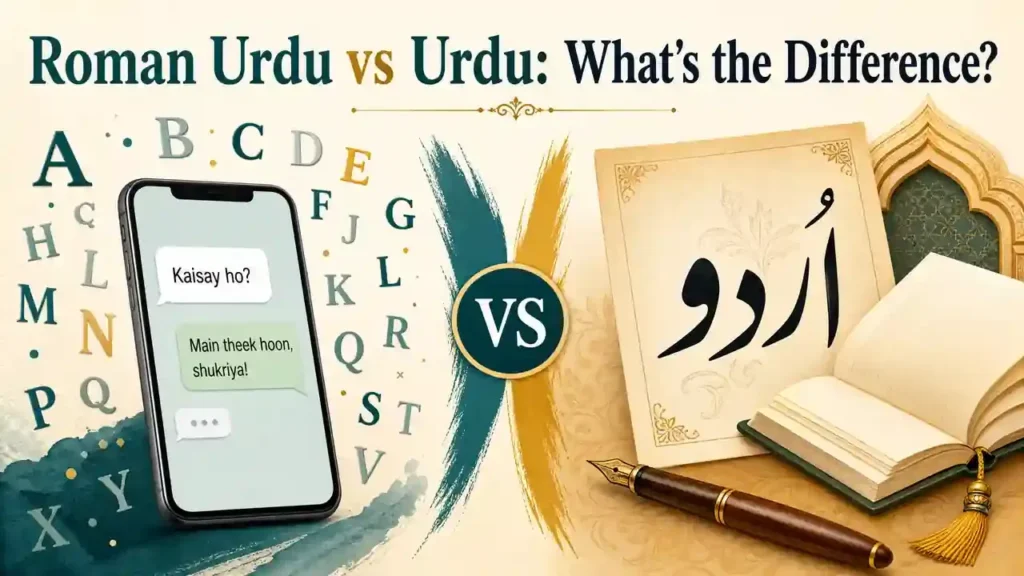
Roman Urdu vs Urdu: What’s the Difference? Urdu is a language. Roman Urdu is a way to write that language. Roman Urdu writes Urdu words with the Latin or Roman alphabet. Urdu normally uses an adapted Perso-Arabic script, with Nastaliq strongly associated with Urdu writing. So, Roman Urdu and Urdu are not two different languages. They represent the same language through different writing systems.
For example:
Urdu:
مجھے اردو پسند ہے۔
Roman Urdu:
Mujhe Urdu pasand hai.
English translation:
I like Urdu.
The first two sentences express the same Urdu meaning. The English sentence translates that meaning into another language. This gives us the key distinction:
Language ≠ Script ≠ Translation
Roman Urdu vs Urdu: Quick Comparison
| Feature | Roman Urdu | Urdu Script |
| What is it? | Urdu written with Latin letters | Conventional script used to write Urdu |
| Writing direction | Left to right | Right to left |
| Alphabet | Latin/Roman alphabet | Adapted Perso-Arabic alphabet |
| Writing style | Often informal and digital | General, formal, literary, and educational writing |
| Spelling | Highly variable | More established writing conventions |
| Typing | Often uses a standard Latin keyboard | Uses Urdu input, phonetic keyboards, or other Urdu typing methods |
| Social media | Common in informal digital communication | Also used across digital platforms |
| Literature | Less traditional as a writing medium | Long-established literary medium |
| Transliteration | Can represent Urdu sounds in Latin letters | Provides the original Urdu script |
| NLP challenges | High spelling variation and mixed writing styles | Script-specific processing and Urdu linguistic complexity |
Roman Urdu vs Urdu: What’s the Difference? has grown strongly in digital communication. Research describes it as Urdu written in the Latin script and notes its widespread use in social media and messaging.
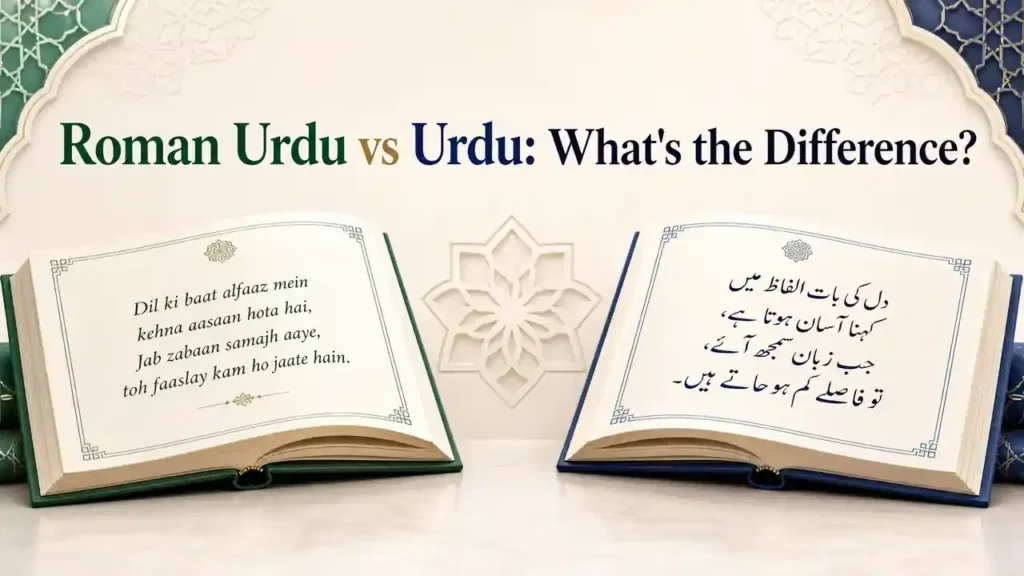
The Same Language, Different Writing Systems
Consider this simple example:
Urdu: مجھے اردو پسند ہے۔
Roman Urdu: Mujhe Urdu pasand hai.
English: I like Urdu.
The Urdu sentence uses the Urdu script. The Roman Urdu sentence uses Latin letters. The English sentence changes the language itself. This difference matters when discussing Roman Urdu vs Urdu. It represents Urdu words with a different script.
Why Does Roman Urdu Look So Different?
Urdu uses an adapted Perso-Arabic writing system. Nastaliq remains closely linked with traditional Urdu writing. Roman Urdu uses Latin letters instead. This creates a major difference in spelling.
Roman Urdu has no single universally accepted spelling system. Writers often spell words according to their pronunciation or personal preference. Research on Roman Urdu repeatedly documents this spelling variation.
For example, a writer may use:
- nahi
- nahin
- nhi
These forms can represent the same Urdu word. The exact spelling can change across users, platforms, and contexts.
Urdu script has more established orthographic conventions. Roman Urdu remains much more flexible in everyday use. That flexibility makes Roman Urdu convenient for quick digital communication.
It also creates challenges for search systems and natural language processing (NLP) tools. Researchers have studied these problems in areas such as information retrieval, language identification, and transliteration.
Roman Urdu Is Not the Same as Urdu-English Mixing
Another important distinction appears in digital conversations.
A person can write Urdu entirely in Roman letters:
Mujhe ghar jana hai.
That is Roman Urdu.
A person can also mix Urdu and English:
Mujhe ghar jana hai because I am tired. That is code-mixing, not simply Roman Urdu. The script and the language mixture are separate issues. A message can contain Roman Urdu without much English. It can also contain Roman Urdu and English in the same sentence.
This distinction becomes important when we study Roman Urdu on social media, in education, and in NLP research.
The Core Difference
Think of the relationship this way:
Urdu = language
Urdu script = traditional writing system for Urdu
Roman Urdu = Urdu represented with Latin letters
English = a different language
Transliteration = converting words between writing systems
Once you understand this difference, the rest becomes much easier.
What Is Urdu Script? Understanding Nastaliq, Alphabet and Writing Direction
To understand Roman Urdu vs Urdu: What’s the Difference? you first need to understand Urdu script. Urdu is a language in the Indo-Aryan branch of the Indo-European language family. It developed in South Asia and shares much of its basic grammar with Hindi.
Urdu has its own literary tradition and written conventions. Its standard writing system comes from the Perso-Arabic script tradition. Urdu uses an adapted form of the Persian script, which itself developed from the Arabic script. This is the script you usually see in Urdu books, newspapers, signs, poetry, and formal writing.
What Is Urdu Script?
Urdu script is the writing system used to represent the Urdu language. It uses Arabic-based letter forms with additions and adaptations for Urdu sounds. Some Urdu letters represent sounds that do not have direct equivalents in the basic Arabic alphabet.
For example, Urdu uses letters such as:
- ٹ for a retroflex “t” sound
- ڈ for a retroflex “d” sound
- ڑ for a retroflex “r” sound
- پ for a “p” sound
- چ for a “ch” sound
- گ for a “g” sound
These adaptations help Urdu represent its own sound system. The exact number of Urdu letters can vary between teaching traditions and descriptions. So, it is better to focus on the writing system than on one fixed letter count.
Why Is Urdu Written Right to Left?
Urdu follows the right-to-left (RTL) direction used by the Arabic-based script tradition. A normal Urdu line starts on the right and moves toward the left. Roman Urdu does the opposite. It follows the left-to-right (LTR) direction of the Latin alphabet.
For example:
Urdu:
مجھے اردو پسند ہے۔
Roman Urdu:
Mujhe Urdu pasand hai.
This difference affects more than reading direction. It also affects text layout, punctuation, typing, web design, and how Urdu interacts with English on digital screens. The Unicode Standard provides rules for displaying text that mixes right-to-left and left-to-right scripts. This matters when Urdu and English appear in the same sentence.
What Is Nastaliq?
Nastaliq is the writing style most strongly associated with Urdu. It developed within the Persian calligraphic tradition and became closely linked with Urdu writing. Encyclopaedia Iranica describes Urdu as historically written in an adapted Persian script. It also highlights the distinctive role of Nastaʿliq in Urdu writing.
Nastaliq has a flowing appearance. Its letters and words create a distinctive visual rhythm across the page. This style gives traditional Urdu writing its familiar appearance.
You can see Nastaliq in:
- Urdu newspapers
- Books
- Poetry collections
- Literary magazines
- Religious publications
- Educational materials
- Digital Urdu content
Nastaliq also differs from Naskh. Naskh is another major style of the Arabic script tradition. It is common in Arabic and Persian print. Urdu publishers have historically favored Nastaliq instead. Modern digital fonts can reproduce the Nastaliq appearance on computers and phones.
Nastaliq Is a Style, Not a Separate Language
This distinction often causes confusion. Urdu is the language. Urdu script is the writing system. Nastaliq is a style used to display that script. Unicode makes this distinction especially clear.
The Unicode Consortium explains that Nastaliq is a style of the Arabic script, not a separately encoded script. A Nastaliq font controls how the characters appear on screen. So, changing the font does not change the language. It changes the visual form of the same underlying characters.
How Does the Urdu Alphabet Work?
Urdu uses a modified form of the Persian-derived Arabic script. The letters can change their visual form depending on their position within a word. Many letters connect with neighboring letters. This gives Urdu its flowing appearance.
Unicode represents the underlying characters rather than every possible visual shape. Fonts and text-shaping systems then determine how those characters appear together. This matters when you compare Urdu with Roman Urdu. Roman Urdu uses separate Latin letters. Urdu uses connected Arabic-derived letter forms.
For example:
Urdu: پاکستان
Roman Urdu: Pakistan
Both forms refer to the same country. The writing systems differ.
Urdu on Computers and Phones
Urdu is no longer limited to printed books and handwritten pages. Modern devices can store, display, search, and process Urdu text digitally. Unicode plays an important role in this process.
Unicode gives digital text standardized character codes. It allows different systems to represent and exchange Urdu characters consistently.
The Unicode Standard includes Arabic-script characters used in Urdu. It also documents Urdu-specific character usage within the Arabic script system. Users can type Urdu through several methods.
Common options include:
- Urdu keyboard layouts
- Phonetic Urdu keyboards
- Mobile Urdu keyboards
- Virtual keyboards
- Speech-to-text tools
- Handwriting input
A phonetic keyboard can make Urdu typing easier for people who already know the Latin alphabet. For example, typing a Latin-based phonetic sequence can produce an Urdu character or word. This creates a useful bridge between keyboard habits and Urdu script.
Urdu Fonts and Typography
Digital Urdu also depends on fonts and text shaping. A Unicode text string does not automatically determine its visual style. The font helps determine how the characters appear. A Nastaliq font can display Urdu with the familiar flowing Nastaliq appearance.
Other fonts can display the same underlying characters in different styles. This distinction matters for Urdu typography. It also explains why two devices can display the same Urdu text differently. The underlying Unicode characters can remain the same. The visual presentation can change.
Why This Matters for Roman Urdu
Roman Urdu removes much of this script complexity. It uses the familiar Latin alphabet. Most users can type it with a standard English keyboard. It also follows the left-to-right direction that users already know from English.
That makes Roman Urdu convenient for quick digital communication. But convenience comes with a trade-off. Roman Urdu does not have one universally accepted spelling system. Writers often use different Latin spellings for the same Urdu word.
Urdu script provides more established orthographic conventions. This difference becomes especially important when we discuss Roman Urdu spelling, transliteration, search, and NLP. In the next section, we will compare Roman Urdu and Urdu with real examples.
Roman Urdu vs Urdu: What’s the Difference? Detailed Comparison With Real Examples
Roman Urdu and Urdu script represent the same language in different ways. The biggest difference lies in the writing system. Roman Urdu uses the Latin alphabet. Urdu uses an adapted Perso-Arabic script, commonly displayed in Nastaliq.
This difference affects spelling, typing, reading, learning, and digital communication. Research also confirms that Roman Urdu has become common in digital communication. It appears across social media, messaging, and other online spaces. Here is how the two forms compare across ten important areas.
Script
Roman Urdu uses letters from the Latin alphabet.
For example:
Roman Urdu: Aap kaise hain?
Urdu writes the same sentence in Urdu script:
Urdu: آپ کیسے ہیں؟
The language remains Urdu. Only the writing system changes. Urdu script comes from the Perso-Arabic script tradition. It includes additional letters for sounds used in Urdu. Roman Urdu instead uses Latin letters to represent Urdu words. This makes Roman Urdu easy to enter on devices designed around Latin text.
It also creates spelling problems because Latin letters cannot represent every Urdu sound in one fixed way.
Writing Direction
The two systems also move in opposite directions.
Roman Urdu: left → right
Urdu: right → left
Roman Urdu follows the direction used by English and most Latin-script languages. Urdu follows the right-to-left direction of its Arabic-based script tradition. This difference becomes important on websites and mobile devices.
Mixed Urdu-English text can require special handling because one sentence may contain both RTL and LTR text. Unicode provides rules for handling these mixed-direction text systems.
Spelling
Spelling creates one of the biggest differences between Roman Urdu and Urdu script. Roman Urdu has no single standardized spelling system. Writers often spell words according to their pronunciation. They may also follow personal habits.
For example, the same Urdu word may appear as:
- nahi
- nahin
- nai
- nhi
These spellings can represent the same word. Research has documented this problem for years. An EMNLP study found multiple Roman Urdu spellings for words such as zindagi. It also identified problems caused by ambiguous and inconsistent spellings.
This variation creates a major difference from standard Urdu writing. Urdu script follows more established spelling and orthographic conventions. Roman Urdu remains much more flexible. That flexibility helps casual communication. It also makes search, spell checking, and language processing harder.
Pronunciation
Roman Urdu often tries to represent Urdu pronunciation with Latin letters. This makes spoken Urdu easier to approximate for people who cannot read Urdu script.
For example:
Urdu: ٹھیک
Roman Urdu: theek
Another writer might use a slightly different spelling. The problem comes from the limits of the Latin alphabet. Several Urdu sounds have no single obvious Latin equivalent. Writers therefore create their own spelling choices. A Roman Urdu writer may choose letters based on sound rather than a fixed spelling rule.
This explains why Roman Urdu can look inconsistent while remaining understandable to another Urdu speaker. The same issue also creates problems for automated transliteration systems. Recent research describes spelling variation as a major challenge when converting Roman Urdu into standard Urdu script.
Readability
Readability depends heavily on the reader. Someone who reads Urdu script fluently may find Urdu script faster and more natural.
A person who cannot read Urdu script may find Roman Urdu much easier. This difference often reflects script familiarity, not a universal advantage. Roman Urdu can make familiar spoken words accessible to readers who know Latin letters. Urdu script gives fluent readers direct access to established Urdu spelling.
The sentence length also matters. Short Roman Urdu messages can feel easy to read. Long Roman Urdu paragraphs can become harder when spelling varies from word to word. Research on Roman Urdu highlights this lexical variation as a challenge for language processing and normalization. So, readability depends on the reader, context, text length, and spelling consistency.
Typing
Typing is another major difference. Roman Urdu can work with a normal Latin keyboard. Most phones already support Latin input. Users can therefore type Roman Urdu without learning an Urdu keyboard layout.
For example, a user can type:
Mujhe kal ghar jana hai. No Urdu keyboard is required. Urdu script needs an Urdu input method. Users can choose an Urdu keyboard, phonetic keyboard, or mobile Urdu input system. Phonetic keyboards can reduce this barrier. They let users enter Urdu sounds through familiar Latin keys.
However, Roman Urdu still offers a simple advantage for users who already type English every day. This helps explain its strong presence in informal digital communication.
Formality and Context
It would be misleading to call Roman Urdu simply “informal” and Urdu script simply “formal.” Real usage is more varied.
Roman Urdu appears frequently in:
- Text messages
- WhatsApp conversations
- Social media comments
- Online chats
- Informal posts
- Quick searches
- Casual digital conversations
Urdu script appears across a much wider range of settings.
It is common in:
- Education
- Newspapers
- Books
- Literature
- Official writing
- Religious publications
- Poetry
- Formal communication
Context matters more than a strict rule. A person can use Urdu script in a casual message. Another person can use Roman Urdu for a serious discussion. The two forms can also appear together.
Literature
Urdu script has the established literary tradition. Major Urdu poetry, fiction, criticism, journalism, and scholarship have developed through Urdu’s established written forms. Nastaliq plays a particularly important role in the visual identity of Urdu literature.
Roman Urdu has also appeared in online writing and digital literary spaces. However, it has not replaced the traditional Urdu-script literary system. This difference matters when reading older Urdu works. A reader who knows only Roman Urdu may understand the spoken vocabulary.
They may still struggle to read the original literary text. Roman Urdu can therefore provide access to Urdu vocabulary. It does not provide the same literacy skills as reading Urdu script.
Digital Communication
Roman Urdu has a strong presence in digital communication. Researchers have studied Roman Urdu in social media, SMS, online discussions, and other informal digital text. Its Latin letters make it convenient on devices built around Latin keyboard input. Users can also mix Roman Urdu with English.
For example:
Aaj meeting hai, mujhe time par pohanchna hai. This sentence uses Roman Urdu.
Another user might write:
Aaj meeting hai. I need to reach on time. Now the message contains Roman Urdu and English. That second example involves code-mixing. The distinction matters. Roman Urdu describes the writing system. Code-mixing describes the use of more than one language.
Modern research also studies Roman Urdu in information retrieval and other NLP tasks. Researchers identify spelling variation and English code-switching as important challenges.
Learning
Roman Urdu can help some people begin learning Urdu vocabulary. It gives learners a way to read familiar sounds before they master Urdu script.
For example:
Aap kaise hain? A beginner can recognize the pronunciation through Latin letters.
The learner can then connect it with:
آپ کیسے ہیں؟
This creates a useful bridge between spoken Urdu and written Urdu. However, Roman Urdu cannot replace Urdu script literacy. A learner who wants to read Urdu books, newspapers, poetry, or traditional writing needs to learn the Urdu script.
Research on Urdu reading also shows that Urdu has a complex orthography with its own reading demands. Roman Urdu can support the learning process. It should not become a substitute for the writing system itself.
Roman Urdu vs Urdu Examples
The easiest way to see the difference is through real sentences.
| Meaning | Urdu | Roman Urdu |
| How are you? | آپ کیسے ہیں؟ | Aap kaise hain? |
| I am fine. | میں ٹھیک ہوں۔ | Main theek hoon. |
| What are you doing? | آپ کیا کر رہے ہیں؟ | Aap kya kar rahe hain? |
| I don’t know. | مجھے نہیں معلوم۔ | Mujhe nahi maloom. |
| I like Urdu. | مجھے اردو پسند ہے۔ | Mujhe Urdu pasand hai. |
Notice what stays the same. The meaning stays the same. The language stays the same. The script changes. The Roman Urdu spellings can also vary.
For example, you may see:
Aap kaise hain?
You may also encounter:
Ap kaisay hain?
Both can communicate the same sentence to a reader familiar with Roman Urdu. This flexibility makes Roman Urdu useful for everyday communication. It also creates problems for systems that expect consistent spelling.
Why Does Roman Urdu Have So Many Different Spellings?
One of the biggest features of Roman Urdu is spelling variation. You may see the same Urdu word written in several ways:
- nahi
- nahin
- nai
- nhi
You may also see:
- kaise
- kaisay
- kese
And:
- zindagi
- zindagee
- zendagi
These forms can represent the same Urdu word. So why does this happen? The answer goes deeper than saying “Roman Urdu has no standard spelling.” Roman Urdu uses Latin letters to represent Urdu sounds. The Latin alphabet does not provide one fixed spelling system for every Urdu sound. Writers therefore make different choices.
Roman Urdu Is Mostly Sound-Based
Many people write Roman Urdu according to how a word sounds. They do not follow a formal spelling dictionary. For example, a writer may hear a long vowel and use an extra vowel letter.
That can produce forms such as:
aap / ap Both forms can represent آپ. Another writer may use aa to make the long vowel clearer. The choice often depends on personal habit. It can also depend on the reader. This creates a flexible writing system rather than one fixed orthography.
The Latin Alphabet Creates Representation Problems
Urdu has sounds and spelling distinctions that do not map neatly onto basic Latin letters. Writers often use combinations of letters to represent these sounds.
Common examples include:
- kh
- gh
- sh
- ch
- ph
- bh
- th
- dh
For example:
خواب → khwab .Here, kh represents a sound associated with the Urdu letter خ.
Similarly:
شکریہ → shukriya.Here, sh represents the sound associated with ش. These combinations are useful. However, they do not create one universal Roman Urdu spelling system. Different writers can make different choices.
Long Vowels Create More Variation
Urdu distinguishes vowel sounds that writers may represent in different ways. Roman Urdu often uses repeated vowels to show a longer sound.
For example:
آپ → aap
Some writers may shorten this to:
ap
Likewise, writers may use i, ee, u, or oo in different contexts.
For example:
زندگی → zindagi
Another writer may write:
zindagee
These choices try to represent pronunciation through Latin letters. They do not necessarily signal different meanings.
“Kh,” “Gh,” and “Sh” Are Not Single Letters
Roman Urdu often uses two Latin letters for one Urdu sound. This creates another source of variation.
For example:
خ → kh
غ → gh
ش → sh
These combinations are called digraphs. A digraph uses two letters to represent one sound. Roman Urdu relies heavily on such combinations. However, everyday writers do not always follow the same conventions. Some may use established-looking forms.
Others may choose spellings that feel closer to their own pronunciation. Formal transliteration systems can solve some of these problems. Everyday Roman Urdu usually does not follow those systems.
Regional Pronunciation Can Influence Spelling
People do not pronounce every word in exactly the same way. Regional speech patterns can affect pronunciation. Those differences can appear in Roman Urdu writing. A writer may therefore choose a spelling that reflects their own speech.
This does not mean every spelling difference comes from regional accents. Typing habits and personal preferences also matter. The important point is that Roman Urdu gives writers more freedom to represent sounds. That freedom increases variation.
Typing Speed Also Changes Spelling
Digital communication adds another factor. People often type Roman Urdu while chatting quickly. They may shorten words to save time.
For example:
nahi → nhi
Or:
mujhe → muje
These shortcuts may work well when the reader already understands the context. They can create problems for unfamiliar readers. They can also make automated language processing harder. Roman Urdu research has repeatedly identified spelling variation as a major processing problem.
There Is Strong Research Evidence
This issue is not just an observation from social media. Researchers have measured Roman Urdu spelling variation in real datasets. A 2024 study published in Data in Brief created a dataset containing 5,244 Roman Urdu words with spelling variations.
The researchers recorded between one and five different spellings for words in the dataset. They also collected 28,090 Roman Urdu reviews from multiple online sources. The detailed dataset shows how large the variation can become.
Among the 5,244 identified Roman Urdu words:
- 42 had one spelling
- 181 had two spellings
- 1,987 had three spellings
- 2,008 had four spellings
- 1,026 had five spellings
That produced 19,527 word forms when the variations were counted separately. This gives us a useful insight. Roman Urdu does not simply have “a few spelling mistakes.” It can represent the same vocabulary through many different written forms.
Common Roman Urdu Spelling Variations
Here are examples documented in Roman Urdu research:
| Urdu | Variant 1 | Variant 2 | Variant 3 |
| نہیں | nahi | nahin | nhi |
| کیسے | kaise | kaisay | kese |
| زندگی | zindagi | zindagee | zendagi |
These examples show the main problem. The Urdu word remains stable. The Latin representation changes. Research on Roman Urdu has documented several forms of zindagi, including zindagi, zindagee, zindagy, zaindagee, and zndagi.
Is There a Correct Roman Urdu Spelling?
There is no single answer for everyday Roman Urdu. Some Roman Urdu systems use formal transliteration rules. Those systems aim for consistency. Everyday Roman Urdu works differently. People usually write for communication rather than strict linguistic transcription. So a form can be common and understandable without being part of a formal spelling standard.
For example:
nahi
is widely understandable.
So is:
nahin
A shorter form such as:
nhi
may work well in casual messaging. But it gives less information to a learner. The best choice therefore depends on your purpose.
Common Roman Urdu Writing Conventions
Although Roman Urdu lacks one universal everyday standard, some patterns appear frequently.
Use “kh” for خ
خواب → khwab
خوش → khush
Use “gh” for غ
غلط → ghalat
غریب → ghareeb
Use “sh” for ش
شکریہ → shukriya
شاید → shayad
Use repeated vowels for some long sounds
آپ → aap
نام → naam
پانی → paani
Some writers shorten these forms. Others keep the repeated vowel for clearer pronunciation.
Use “ee” or “i” in different ways
For example:
زندگی → zindagi
or:
zindagee
The choice reflects how the writer wants to represent the sound.
Use shortcuts in casual messages
Fast typing can produce forms such as:
nahi → nhi
mujhe → muje
These forms can save time. They can also reduce clarity for learners and automated systems.
Why Spelling Variation Matters
Spelling variation does more than change how a word looks. It affects search and language technology.
Imagine a system searching for:
zindagi
A user might write:
zindagee
Another might write:
zndagi
A simple exact-match system may treat these as different words. The meaning remains similar. The written forms do not. Researchers call this problem lexical variation. It can increase the number of unique word forms in a dataset. That creates a larger vocabulary for an NLP system to process.
Research has linked Roman Urdu spelling variation with problems in tasks such as spell checking, information retrieval, text classification, and sentiment analysis.
Why Standardization Is Difficult
Standardizing Roman Urdu sounds simple. In practice, it raises several questions. hould a long vowel always use two letters? Should nahi and nahin both remain acceptable? Should pronunciation determine spelling? Should the system preserve differences found in Urdu script?
Should writers use special characters such as ṭ, ḍ, or ṛ? Should Roman Urdu use only the 26 basic English letters? Different Romanization systems have made different choices. Researchers have also noted problems with existing Romanization schemes. Some systems prioritize reversibility, while others prioritize pronunciation.
Everyday Roman Urdu adds another layer. People type quickly. They use phones. They follow personal habits. They write for readers who already understand Urdu. That makes complete standardization difficult.
So, What Should You Call “Correct” Roman Urdu?
For everyday writing, consistency and readability matter more than forcing one spelling. If your audience knows Roman Urdu well, several common variants may work.
If you are teaching Urdu, clearer and more consistent spellings can help. If you are building a search or NLP system, you may need normalization. Normalization maps different spellings toward a common form.
For example:
nahi → nahin → nhi
A system can recognize these as related forms of the same Urdu word. This process helps computers handle the variation. It does not mean that every Roman Urdu writer must use one spelling.
Roman Urdu Spelling vs Urdu Spelling
This is the key difference:
Urdu script has established orthographic conventions. Everyday Roman Urdu has much more spelling freedom. That freedom makes Roman Urdu easy to adapt. It also makes Roman Urdu harder to standardize. So when someone asks, “What is the correct Roman Urdu spelling?”, the better question is:
“Which spelling is clearest and most appropriate for this audience and purpose?” That distinction becomes important when we look at Romanization, transliteration, transcription, and translation. They sound similar. They are not the same process.
Roman Urdu, Transliteration, Translation and Code-Mixing: What’s the Difference?
Roman Urdu, transliteration, translation, and code-mixing often appear together. That creates confusion. They describe different linguistic processes. Romanization changes the writing system. Transliteration maps text from one script to another. Translation changes the language and meaning.
Code-mixing combines languages within the same communication.Understanding these differences makes Roman Urdu much easier to understand.
Romanization: Writing Urdu With Roman Letters
Romanization means representing a language with the Roman or Latin alphabet. For Urdu, this means writing Urdu words with Latin letters.
For example:
Urdu: مجھے بھوک لگی ہے۔
Roman Urdu: Mujhe bhook lagi hai.
The language remains Urdu. Only the writing system changes. Romanization can follow different systems. Some systems use strict rules. Everyday Roman Urdu usually follows informal spelling habits instead. That explains why people may write the same Urdu word in different ways.
Roman Urdu has become common in digital communication, including social media and messaging. Recent NLP research describes it as a widely used Romanized form of Urdu.
Transliteration: Converting One Script Into Another
Transliteration converts written text from one script to another. The goal usually involves preserving the written form or its sound relationships.
Unicode’s Common Locale Data Repository defines transliteration as converting characters from one script to another. It also clearly separates transliteration from translation.
Consider this example:
Urdu: مجھے بھوک لگی ہے۔
Roman Urdu: Mujhe bhook lagi hai.
The Urdu text has moved from the Urdu script to Latin letters. The underlying Urdu words have not become English. That makes this a script conversion, not a translation.
Modern research also treats Urdu ↔ Roman Urdu conversion as a transliteration problem. Researchers have developed systems that convert between the two writing forms.
Romanization vs Transliteration
These terms overlap, but they are not always identical. Romanization specifically means representing a language in the Roman or Latin script. Transliteration is broader. It can describe conversion between many different scripts.
So:
Urdu script → Latin script can be described as Romanization. It can also be described as transliteration.
But:
One non-Latin script → another non-Latin script. can be transliteration without being Romanization. This distinction becomes useful when discussing Urdu-to-Roman Urdu tools.
Translation: Changing the Language
Translation is different. Translation transfers meaning from one language into another.
For example:
Urdu: مجھے بھوک لگی ہے۔
becomes:
English: I am hungry.
Now the language has changed. The English sentence does not use Urdu words written in Latin letters. It expresses the Urdu meaning in English.
Compare the three forms:
| Process | Result | What changes? |
| Urdu script | مجھے بھوک لگی ہے۔ | Original writing system |
| Romanization | Mujhe bhook lagi hai. | Script |
| Translation | I am hungry. | Language |
This is one of the most important distinctions in the entire topic. Roman Urdu is not English translation. It is Urdu represented through Latin letters.
A Simple Way to Remember It
Think of the three forms as different layers:
Urdu
→ the language
Roman Urdu
→ Urdu written with Latin letters
English
→ a different language
The words may look different. The underlying process is different too. This distinction prevents a common mistake. Someone may search for “Urdu to Roman Urdu translation.” Technically, they often mean Urdu-to-Roman-Urdu transliteration. The meaning stays in Urdu. Only the script changes.
Code-Mixing: Using More Than One Language
Code-mixing is different again. It happens when speakers use elements from two or more languages within the same communication.
For example:
Aaj meeting bohat important hai. Here, the sentence contains Urdu and English vocabulary. Aaj, bohat, and hai are Urdu. Meeting and important come from English. The sentence also uses Latin letters.
That means two separate things are happening:
- Urdu is being written in Roman letters.
- English vocabulary appears within the Urdu sentence.
The first is Romanization. The second is code-mixing. These concepts should not be treated as synonyms.
Code-Mixing vs Code-Switching
Code-mixing and code-switching are closely related terms. Both involve more than one language. Researchers often use code-switching for shifts between languages during communication. Code-mixing often describes the blending of linguistic elements within the same discourse.
The exact boundary can vary across linguistic studies. For practical purposes, the important point is simple: Using Latin letters does not automatically mean someone is mixing languages.
Consider:
Mujhe ghar jana hai. This is Roman Urdu.
Now consider:
Mujhe ghar jana hai because
Why Do People Use Roman Urdu? Social Media, Mobile Phones, Learning and Diaspora
People use Roman Urdu for practical, social, and linguistic reasons. Its appeal often comes from the tools and audiences surrounding digital communication.
Mobile Typing
Many users already know the Roman alphabet from English keyboards. Typing Urdu script can require a different keyboard layout or input method. Research on Roman Urdu texting links its use with mobile communication and limited access to convenient Urdu keyboards.
Social Media
Roman Urdu appears across Facebook, Instagram, YouTube, X, and WhatsApp. Users write it in comments, captions, messages, and posts. A 2026 study analyzed 900 posts from YouTube, Facebook, and X. It found substantial Roman Urdu and Urdu-English code-mixing.
Informal Communication
Friends and families often use Roman Urdu for quick messages. Online communities may also mix Roman Urdu with English. The choice often depends on the audience, platform, and conversation.
Urdu Learners
Some people understand spoken Urdu but cannot read its script confidently. Roman Urdu can give them a familiar way to follow conversations. It does not replace learning the Urdu script.
Pakistani Diaspora
People outside Pakistan may encounter Urdu mainly through speech, family conversations, and digital messages. Roman Urdu can help maintain everyday communication across generations.
Accessibility
Users without Urdu typing skills may find Roman keyboards easier. This makes Roman Urdu useful when Urdu input feels unfamiliar.
Search and Digital Content
Roman Urdu also appears in online searches. One study found users searching for information with Roman Urdu because Urdu keyboard characters felt difficult.
Is Roman Urdu Good or Bad for Urdu? Literacy, Culture and Literature
Roman Urdu creates both opportunities and challenges for Urdu users. Its impact depends on the user’s goal, audience, and context. For digital communication, it can reduce typing barriers. However, easier communication does not automatically build Urdu-script literacy.
Potential Advantages of Roman Urdu
Roman Urdu can make Urdu communication more accessible to people who lack Urdu typing skills. Latin keyboards also provide a familiar input method for many users.
It can help people communicate with readers who understand Urdu but struggle with its script. This can include some learners, younger users, and members of multilingual families.
Roman Urdu can also expand Urdu’s digital reach. Research describes Roman Urdu as widely used in digital communication, while newer NLP research highlights its growing importance for search and language technology.
Potential Limitations
Roman Urdu also creates practical limitations. Spelling can vary widely because everyday users lack one universal spelling system. One 2024 dataset contained 5,244 Roman Urdu words with multiple spelling forms.
This variation can create ambiguity. It can also make search, text processing, and language technology harder.
Roman Urdu may also reduce a user’s exposure to Urdu orthography. Someone who communicates comfortably in Roman Urdu may still struggle with Urdu-script reading.
That distinction matters.
Roman Urdu can make communication easier without necessarily developing Urdu-script literacy.
Roman Urdu and Urdu Literature
Urdu literature has a deep written tradition. It includes poetry, ghazals, novels, religious works, essays, and other literary forms.
Much of this tradition exists in Urdu script. Readers who rely only on Roman Urdu may therefore face barriers when accessing traditional texts.
Transliterated editions can reduce that barrier. They can help readers approach Urdu poetry and prose without immediately mastering the original script.
However, transliteration does not fully replace the original writing system. Literary spelling, visual form, punctuation, and established conventions remain tied to Urdu’s script.
Roman Urdu can therefore act as a bridge to literature. It does not provide the same access as Urdu-script literacy.
Can You Speak Urdu Without Reading Urdu?
Yes. Language ability and script literacy are separate skills. A person can understand spoken Urdu and communicate fluently without reading Urdu script. The reverse can also occur in limited cases. Someone may recognize written Urdu without speaking it fluently.
Research on Urdu reading treats reading ability as a distinct skill. Studies examine factors such as orthographic structure, phonological processing, and exposure to reading instruction.
This distinction helps explain why Roman Urdu can support communication without automatically teaching Urdu reading.
The Balanced View
Roman Urdu is not inherently good or bad for Urdu. It solves some communication problems while creating other challenges.
For quick digital communication, Roman Urdu can improve access and convenience. For formal writing, literature, and Urdu-script literacy, the traditional script remains important.
The two forms can therefore serve different purposes. Roman Urdu can function as a practical digital bridge, while Urdu script preserves established written conventions and access to the wider literary tradition.
Frequently Asked Questions
Is Roman Urdu the same as Urdu?
Roman Urdu represents Urdu using Latin letters. Urdu remains the language. The writing system changes.
Is Roman Urdu a language or a script?
Roman Urdu is generally described as a Romanized form of Urdu. It is not a separate language simply because it uses Latin letters. Recent NLP research uses the term “Romanized version of Urdu.”
What is the difference between Roman Urdu and Urdu?
The main difference is the writing system. Roman Urdu uses Latin letters, while Urdu normally uses an adapted Perso-Arabic script. Nastaʿliq has a particularly strong association with Urdu writing.
Is Roman Urdu written in English?
No. Roman Urdu uses the Latin alphabet, but the language can remain Urdu.
For example:
Urdu: مجھے گھر جانا ہے۔
Roman Urdu: Mujhe ghar jana hai.
English: I have to go home.
The first two express Urdu. Only the writing system differs.
Why do Pakistanis use Roman Urdu?
People use Roman Urdu for several practical reasons. These include familiar Latin keyboards, quick mobile typing, informal messaging, and digital communication. Research also identifies Roman Urdu as widely used online.
Why does Roman Urdu have different spellings?
Roman Urdu lacks one universally followed spelling system. Users often represent Urdu sounds in different ways. For example, nahi, nahin, and nhi can represent the same Urdu word. Researchers identify spelling variation as a major challenge for Roman Urdu information retrieval.
Is there a standard Roman Urdu spelling?
There is no single everyday Roman Urdu spelling standard that all users follow. Academic transliteration systems can provide consistent rules. Everyday Roman Urdu often follows personal, regional, or platform-specific habits.
Is Roman Urdu easier to learn than Urdu script?
It can feel easier for users who already know the Latin alphabet. However, ease depends on the learner and the learning goal. Roman Urdu may help someone communicate quickly. Learning Urdu script requires learning a separate writing system.
Can Roman Urdu help me learn Urdu?
Yes, it can provide an entry point for some learners. It can help them connect spoken Urdu with written words.
However, learners who want to read Urdu books, poetry, newspapers, or other traditional texts still need Urdu-script literacy.
Can Roman Urdu replace Urdu script?
It can replace Urdu script in some informal digital contexts. It does not provide the same access to Urdu’s established written and literary tradition.
Roman Urdu and Urdu script therefore work better as complementary forms than as direct replacements.
Conclusion
Roman Urdu and Urdu are not two competing languages. Roman Urdu is a way of writing Urdu with Latin letters, while Urdu uses its established script and writing traditions.
Roman Urdu has a clear place in modern communication. It can make typing easier, support informal messaging, and help users communicate when Urdu-script input feels difficult. Its use in digital spaces has also created new challenges for search engines and language technology. Researchers now develop dedicated systems for Roman Urdu transliteration and information retrieval.
Urdu script serves a broader written role. It connects readers with Urdu literacy, poetry, ghazal, novels, religious texts, and the wider literary tradition. The most useful way to understand Roman Urdu vs Urdu is through their different functions: